Magoshi-Nagahizuka Kofun: An Elite Kofun-Period Burial Mound in Japan


Site at a Glance
- Rating
- 4.4
- Popularity
- Very Low
- Country
- Japan
- Primary era
- Medieval
- External website
- Open
- Eras represented
- Medieval
- Civilizations
- Yamato
- Site type
- Burial
- Remains
- Burial Mound
On this page12 sections
History
Magoshi-Nagahizuka Kofun is a large Kofun-period burial mound in Japan, located in Toyohashi, Aichi. It was built around the end of the sixth century, during the era when monumental earthen tombs were constructed for elite members of ancient Japanese society. The mound is among the largest of its period in the Tōkai region and is the largest in East Mikawa.
A late Kofun-period chiefly tomb
The scale of Magoshi-Nagahizuka Kofun and the richness of its grave goods have led to its identification as the tomb of the Hono-kuni no miyatsuko. Hono-kuni was an ancient regional polity corresponding broadly to eastern Mikawa, while a kuni no miyatsuko was a local chieftain recognized within the political order of the Yamato polity, the central ruling power that developed in the Japanese archipelago during the Kofun period.
The burial is regarded as one of the representative great chiefly tombs of the later Kofun period. Gilt-bronze horse fittings of the thorn-leaf-shaped type provide particularly important evidence about the status of the person buried there. Comparable fittings are understood to have been gifts from the Yamato polity to the highest-ranking local rulers under its authority. Their presence therefore points to a close political relationship between the buried chieftain and the Yamato court.
Political and technological importance
The mound’s unusual proportions have also shaped its historical interpretation. Its low, relatively flat front section differs greatly from its much higher rear section, and some earlier interpretations treated the site as two separate round mounds rather than as a single keyhole-shaped tomb. Similar unusually proportioned mounds, including Misemaruyama Kofun in Kashihara, Nara, have been associated with powerful western Japanese clans involved in diplomacy with the Korean Peninsula during the reign of Emperor Kinmei, a sixth-century ruler traditionally linked with the consolidation of relations between the Yamato court, regional elites, and the peninsula. A related interpretation has been proposed for the class of tomb represented by Magoshi-Nagahizuka.
The quantity and character of the burial goods also illuminate the development of metalworking in ancient Japan. The gilt-bronze fittings and beads are especially important in this respect. A large group of pottery placed in the forecourt indicates that a commemorative rite was held at the front of the tomb around the middle of the seventh century, after the mound had been constructed.
Wartime alteration and heritage protection
In 1944, during the Pacific War, the Imperial Japanese Army adapted the stone chamber for use as an ammunition store. Soil was removed from the chamber and a wooden partition was installed, but the war ended before it was converted into a gunpowder store. A local tradition holds that stones from the tomb were reused at Yoshida Castle, although this remains a reported tradition rather than an established fact.
Magoshi-Nagahizuka Kofun became an Aichi Prefectural Historic Site in 1981. On March 1, 2016, it and the adjacent Otsuka-Minami Kofun and Kuchiakezuka-Minami Kofun were designated collectively as the Magoshi-Nagahizuka Kofun Group, a National Historic Site of Japan.
Remains
Mound and stone chamber
Keyhole-shaped mound
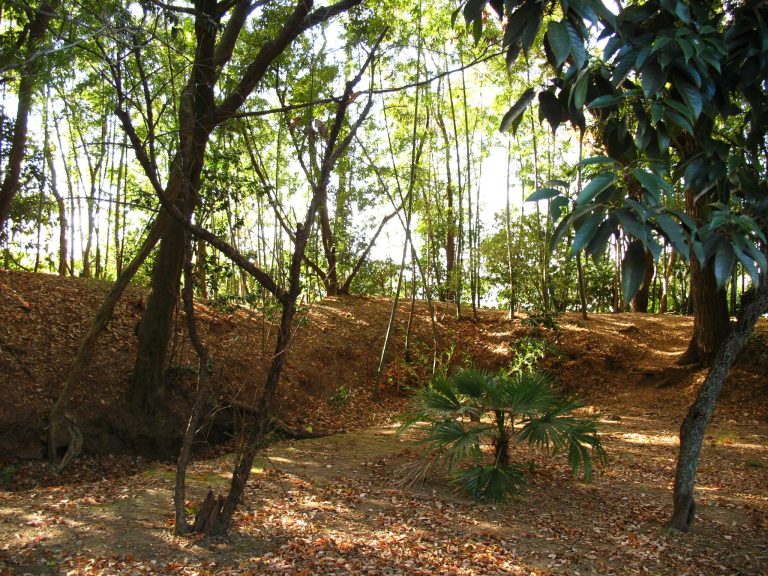
The mound is a keyhole-shaped burial mound, a form that combines a rectangular front section with a circular rear section when viewed from above. It is approximately 70 meters long. The front is comparatively low and flat, while the rear circular section rises to about 5.5 meters and has a steep slope. This striking difference in height gives the mound a distinctive form among later keyhole-shaped tombs, whose two sections are generally more similar in elevation.
Horizontal stone chamber
A horizontal stone-lined burial chamber is set into the southern side of the rear section. Including the forecourt, which remains buried for preservation, the chamber complex is approximately 17 meters long. Several rooms are divided by upright pillars. The ceiling has an arc-shaped vertical profile, and the rear wall is made from a single large slab known as a mirror stone. These features make the chamber a typical example of a large horizontal stone chamber in the Mikawa region of Aichi.
Burial goods and ritual remains
Gilt-bronze horse equipment
The excavated horse equipment includes thorn-leaf-shaped pendants, bells, bridles, harnesses, and stirrups. The pendants are decorated with an elegant honeysuckle arabesque design. Unlike related examples from the Okinoshima ritual site and the Uchikoshi-Inariyama Kofun, which were imported from the Korean Peninsula, the Magoshi-Nagahizuka pendants are regarded as among the earliest domestically produced objects of this type. They provide valuable evidence for the development of bronze working in ancient Japan.
Beads, weapons, and tools
Other grave goods include swords, spears, bows, arrows, agricultural implements, and beads made in varied materials, sizes, and forms. The glass beads are considered domestically produced. Some combine spotted and linear decoration, while others are polygonal, designs with no other known domestic parallels. In 2012, a total of 311 excavated items were collectively designated Important Cultural Properties, a legal category for objects judged to possess significant cultural and historical value.
Sue ware forecourt group
A large, coherent group of Sue ware vessels was excavated from the forecourt. Sue ware is high-fired gray pottery made in specialized kilns and used for elite and ritual purposes in ancient Japan. The vessels were used in a seventh-century commemorative ceremony held at the tomb front. They were produced mainly in the Kosai kiln area and retain a strong chronological unity, preserving evidence for the ritual activity associated with the burial mound.