Sone Castle: A Sengoku-Period Japanese Castle in Ogaki


Site at a Glance
- Rating
- 3.7
- Popularity
- Low
- Country
- Japan
- Primary era
- Early Modern
- External website
- Open
- Eras represented
- Early Modern
- Civilizations
- Japanese
- Site type
- Military
- Remains
- Castle
On this page8 sections
History
Construction and Sengoku Rule
Sone Castle was a Sengoku-period Japanese castle in Ogaki, Japan, built by the samurai lord Inaba Yoshimichi, also known as Ittetsu, between 1558 and 1569. The Sengoku period was an era of political fragmentation and warfare that lasted from the fifteenth to the late sixteenth century. Sone was a flatland castle, constructed on relatively level ground rather than on a mountain or hill. Its principal lords included Inaba Yoshimichi, Inaba Sadamichi, and Nishio Mitsunori.
After the Honnoji Incident of 1582, the coup in which Akechi Mitsuhide turned against Oda Nobunaga, Inaba Ittetsu incurred the suspicion of Toyotomi Hideyoshi, the military leader who unified most of Japan in the late sixteenth century. Ittetsu withdrew to Shimizu, in present-day Ibigawa. Nishio Mitsunori became lord of Sone Castle in 1588.
The Battle of Sekigahara and Abandonment
During the Battle of Sekigahara in 1600, a conflict that enabled Tokugawa Ieyasu to establish political dominance in Japan, Nishio Mitsunori belonged to the eastern army. Forces commanded by Shimazu Yoshihiro set fire to the castle town and fired on Sone Castle as a demonstration of force. Mizuno Katsunari arrived with reinforcements and counterattacked.
After the battle, Nishio Mitsunori moved to Ibi Jin’ya, a regional administrative and residential headquarters near Ibi Castle in present-day Ibigawa. Sone Castle was abandoned in 1601.
Memory, Religious Use, and Preservation
A long-standing tradition associates Sone with Kasuga no Tsubone, a prominent woman of the early Tokugawa period who served in the shogunal court. Her father, Saito Toshimitsu, was a senior retainer of Akechi Mitsuhide, and her mother was a daughter of Inaba Yoshimichi. Kasuga later became the wife of Inaba Masanari.
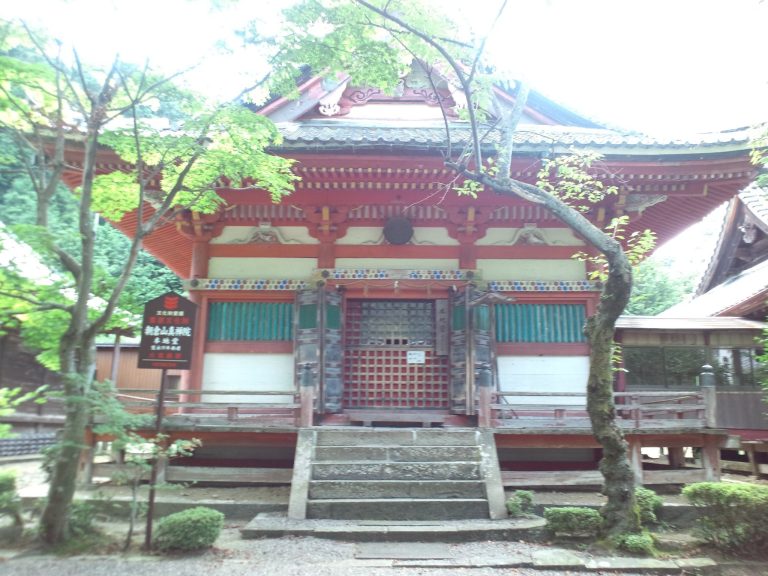
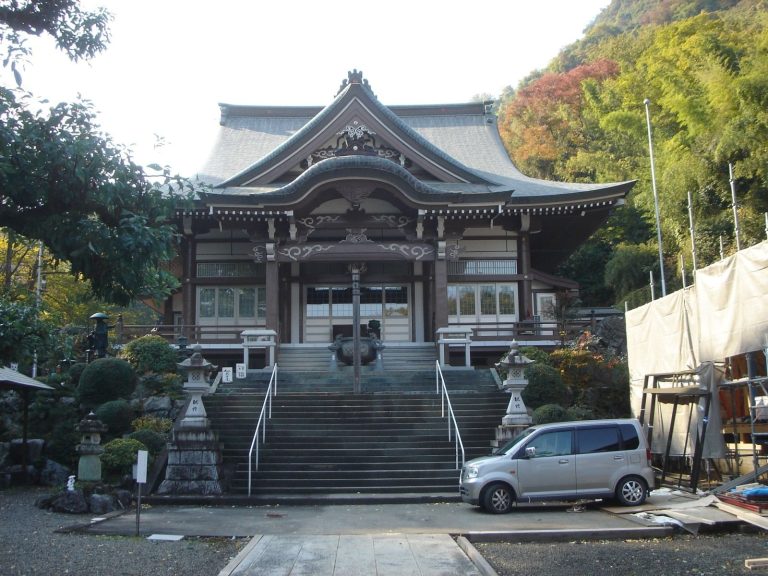
An old map preserved by Kakei-ji shows a residence attributed to Saito Toshimitsu. Kasuga is sometimes said to have been born at Sone, although the tradition remains uncertain because Toshimitsu was with Mitsuhide at Kuroi Castle in Tamba at the time. Kakei-ji was founded by Inaba Ittetsu as a mortuary temple for his mother and moved onto the former castle site in 1734.
Sone Castle is a designated historic site of Ogaki City. An archaeological investigation in 1989 revealed parts of its fortifications. These remains were reburied for preservation and reconstructed above ground. The former castle area is now incorporated into Sone Castle Park, which also provides habitat for the hariyo, a small freshwater fish designated as a natural monument.
Remains
Castle Layout
Sone Castle was organized as a level-ground fortification with a principal enclosure and a second bailey, a subordinate enclosure connected to it. According to the old map preserved by Kakei-ji, the second bailey lay east of the main bailey. Inner and outer moats defended the castle, while another outer moat enclosed the castle town. The complex is thought to have included residences for senior retainers, samurai residences, and town houses.
The main bailey covered approximately 1,000 tsubo, a traditional Japanese area unit equal to about 3.3 square meters. The area including the second bailey was estimated at approximately 4,000 to 5,000 tsubo. Kakei-ji now occupies the former main-bailey area, while a memorial museum devoted to the Edo-period Chinese-style poet Yanagawa Seigan and his wife, Koran, stands in the surrounding area.
Fortifications and Water Features
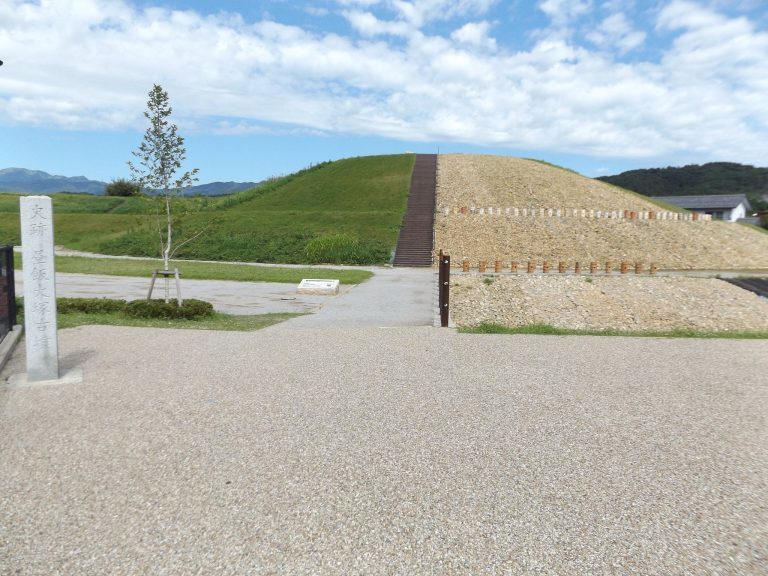
Stone walls and earthen ramparts were found north of Kakei-ji during the 1989 excavation. They were reburied for conservation and reconstructed above ground, allowing the defensive character of the former castle to remain visible within the park.
Sone Castle Park covers approximately 20,000 square meters and contains a pond or wetland measuring about 4,000 square meters. The pond, known as an oppori, formed when an earlier embankment breach flooded and scoured the ground. On the east-side embankment of the Hiranoi River, a monument commemorates the location of a separate embankment breach during the Meiji era.
Park Landscape
The park contains approximately 80 types and 16,000 plants of Japanese iris. These plantings form part of the setting in which the surviving castle defenses, former religious site, and water features are preserved.