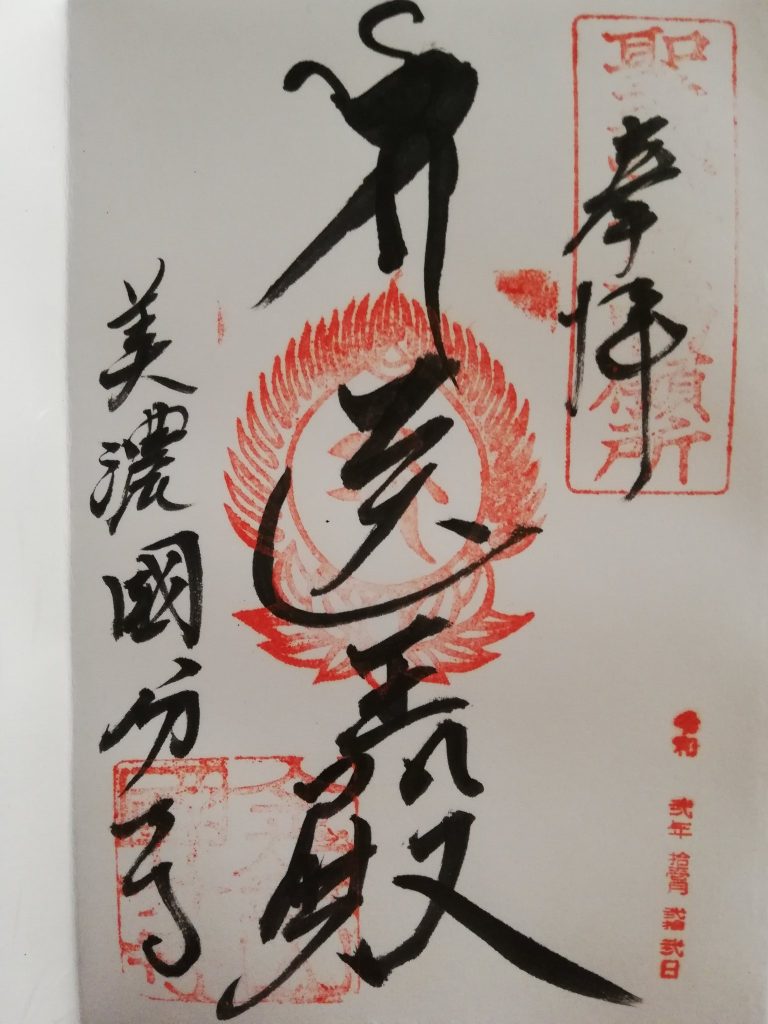
Shinzen-in Temple: A Tendai Buddhist Temple in Gifu

Site at a Glance
- Rating
- 4.1
- Popularity
- Low
- Country
- Japan
- Primary era
- Early Modern
- External website
- Open
- Eras represented
- Medieval, Early Modern
- Civilizations
- Tokugawa
- Site type
- Religious
On this page8 sections
History
Shinzen-in Temple is a Tendai Buddhist temple in Tarui, Gifu Prefecture, Japan, whose present pagoda and honji hall date from 1642, during the Edo period. It bears the mountain title Asakurayama and was formerly one of the monastic quarters serving Nangu Taisha, once known as Nangu Shrine. The temple is also called Asakurayama Shinzen-in or Asakura Temple.
Shinzen-in’s principal religious images are Amida Buddha, understood as the Buddhist manifestation underlying the deity of Nangu Taisha, and the Eleven-Headed Kannon. This association reflects honji-butsu, the belief that a Buddhist figure represented the underlying manifestation of a shrine deity. The temple was regarded as a place where prayers could bring spiritual aid. During the Tengyō–Jōhei War, Emperor Suzaku ordered prayers there for the suppression of Taira no Masakado, a tenth-century provincial warrior whose rebellion became the subject of imperial rituals. During the Former Nine Years’ War, Emperor Go-Reizei likewise ordered prayers for the defeat of Abe no Sadato.
Early foundations and shrine-temple worship
Tradition traces Shinzen-in to Gūshoji on Mount Zōhai, which was said to have been founded by Gyōki in 739. Gyōki was an eighth-century Buddhist monk known for organizing religious communities and public works, but the association with this temple appears to be a later attribution, since Shinzen-in’s name does not occur in the annals connected with him.
The Shoku Nihongi records that Emperor Shomu visited Gūshoji and Hikitsune Spring in 740. This confirms that a temple called Gūshoji existed in the Tarui area by that time. A nearby Nara-period temple site identified as the remains of Gūshoji is designated a Gifu Prefectural Historic Site. Housing development destroyed its remains before excavation was completed, however, so its identification as the predecessor of the temple associated with Nangu Taisha cannot be established conclusively.
Another tradition states that, around 790, an imperial order led Saichō to unite Gūshoji with Nangu Shrine through combined Buddhist and kami worship. Saichō was the monk who established Tendai Buddhism in Japan. The resulting institution became a jinguji, meaning a Buddhist temple established to serve a shrine. A record for 940 states that Myōtatsu, a monk of Enryakuji, performed rituals at the Nangu Shrine temple to subdue Taira no Masakado. The record demonstrates that a shrine temple existed there by the Heian period.
Under this combined religious system, Nangu Shrine maintained Buddhist halls, pagodas, and several residences for monks until the end of the early-modern period. Shinzen-in was one of these monastic quarters. An early-modern register states that ten shrine-affiliated monks were assigned to a second shrine within the Nangu complex for rites against Taira no Masakado, and identifies Shinzen-in among the quarters established in that setting.
Fire, reconstruction, and relocation
A fire destroyed Shinzen-in in 1501. Toki Masafusa, the military governor of Mino Province, rebuilt the temple in 1511. Shinzen-in and Nangu Shrine were then destroyed by fire together during the Battle of Sekigahara in 1600, the decisive conflict that established Tokugawa political dominance in Japan.
Nangu Shrine was rebuilt under the patronage of Tokugawa Iemitsu, the third shogun of the Tokugawa shogunate, and the work was completed in 1642. Shinzen-in’s pagoda and honji hall belong to this same construction campaign. A honji hall, or honjido, is a Buddhist hall associated with the Buddhist manifestation of a shrine deity.
In 1868, the Meiji government ordered the separation of Buddhism and kami worship. This policy dismantled many combined shrine-temple institutions and led to the consolidation and abolition of the Buddhist halls and institutions within Nangu Shrine. Shinzen-in’s abbot and local residents moved the pagoda, honji hall, and other elements to the present site. The relocation was complete by 1871, when the institution re-emerged as Asakurayama Shinzen-in.
The pagoda, honji hall, and bell are designated Important Cultural Properties, a Japanese legal heritage classification for structures or objects judged to possess significant cultural value. Shinzen-in is also the seventeenth station of the Western Mino Thirty-Three Sacred Places pilgrimage and is associated with Daikokuten in the Mino Seven Lucky Gods pilgrimage. Daikokuten is a Buddhist-associated deity widely worshipped in Japan as a god of prosperity and household well-being.
The pagoda underwent major repairs from 1982 to 1984. Work on the honji hall followed from 2015 to 2018. Investigations during those repairs restored or reconstructed historically documented features, including the hall’s pre-relocation ceiling arrangement and other elements of its paintwork, roof form, and interior partitions.
Remains
The precinct contains a three-storied pagoda, a honji hall, a bell, and images associated with the zodiac guardian Buddhas. The pagoda and hall were constructed at Nangu Shrine in 1642 and transferred to Shinzen-in during the early Meiji period. Together they preserve the material remains of the Edo-period shrine-temple complex after the religious separation of 1868.
Buildings and bell
Three-storied pagoda
The three-storied pagoda was built in 1642 and moved from the grounds of Nangu Shrine to Shinzen-in during the early Meiji period. Its horizontal trim boards and other elements carry polychrome decorative patterns. Major repairs between 1982 and 1984 helped preserve the structure in its present form.
Honji hall
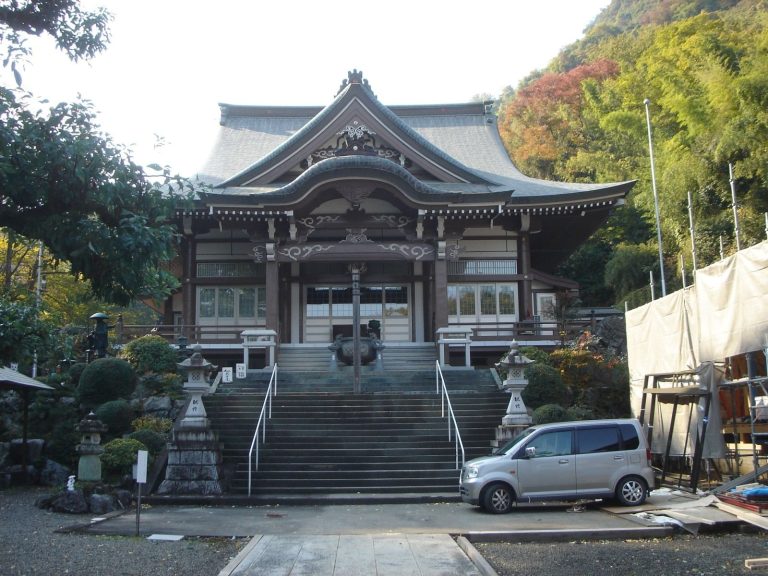
The honji hall was also built in 1642 and relocated from Nangu Shrine during the early Meiji period. It has an irimoya-style tiled roof, a roof form combining a gabled upper section with sloping sides, and a tsumairi orientation, in which the gabled end serves as the front. During the relocation, the paintings on its coffered ceiling were arranged irregularly. Repairs from 2015 to 2018 restored them to their pre-relocation arrangement, while investigations guided the restoration or reconstruction of paintwork, roof form, and interior partitions.
Bell
The temple bell is uninscribed. Its striking bosses and the way its dragon-head suspension fitting is attached display characteristics associated with ancient bells. On this basis, it is estimated to date from the Nara period or the early Heian period.