Karatsu Castle: A Hirayama-Style Castle in Japan


Site at a Glance
- Rating
- 4.1
- Popularity
- Medium
- Country
- Japan
- Primary era
- Early Modern
- External website
- Open
- Eras represented
- Early Modern, Modern
- Civilizations
- Japanese, Tokugawa
- Site type
- Military
- Remains
- Castle
On this page10 sections
History
Karatsu Castle is a Japanese castle in Karatsu, Japan, built for Terazawa Hirotaka between 1602 and 1608 in the hirayama style, which combines a hilltop defensive site with surrounding level ground. Its construction followed Terazawa’s rise as lord of Karatsu and used materials from the former Nagoya fortress.
Terazawa Foundations
Terazawa Hirotaka was a retainer of Toyotomi Hideyoshi, the military ruler who unified Japan before the Tokugawa regime. He became lord of Karatsu in 1595. After joining Tokugawa Ieyasu’s forces and attacking Gifu Castle during the Battle of Sekigahara in 1600, Terazawa received additional lands around Karatsu. These territories formed a domain assessed at 123,000 koku, a unit of agricultural production conventionally associated with the rice needed to support one person for a year.
Terazawa abandoned his original Nagoya Castle in 1598 and began developing a new stronghold at Karatsu. Construction took place from 1602 to 1608, with materials dismantled from the former Nagoya fortress incorporated into the work. The Tokugawa shogunate also required neighboring tozama domains to contribute. These were domains whose lords were regarded as external or less-trusted vassals, and their principal contribution at Karatsu was the excavation of the castle’s network of moats.
Changes under the Shogunate
In 1637, partly because Terazawa failed to suppress the Shimabara Rebellion, the shogunate confiscated his lands. The rebellion was a major uprising in Kyushu involving local peasants and Christians, and the shogunate suppressed it in 1638. Karatsu Domain subsequently passed through the control of the Okubo clan, the Matsudaira clan of the Ogyu branch, the Doi clan, and the Mizuno clan. The Ogasawara clan ultimately held the domain at the end of the Edo period, the era of Tokugawa rule conventionally dated from 1603 to 1868.
Demolition and Reconstruction
The title of daimyo, a major territorial lord under Japan’s feudal political system, was abolished in June 1869. Karatsu Domain ended in 1871 with the abolition of the han system, the network of semi-autonomous domains governed by daimyo under the shogunate, and the area became part of Saga Prefecture. The castle was demolished shortly afterward, and Maizuru Park was established on the site in 1877.
The donjon and some other castle structures were reconstructed in 1966 as part of local tourism development and to house a local museum. The Tatsumi Yagura, a fortified tower or watchtower, was added in 1990. These modern interventions shape the castle that stands on the site today.
Remains
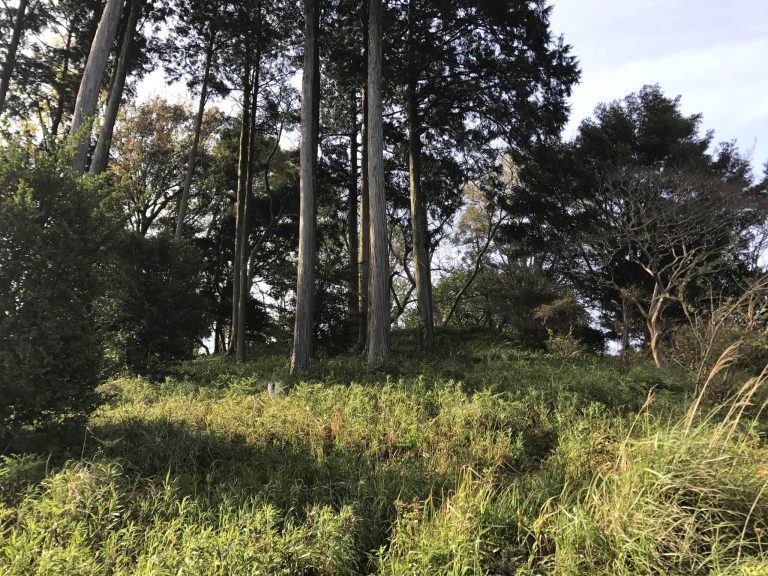
Karatsu Castle occupies Mount Manto beside Karatsu Bay. It is organized as a hilltop castle with the Honmaru, or first bailey, at the summit, the Ni-no-maru, or second bailey, and San-no-maru, or third bailey, to the west, and outer structures to the south. Stonework rises directly from the water, while the sea serves as a natural moat.
Baileys and Domain Buildings
The Ni-no-maru contained the Karatsu daimyo’s palace and the administrative offices of the domain. Its position within the castle’s westward sequence of baileys connected the residential and governmental functions of the domain with the summit of Mount Manto.
Water Defenses and Pine Forest
Karatsu’s defensive setting combined the elevated ground of Mount Manto with the surrounding waters of Karatsu Bay. At the time of construction, a pine forest extended along both sides of the sea. Its shape was compared to a crane spreading its wings, giving Karatsu Castle the alternative name “Dancing Crane Castle.” Nijinomatsubara Forest survives on the right bank of the Matsuura River.
Donjon and Towers
Honmaru Donjon
The evidence for a historical donjon in the Honmaru is uncertain. Records indicate that a stone foundation base existed by at least 1627, while the Tokugawa government did not authorize construction of a donjon. The present building is a modern reconstruction based on artistic interpretations of a donjon from the Keicho period, an era spanning 1596 to 1615 during the transition from Toyotomi to Tokugawa rule. It has five tiers, five stories, a lower-ground floor, and an exhibition area.
Yagura Towers
Many of the castle’s yagura date from the 1966 reconstruction. The Tatsumi Yagura was added in 1990, providing a later reconstructed example of the fortified towers associated with the castle’s defensive layout.