Ito Castle: A Nara-Period Mountain Fortress in Japan


Site at a Glance
- Rating
- 3.7
- Popularity
- Very Low
- Country
- Japan
- Primary era
- Medieval
- External website
- Open
- Eras represented
- Medieval
- Civilizations
- Yamato
- Site type
- Military
- Remains
- Fort
On this page8 sections
History
Ito Castle is an ancient mountain fortress in Fukuoka, Japan, built during the Nara period between 756 and 768 in a Chinese-style design associated with early Korean-style mountain fortresses. Unlike most fortifications in this category, it belongs to the eighth century rather than the late seventh century. The castle formed part of the large military and administrative projects directed by the Yamato court, the early Japanese imperial government.
Construction during the Nara period
The Shoku Nihongi states that construction began in 756 under Kibi no Makibi and was completed in 768. Kibi was a court official and scholar who had served twice as an envoy to Tang China. His familiarity with contemporary Chinese fortifications is considered relevant to the design adopted at Ito Castle.
The fortress may have been built in preparation for a Japanese campaign against Silla, a Korean kingdom, or to guard against a Tang invasion during the An Lushan Rebellion. That revolt against the Tang dynasty began in 755 and disrupted the stability of the Chinese empire. The project also kept Kibi no Makibi away from the imperial court for several years, reducing the influence of his political rival, Fujiwara no Nakamaro.
Abandonment and later reuse
Ito Castle was never used in combat and had fallen into ruin by the beginning of the Heian period, which followed the Nara period in 794. Centuries later, during the Sengoku period, an era of prolonged political and military conflict in Japan, the Harada clan reused the site. The clan ruled Itoshima and established Takaso Castle as its base there. Toyotomi Hideyoshi destroyed Takaso Castle in 1587.
Excavation and protection
Archaeological excavation began in 1938, bringing roof tiles, pottery, and wall remains to light. Recovered material is displayed at the Itokoku History Museum in Itoshima. The ruins have been protected as a National Historic Site since 1938, a Japanese legal designation for places valued for their historical and archaeological heritage. The protected area was expanded in 1944 and again in 2007.
Remains
Mountain defenses
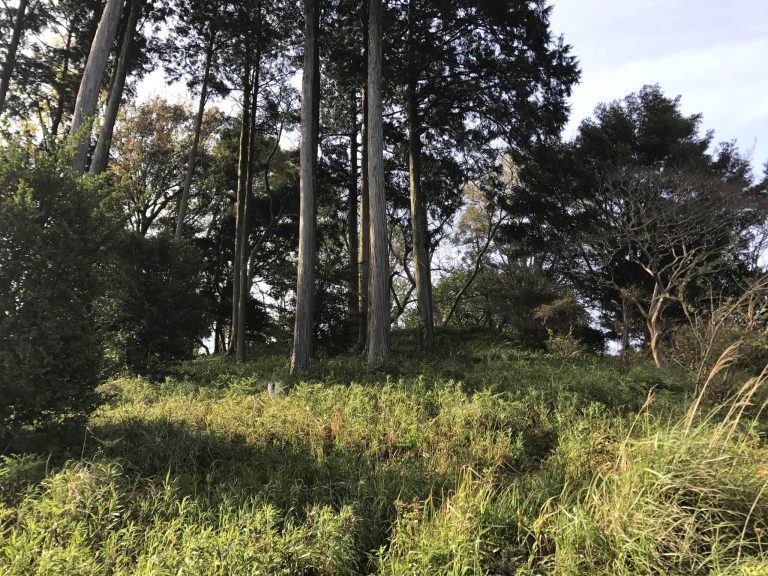
The ruins occupy the western slopes of 955-meter Mount Takasuyama, at an elevation of 416 meters. Eight watchtower remains are distributed along the mountain ridge, while foundation stones for another watchtower and the remains of a gate survive within the site. Together, these features indicate a defensive layout extending across both the ridge and the lower parts of the mountain.
Ramparts and moats
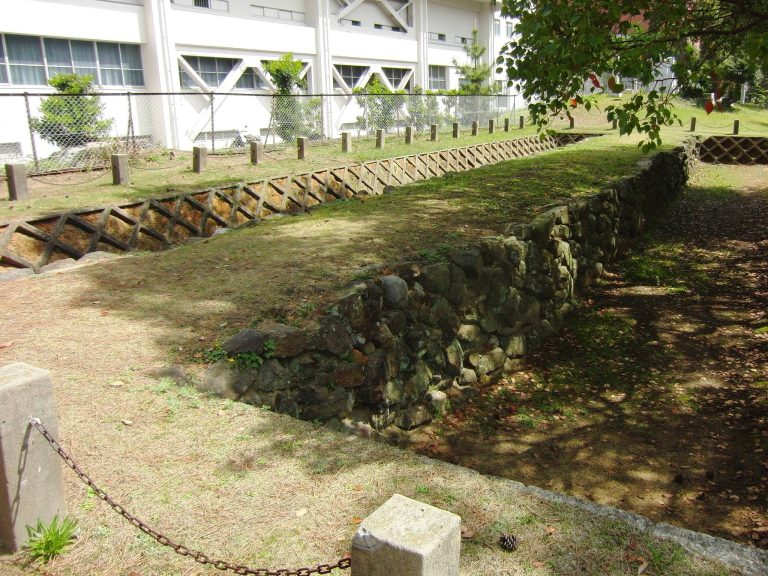
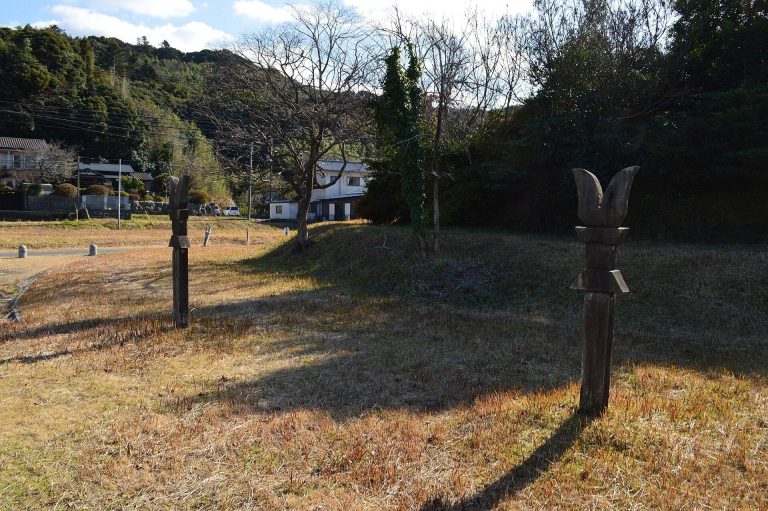
A roughly two-kilometer line of earthen ramparts runs from north to south along the foot of the mountain. Studies of some sections indicate that concentrated seawater and lime-based materials may have been mixed into the earth to strengthen the defenses. An outer moat approximately 15 meters wide formerly ran outside the ramparts, and an inner moat is also thought to have existed in some sections. Stone wall remnants survive alongside the earthen works.
Roof tiles and pottery
Excavations have recovered numerous roof tiles and pottery. Most of the roof tiles are flat, measuring approximately 41 by 31 centimeters, about five centimeters thick, and weighing approximately 10 kilograms each. The location of the kiln where they were fired remains unknown. These materials, together with the surviving foundations and wall remains, provide archaeological evidence for the construction and organization of the fortress.