Sakado Castle: A Mountain Fortress in Japan


Site at a Glance
- Rating
- 4.3
- Popularity
- Very Low
- Country
- Japan
- Primary era
- Medieval
- Eras represented
- Medieval, Early Modern
- Civilizations
- Ashikaga shogunate, Toyotomi regime
- Site type
- Military
- Remains
- Castle
On this page14 sections
History
Sakado Castle was a Japanese mountain castle in Ozuki, Japan, whose later form was established around the late fourteenth century during the Northern and Southern Courts period. Built on Mount Sakado, it controlled routes between Echigo Provincial Headquarters and the Kantō Plain, river traffic on the Uono River, and the grain-producing southern Uonuma region.
Origins and the Ueda Nagao family
The castle stood within Ueda Estate, an area controlled by a branch of the Seiwa Genji Nitta clan during the Kamakura period. Its foundation is attributed either to the Nitta clan or to the years after the Northern and Southern Courts conflict began. Substantial construction appears to have followed from that fourteenth-century period, leading to the castle’s later form.
After Uesugi Noriaki became military governor of Echigo, tradition holds that a member of the Nagao Takakage clan received Ueda Estate during the Bunna era, from 1352 to 1355. He adopted the name Ueda Nagao and made Mount Sakado his residence. A genealogical record instead names Amakasu Shigekuni as lord of Sakado Castle. The Ueda Nagao family nevertheless became an important power in Echigo alongside the Nagao deputy-governor clan.
Sakado’s position gave the Ueda Nagao a strong base in the Uonuma region. The nearby Ueda Silver Mine, then Echigo’s leading source of silver, added to the economic and strategic value of the surrounding territory.
Conflict in Echigo
In 1507, Nagao Tamekage, the deputy military governor of Echigo, brought local landholding warriors together, expelled Governor Uesugi Fusayoshi, and began asserting control over the province. In 1510, he defeated and killed Kantō Kanrei Uesugi Akisada at the Battle of Nagamorigahara. The Kantō Kanrei was the senior official responsible for supervising the Kantō region on behalf of the shogunate.
Sakado Castle became directly involved in the struggle for control of Echigo in 1551, when Nagao Masakage of the Ueda Nagao family was besieged by Nagao Kagetora, later known as Uesugi Kenshin. Masakage submitted a pledge of allegiance and entered Kagetora’s service. He later married Kenshin’s sister, Sento-in, and the Ueda Nagao family supported Kenshin’s campaigns against the Takeda and Odawara Hojo clans.
Masakage died in 1564 during a boating excursion on nearby Lake Nojiri with Usami Sadamitsu, lord of Biwasima Castle. The circumstances may have been accidental. Masakage’s son Akikage was adopted by Kenshin and later became Uesugi Kagekatsu.
The Otate War and Uesugi rule
When Kenshin died in 1578 without naming an heir, the Otate War began between Kagekatsu and Kenshin’s other adopted son, Uesugi Kagetora. Hojo forces supporting Kagetora captured nearby Kabasawa Castle and attacked Sakado Castle, but the defenders held their position. Winter, heavy snowfall, and disrupted supply lines forced the Hojo army to withdraw. This helped Kagekatsu retain his power base and defeat Kagetora in 1579.
After the war, Ueda retainers including Higuchi Kanetsugu, later known as Naoe Kanetsugu, became Kagekatsu’s direct retainers. Sakado became an important subsidiary castle of Kasugayama Castle and a center for governing Kagekatsu’s territory. Amakasu Nagashige, also called Kagemochi, served as its lord until his transfer to Sanjo Castle.
The castle also resisted an attack in 1582 by forces led by Takigawa Kazumasu. They entered Echigo from Umayabashi Castle while Kagekatsu was engaged against Oda Nobunaga’s forces toward Etchu Province.
Early-modern remodeling and abandonment
In 1598, Toyotomi Hideyoshi transferred Kagekatsu to Aizu. Hori Hideharu then entered Echigo from Echizen Province and installed his retainer Hori Naoyori at Sakado Castle. Naoyori held the Ueda territory, assessed at 30,000 koku, a historical measure of agricultural yield used to calculate a domain’s economic value.
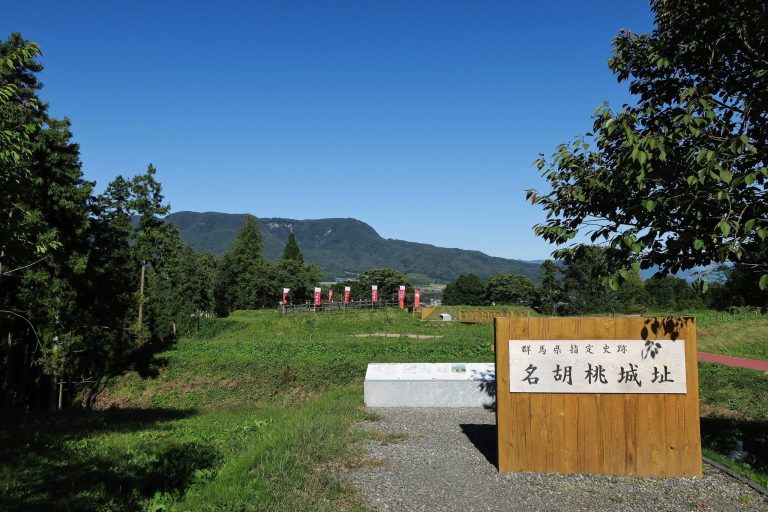
Naoyori extensively remodeled the castle and the residence at its foot, converting them into an early-modern castle complex. After Naoyori was transferred to Iiyama in Shinano Province, Sakado Castle was abandoned in 1609. Until that time, it served as a border fortification of Echigo. The ruins were designated a National Historic Site of Japan on June 11, 1979, protecting the surviving earthworks, moats, stone walls, and related remains.
Remains
Sakado Castle occupied Mount Sakado, a 634-meter peak rising more than 400 meters above its foothills. The mountain projects toward the junction of the Uono and Mikuni rivers. Steep cliffs protect its northern, eastern, and western sides, while the Uono River along the western foot formed a natural outer moat and defensive line. The fortification was a yamajiro, a Japanese mountain castle whose compounds spread across steep ridges and slopes.
Summit fortification
Honmaru and the southeastern summit
The principal summit enclosure, the Honmaru or main bailey, occupied a nearly circular level area about 20 meters across near the peak. It was not especially high compared with the mountain itself, and stone walls were added at a later stage. A second summit to the southeast, almost equal in height, was flattened into another bailey with a large watchtower. A narrow ridge path about 100 meters long connected the two areas. A turret foundation and surviving stone walls remain in the summit zone.
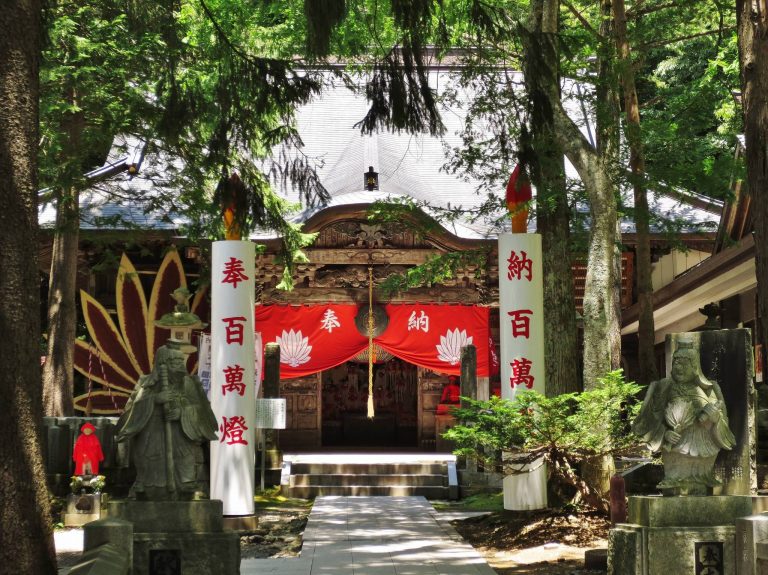
Springs near the mountain’s seventh station supplied water to the upper fortification, increasing the value of the summit position during warfare. A Shinto shrine now occupies the former Honmaru area. A Fuji Gongen shrine on the summit is traditionally associated with an initiative by Naoe Kanetsugu in 1586.
Ridge baileys and ditches
The Ninomaru and Sannomaru, traditionally the second and third baileys, extend northward from the Honmaru along the ridge. Other enclosed areas survive along the southeastern rear approach. These include the Tsume-no-maru, a level area at 631 meters where an earth rampart remains. Large cut ditches protected important ridge positions, and stone walls survive on the slope east of the Honmaru.
The Nishinomaru remains near the 500-meter elevation on the ridge running southwest from the summit. From there toward the outwork at Teragahana, at the end of the ridge, more than 100 ridge-shaped vertical ditches extend for approximately two kilometers. These earthworks form part of the castle’s long defensive structure across the mountain.
Foothill residences and approaches
Lord’s residence and retainers’ compounds
The western foothills, where the ground slopes gently, contained the lord’s residence and the compounds of his retainers. The rectangular lord’s residence measured approximately 110 meters from east to west and 80 meters from north to south. Earth ramparts enclosed it, while stone walls around two meters high survive especially well along the western front.
The Umeta moat remains between the retainers’ compounds and the Uono River. Together, the residence area and the castle town were protected by earthworks and water defenses, extending the castle’s defensive system beyond the mountain ridges.
Nakayashiki and Kamiyashiki
South of the lord’s residence, halfway up the Yakushimine ridge, lies the enclosure called the Nakayashiki. It measures approximately 40 meters from east to west and 50 meters from north to south. Farther east, along the principal approach from the residence toward the mountain ridge, the Momo-no-kidaira area contains the long, narrow Kamiyashiki enclosure, which measures about 30 meters from east to west and 120 meters from north to south.
Memorial and religious features
Shrines and monuments
At the foot of Mount Sakado are the cemetery of Nagao Masakage and a monument commemorating the area as the birthplace of Uesugi Kagekatsu and Naoe Kanetsugu. Stone monuments near the surviving walls commemorate Sakado Castle and identify the area as the birthplace of the Ueda Fifty Horsemen.