Kanda-myōjin: A Historic Shinto Shrine in Tokyo


Site at a Glance
- Rating
- 4.4
- Popularity
- Very High
- Country
- Japan
- Primary era
- Early Modern
- External website
- Open
- Eras represented
- Early Modern, Modern
- Civilizations
- Japanese, Tokugawa
- Site type
- Religious
- Remains
- Sanctuary
On this page20 sections
History
Kanda-myōjin, officially Kanda Shrine, is a Shinto shrine in Japan, located in Tokyo’s Chiyoda City. Traditionally founded in 730 during the Nara period, it began as a shrine of an immigrant clan associated with Izumo and was established to protect and pacify the Kanda area. Its religious life later came to encompass the worship of Ōnamuchi-no-Mikoto, Sukunabikona-no-Mikoto, and Taira no Masakado, while its festivals connected it closely with the political and social history of Edo.
Foundation and early worship
The shrine was founded in Shibasaki village, in Toshima District of Musashi Province. The clan that established it enshrined Ōnamuchi-no-Mikoto, regarded as its ancestral deity, and called the shrine Kanda-no-miya. The ground had previously contained rice fields belonging to Ise Grand Shrine. From this early foundation, Kanda-myōjin developed as a place intended to safeguard the surrounding Kanda district.
Its principal deity, Ōnamuchi-no-Mikoto, is associated with marriage and social bonds. He is also identified with Daikoku, one of the Seven Gods of Fortune, whose associations include prosperity and abundance. Over time, the shrine’s tutelary area expanded to include Kanda, Nihonbashi north of the Nihonbashi River, Akihabara, Ōtemachi, Marunouchi, and the former Kanda and Tsukiji fish markets. These communities together comprise 108 neighborhood associations.
The enshrinement of Taira no Masakado
Taira no Masakado was a tenth-century provincial warrior and government official who rebelled against the Heian government and claimed the title of “New Emperor.” After he was defeated and killed, his severed head was brought from Kyoto and buried near the shrine. Fear of his spirit, combined with admiration for his defiance, contributed to the development of his local worship.
An epidemic in the early fourteenth century was attributed to Masakado’s angered spirit. To appease him, the shrine enshrined him as a co-enshrined deity in 1309. His worship became associated with protection against disasters and with victory in contests. The connection between Masakado, misfortune, and religious appeasement also survives in a tradition warning devotees not to visit Naritasan Shinshōji. The monk Kanchō was sent there to perform goma rites, Buddhist fire rituals, intended to suppress Masakado’s rebellion, and the tradition holds that these rites cause suffering to his spirit.
Relocation and the Edo period
In 1603, the year Tokugawa Ieyasu established the Tokugawa shogunate, the shrine was moved to Kanda-dai during the expansion of Edo Castle. Ieyasu was the founder of the shogunate, the military government that ruled Japan during the Edo period. In 1616, the shrine was transferred again, on Ieyasu’s orders, to its present position on a small hill near Akihabara. Tradition connects this second relocation with concern about the proximity of Masakado’s powerful spirit to the castle.
During the Edo period, warriors and townspeople revered Kanda-myōjin as Edo’s guardian shrine. Its Kanda Festival became one of the city’s major public celebrations. Elaborately decorated portable shrines and floats were carried through Edo and into Edo Castle for the shogun to view, earning the festival the title “Tenka Festival.” Its origins were also associated with Ieyasu’s celebration of his victory at Sekigahara in 1600.
The name Kanda-myōjin was widely used during the Edo period and became part of many surrounding place names. The shrine’s religious identity also continued to develop through its principal deities. Sukunabikona-no-Mikoto, transferred from Ōarai Isosaki Shrine, was enshrined at Kanda in 1874 and became associated with commercial prosperity. He is identified with Ebisu, a member of the Seven Gods of Fortune associated with commerce, fishing, and good fortune.
Imperial-era changes and modern reconstruction
In 1868, Kanda-myōjin was designated a former quasi-imperial shrine, a category connected with the imperial shrine-ranking system. By 1870 it no longer held that status, and it was subsequently ranked as a prefectural shrine. Its official name changed to Kanda Shrine in 1872.
When Emperor Meiji was due to visit in 1874, Masakado was removed from the shrine’s principal group of enshrined deities because the imperial government regarded him as a rebel. His spirit was transferred to the subsidiary Masakado Shrine within the precincts, while Sukunabikona-no-Mikoto was installed in the main shrine. Masakado was restored there in 1984. The three principal deities now comprise Ōnamuchi-no-Mikoto, Sukunabikona-no-Mikoto, and Taira no Masakado.
The wooden sanctuary complex built in 1782 was destroyed by the Great Kantō Earthquake of 1923. Reconstruction was completed in 1934 using reinforced concrete while retaining the earlier architectural form. This decision helped the shrine survive the Tokyo firebombing of 1945, even though incendiary bombs fell within the precincts. Fires and earthquakes had already led to repeated rebuilding, and work on individual buildings continued during the postwar and modern periods.
In 1961, the Mitani Chōsaburō monument was moved from behind the shrine to a position west of it during improvements to the precinct. The shrine’s buildings were registered as nationally registered tangible cultural properties in 2003. Kanda-myōjin is also included among the Tokyo Ten Shrines, a group of major Tokyo shrines formerly associated with the imperial ranking system, and belongs to the Beppyo category of the Association of Shinto Shrines, which grants special institutional status.
Continuing religious and cultural associations
The Kanda Festival remains part of the shrine’s religious identity and is held around May 15 in odd-numbered years. The January Daikoku Festival provides another recurring focus for worship. The Kanda Hayashi musical tradition has been designated an intangible folk cultural property of Tokyo.
From the 2010s, Kanda-myōjin also became associated with anime and light-novel works set in the nearby Akihabara and Kanda districts, including Love Live!, Steins;Gate, and Tokyo Ravens. In 2019 it was recognized among Japan’s “88 Anime Pilgrimage Sites.” A recognition plate and stamp were installed at the EDOCCO cultural complex. EDOCCO opened within the precincts on December 15, 2018, as part of preparations for commemorations planned for the shrine’s 1,300th anniversary in 2029. Its construction required the removal of a former side building used to store treasures and religious goods.
Remains
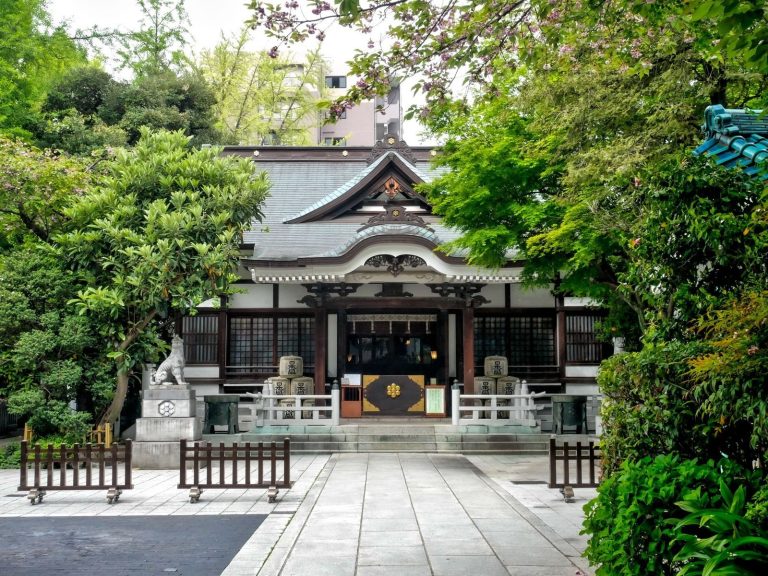
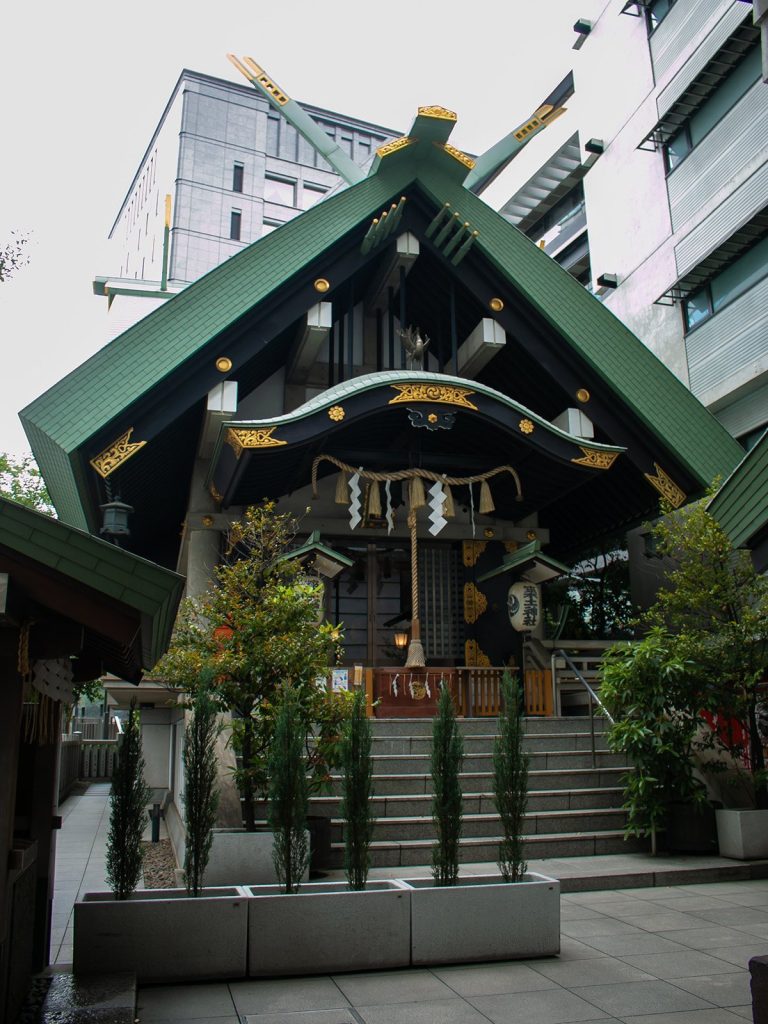
The present precinct occupies a small hill near Akihabara and is approached from the surrounding streets. A copper torii, the traditional gateway to a Shinto sacred precinct, marks the approach, followed by Zuishin-mon, the principal entrance gate. Beyond it, the shrine’s main buildings form a unified reinforced-concrete complex in the Gongen-zukuri arrangement, in which the sanctuary and worship hall are joined by an intermediate structure.
Main shrine buildings and entrance
Principal sanctuary
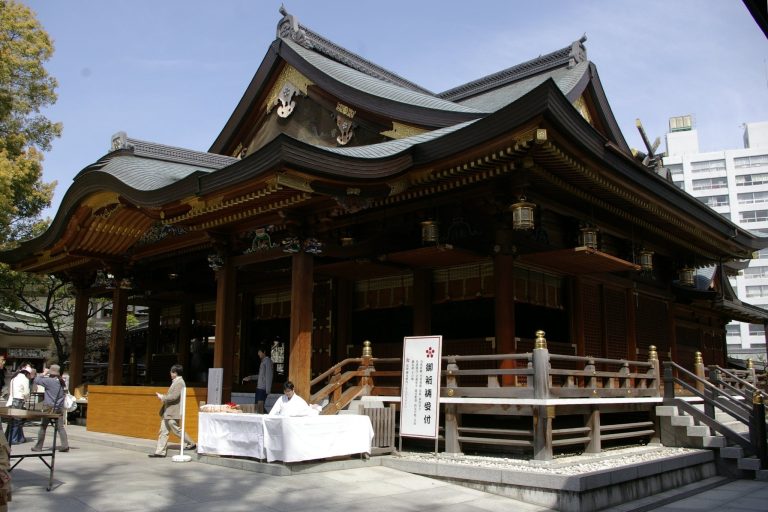
The principal sanctuary complex was completed in 1934 after the earthquake destroyed the wooden buildings erected in 1782. It follows the earlier Gongen-zukuri form and is finished overall in vermilion lacquer. The principal sanctuary has an irimoya roof, a hipped-and-gabled roof form, covered with copper tile-style roofing. Gold ornament and lacquered interiors enrich the buildings. The earlier wooden complex had also been painted vermilion and carried the Tokugawa family crest of three hollyhock leaves, details that informed the form retained in the reconstruction.
Zuishin-mon
Zuishin-mon is a two-storey entrance gate reconstructed in 1995 from cypress wood. It has an irimoya-style roof and a vermilion finish with gold decoration. Together with the torii, the gate defines the principal approach into the hilltop precinct.
Copper torii
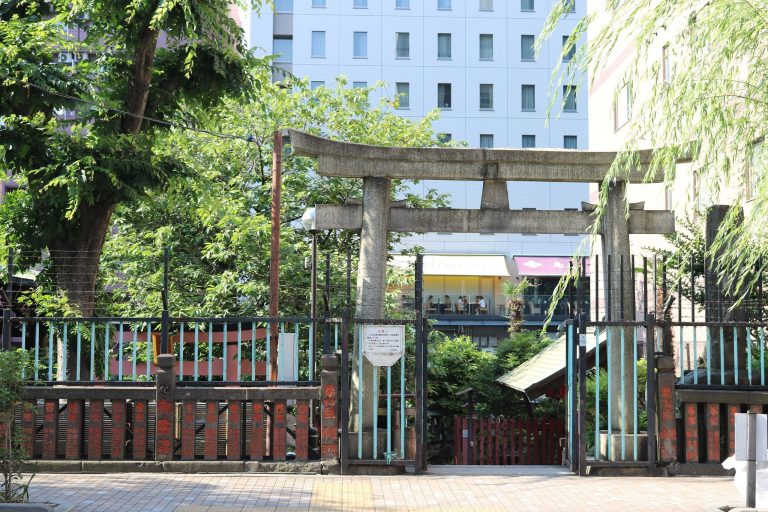
The torii at the approach is made of copper rather than the more usual materials associated with such gateways. Its surface has developed a green patina, giving the entrance a subdued appearance. The gate marks the transition into the sacred grounds before the route reaches Zuishin-mon.
Monuments and festival objects
Statues and commemorative monuments
Several statues and monuments occupy the precinct. They include representations of Daikoku and Ebisu, the Mitani Chōsaburō commemorative monument, a monument associated with senjafuda, or votive paper and wooden tags, and numerous other stone monuments and strength-testing stones. Beside the right side of the principal sanctuary stands a monument to Zenigata Heiji, the fictional detective created by Kōdō Nomura. In Nomura’s Zenigata Heiji Crime Reports, the detective’s residence was located in a tenement below Kanda-myōjin.
Festival portable shrine
A mikoshi, a portable shrine used to carry a kami symbolically during festivals, is kept in an ancillary building. It is brought out for the Kanda Festival every two years and is not ordinarily displayed outside that festival.
Subsidiary shrines
Sorei and Kago-so shrines
Sorei Shrine was founded in 2004 and is dedicated to the ancestors of the shrine’s parishioners and devotees. Kago-so Shrine was founded in 1795 by basket makers. It enshrines Sarutahiko-no-Ōkami, associated with guidance, Shiotsuchi-no-Kami, associated with the making of a bamboo basket boat, and Ninigi-no-Mikoto, the heavenly grandson traditionally regarded as an ancestor of the imperial line.
Kotohira and Suijin shrines
Kotohira Shrine was founded in 1783 at Yagenbori in Toshima District, where boatmen on the Sumida River revered it. Formerly independent, it was moved to Kanda-myōjin in 1966 after its religious corporation was dissolved and it became a subsidiary shrine. Nihonbashi Fish Market Suijin Shrine began as the guardian shrine of the Nihonbashi fish market and was moved into the Kanda-myōjin precinct during the early seventeenth century.
Yakumo shrines
The three subsidiary Yakumo shrines all enshrine Takehayasusanoo-no-Mikoto. Edo Shrine was founded in 702 in Edo, in Toshima District, and is described as Edo’s oldest land-deity shrine. It was revered by the Edo clan, later stood within Edo Castle after Ōta Dōkan’s castle construction, and was moved to Kanda-myōjin during Ieyasu’s 1603 expansion of the castle. Ōdenmachō Yakumo Shrine is traditionally dated to before the Edo period and took its name from the temporary sanctuary used when its portable shrine was carried during festivals. Kobunachō Yakumo Shrine formerly stood inside Edo Castle and received its name in the same way.
Inari shrines
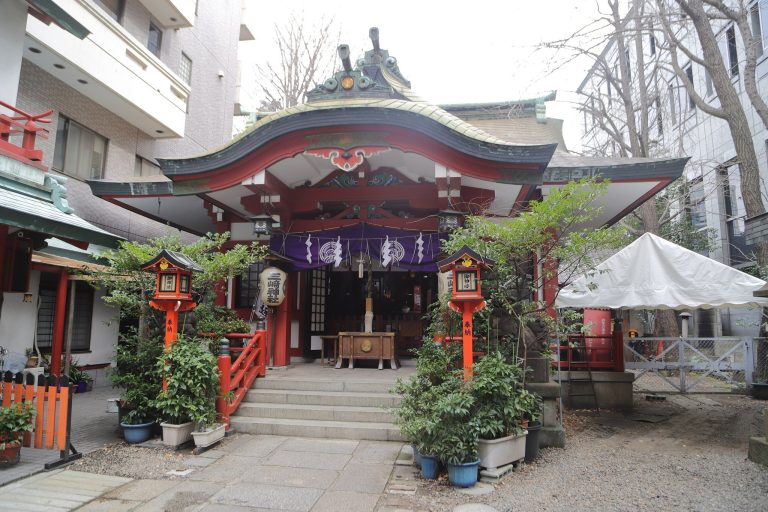
The three subsidiary Inari shrines enshrine Ukanomitama-no-Kami. Suehiro Inari Shrine has an uncertain foundation date but is traditionally associated with around 1616 and is worshipped as a deity of advancement. Mishuku Inari Shrine served as the tutelary shrine of Kanda Mikawachō during the Edo period and was later combined with an Inari shrine from the residence of Kanda-myōjin’s shrine priest. Urayasu Inari Shrine formerly stood in Chiyoda village, Toshima District, and was moved into the precinct in 1843 during the expansion of Edo Castle.
EDOCCO cultural complex
EDOCCO is a four-storey building above one basement level within the shrine precinct. Its basement contains an event and cultural-performance space with a fixed stage, seating for 140 people, and standing capacity for 200. The first floor contains a shop and café. Kanda-myōjin Hall occupies the second and third floors and has an elevating stage, seating for 400, standing capacity of approximately 700, and 15 fixed VIP seats. The fourth floor contains the Reiwa-no-Ma multipurpose lounge. Exhibited works include metalwork by Ryōhei Miyata, paintings by Morio Matsui, and designs by fashion designer Jutarō Saitō.
Nearby sites