Komadome-Hachiman Shrine: A Tutelary Shrine of Kamiuma in Tokyo


Site at a Glance
- Rating
- 4.1
- Popularity
- Low
- Country
- Japan
- Primary era
- Unclassified
- External website
- Open
- Eras represented
- Unclassified
- Civilizations
- Unclassified
- Site type
- Religious
- Remains
- Sanctuary
On this page10 sections
History
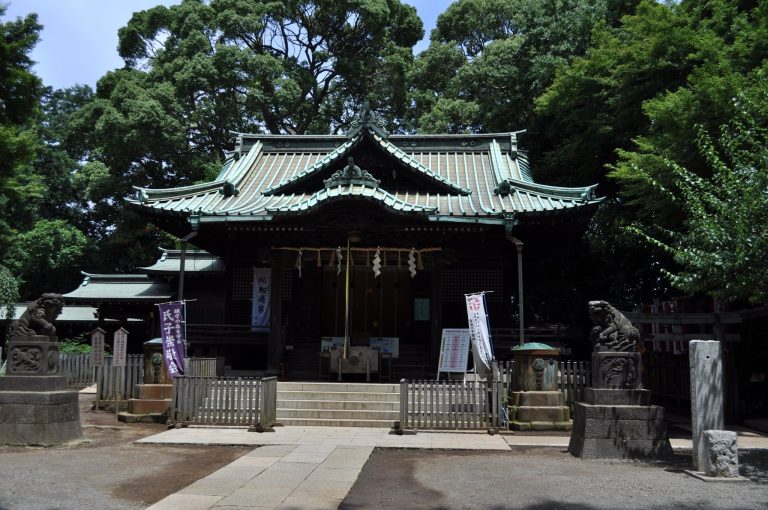
Komadome-Hachiman Shrine is a tutelary Hachiman shrine in Japan, serving the former Mabikizawa Village area, now Kamiuma in Setagaya City, Tokyo. Hachiman is a deity associated with protection and warfare and traditionally identified with Emperor Ojin, who is the shrine’s principal deity. The shrine’s foundation date is uncertain, although local tradition places it in 1306 or 1307, during the Kamakura period.
Foundation traditions and early history
The foundation story connects the shrine with a landholder who had received an estate from the Kamakura shogunate, Japan’s military government based at Kamakura from the late twelfth century until 1333. Seeking a central place of worship for the village, he is said to have dreamed that Hachiman instructed him to establish the shrine where his horse stopped. He chose that place for the sanctuary, which became known as Komadome-Hachiman, or Wakamiya Hachiman.
The Shinpen Musashi Fudoki Kō stated that the date of enshrinement was unknown. A copper plaque found at the shrine gives a more precise tradition, naming the twenty-third day of the tenth month in 1308 as the date when Komadome Hachiman was established by a figure identified as Hōjō Sakontarō Nyūdō Jōgan. The same historical account questioned whether the plaque was genuine, proposing that a later priest might have placed it in a sutra container to make the principal image appear older.
Buddhist administration and Meiji reclassification
Before the Meiji separation of Buddhism and Shinto, a nineteenth-century state policy that formally divided the two religious traditions, the Soto Zen temple Soenji administered the shrine and oversaw its rituals. Soenji was a branch temple of Daienji in Komagome and used the mountain name Hachimanzan. Temple records identified its founding priest, Shinkaku Soen, with the traditional founder of Komadome-Hachiman, although the Shinpen Musashi Fudoki Kō also challenged that identification.
In April 1873, the shrine received the historical rank of village shrine. In 1909, permission was granted to combine the Tenso and Itsukushima shrines that had stood in Mabikizawa Village with Komadome-Hachiman, and the completed merger was reported on July 20 of that year.
Local worship and the tradition of Princess Tokiwa
The shrine serves parishioners from Kamiuma and three neighborhoods of Sangenjaya. Before the Second World War, the parish organization was divided into four groups called Mukai, Higashi, Nishi, and Sancha. After the war, it reportedly included 22 representatives chosen from financially secure households.
Wakamiya Hachiman, the associated deity, and Itsukushima Shrine within the grounds are linked to the tradition of Princess Tokiwa, said to have been a secondary consort of Kira Yoriyasu, lord of Setagaya Castle. According to the story, jealous consorts falsely accused Tokiwa of infidelity, leading Yoriyasu to distrust and abandon her. She fled the castle and either took her own life near the shrine or was killed by pursuers. Although pregnant, she gave birth to a son. When the afterbirth was washed in clear water, the Kira family’s paulownia crest allegedly appeared, revealing her innocence. Yoriyasu is then said to have executed the twelve women who had accused her.
The tradition continues by saying that Yoriyasu enshrined Tokiwa’s son as Wakamiya Hachiman and worshipped Tokiwa’s spirit as Benzaiten, a Buddhist-Shinto deity associated with music, eloquence, learning, and prosperity. Tokiwa’s historical existence remains doubtful, but the story has been treated as credible within local tradition because it refers to numerous real place-names and religious sites. Her alleged burial place, Tokiwa-zuka, survives nearby and became a Setagaya Ward historic site on November 12, 1983, as a related place in the traditional narrative Nagori Tokiwa-ki.
Deities and civic recognition
Amaterasu, the Shinto sun deity and ancestral deity of the Japanese imperial line, is enshrined together with Emperor Ojin. Additional deities include Ichikishimahime, Ukanomitama, Sugawara no Michizane, Haniyamahime, Kunitokotachi, Otorimoraji no Mioya no Kami, and Kotoshironushi. The shrine has also been selected among the “One Hundred Views of Setagaya” as “Komadome-Hachiman Shrine of Kamiuma.”
Remains
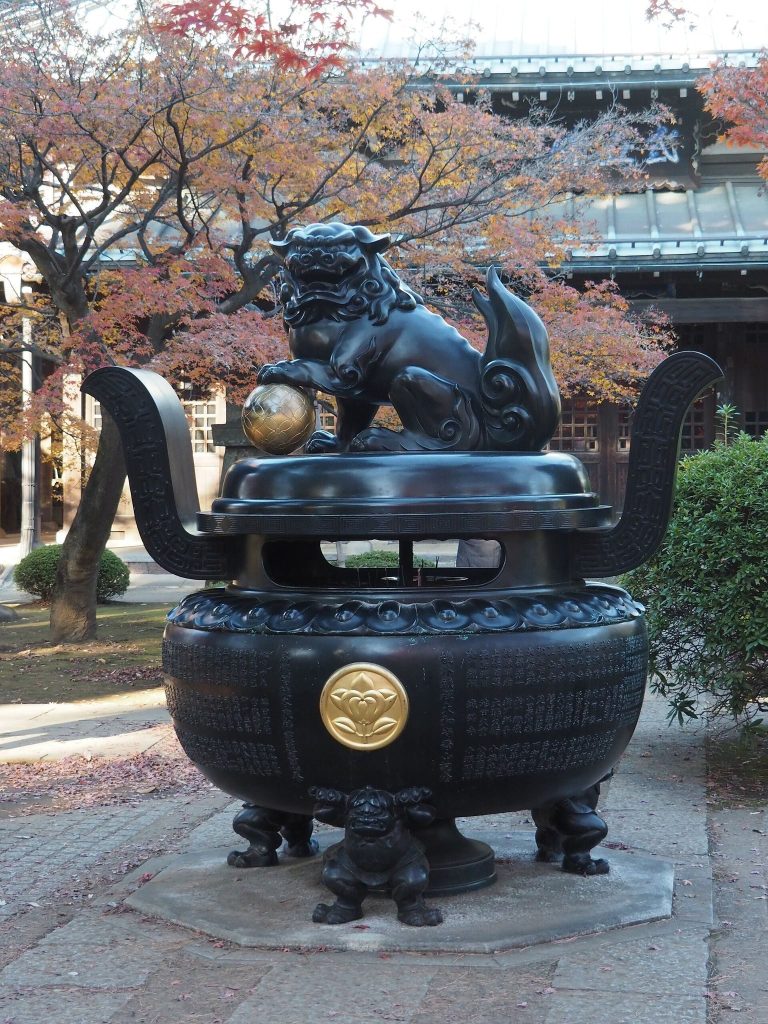
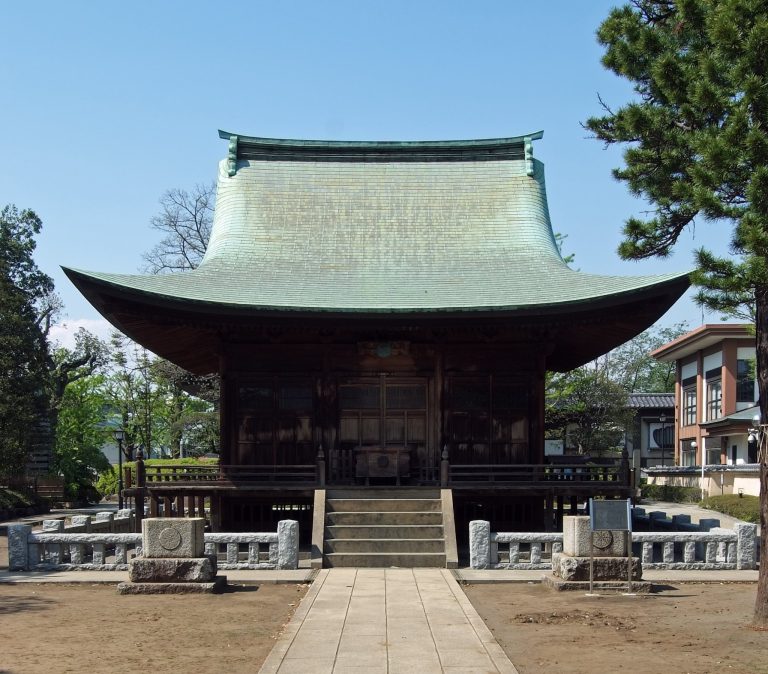
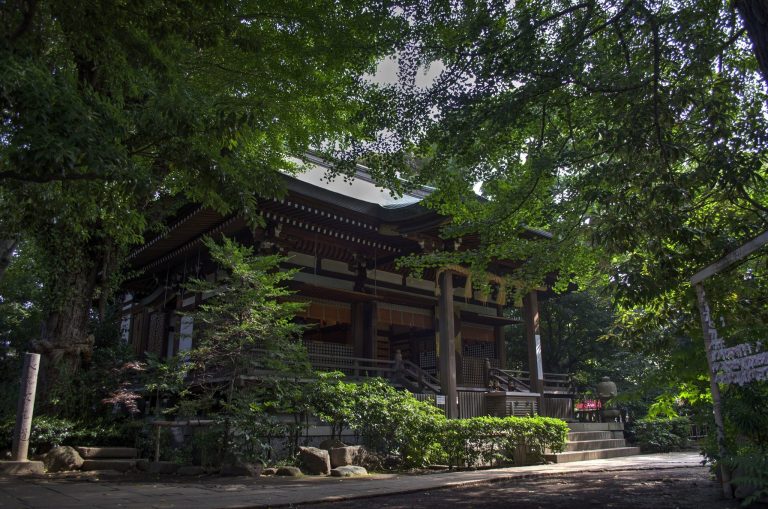
The shrine precinct lies south of the intersection of the Kanjo-nana-go road, formerly called Horinouchi Road, and Setagaya Avenue, formerly called Oyama Road. Its religious complex includes the main Komadome-Hachiman Shrine, Wakamiya Hachiman as an associated shrine, and Itsukushima Shrine within the grounds. Smaller subsidiary shrines are dedicated to Inari, Washi, Mitsumine, Sugawara, Haruna, and Ontake.
Excavated sacred objects
Image, sutra container, and copper plaque
Near the shrine steps, excavation during the Tenna period, from 1681 to 1684, produced an image approximately 33 centimeters high and a sutra container. The associated copper plaque links the buried objects with Komadome Hachiman, identifies the traditional founder, and gives the foundation date as 1308. These objects preserve the material form of the shrine’s early foundation tradition, while the plaque’s authenticity was questioned in the Shinpen Musashi Fudoki Kō.
Water feature and wooded precinct
Benzaiten shrine and former pond
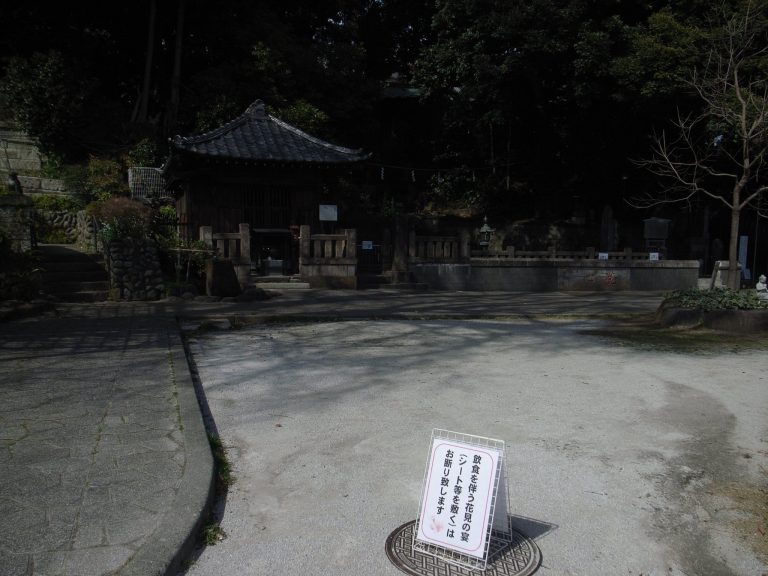
Before the Second World War, the Benzaiten shrine connected with the Tokiwa tradition stood on an island in a pond within the precinct. The pond was later filled in. The grounds also contain a protected woodland area and a black pine selected among Setagaya’s one hundred notable trees.
Nearby sites