Tagajō Stele: A Nara-Period Monument to Tagajō’s Renovation


Site at a Glance
- Rating
- 4.2
- Popularity
- Low
- Country
- Japan
- Primary era
- Medieval
- External website
- Open
- Eras represented
- Medieval
- Civilizations
- Yamato
- Site type
- Civic
- Remains
- Monument
On this page7 sections
History
The Tagajō Stele is a Nara-period stone monument in Tagajō, Japan, erected in 762 at the entrance to Tagajō, the provincial government seat of Mutsu Province. Its inscription records the site’s establishment in 724 and renovation in 762, making it the only written record of that renovation and an important source for the history of Japan’s centralized imperial government and its northeastern frontier.
Foundation and renovation
The inscription states that Tagajō was established in 724 by Ōno no Azumabito, an imperial inspector of Mutsu and commander of the local garrison. Mutsu was a northeastern administrative province, while the Emishi were communities in northern and northeastern Japan whom the imperial state sought to subdue and incorporate.
The monument itself was erected on December 20, 762, to commemorate the renovation of Tagajō. Fujiwara no Asakari, a court official of the Fujiwara family, commissioned it to celebrate his achievements in pacifying the Emishi. The inscription also gives distances from Tagajō to Heijō-kyō, the capital now known as Nara, as well as to the borders of Hitachi and Shimotsuke, the Emishi frontier, and the land of the Mohe, an ancient people of northeastern Asia. Its west-facing position and the large character meaning “west” at the top have been interpreted as an appeal directed westward toward the emperor in the capital.
Discovery and authenticity debate
The stele was discovered during the Manji to Kanbun years, approximately 1658 to 1672. From the beginning, it was identified with the celebrated poetic landmark known as the “Tsubo Stele,” which helped make it widely known. Matsuo Bashō visited it in 1689, and the visit was later described in The Narrow Road to the Deep North.
Different transcriptions circulated after the discovery. The text now readable was established in 1699, when the Sendai-domain Confucian scholar Sakuma Yoshikazu, also known as Sakuma Dōgan, made a rubbing with his son Yoshikata. From the late Edo period through the Meiji period, the stele was suspected of being a later forgery, and the debate became particularly active during the Meiji period.
Arguments for forgery focused on several features. Critics considered the seal-style script lifeless and archaizing, identified the carving as the early-modern box-carving technique, questioned the ranks and offices attributed to Fujiwara no Asakari, and objected to the use of the name Mohe after the polity associated with that name had adopted the name Bohai. They also argued that the stated distance to the Hitachi border did not match routes described in later historical records. One theory proposed that the Sendai domain had commissioned Sakuma Dōgan to create the monument.
Excavations at the Tagajō ruins in 1963 revealed major renovation from the middle of the eighth century. This matched the previously unrecorded renovation described by the inscription and renewed attention to the stele as evidence for that event. Palaeographic study concluded that the text was written by a highly educated person, such as a contemporary aristocrat or eminent Buddhist cleric. Further reassessment identified V-shaped groove carving rather than box carving and found that the inscription’s layout followed the Nara-period Tenpyō measure, equivalent to 2 shaku 4 sun. The recorded rank of Ōno no Azumabito can be understood as a rank he held during his service in Mutsu, while Fujiwara no Asakari’s rank may have been presented in a similar form to honor his achievement in renovating Tagajō. The authenticity hypothesis is now predominant.
Preservation and recognition
Excavation carried out in 1997 during the dismantling and repair of the protective shelter found ancient setting traces around the stele. These traces strengthened the possibility that the monument has stood in its present location since its original erection. Concern for its preservation dates back to the Edo period, including an initiative associated with Tokugawa Mitsukuni, a seventeenth-century Tokugawa-domain lord and historian. The stele was designated an Important Cultural Property in 1998, recognized as a component of Japan Heritage in 2016, and designated a National Treasure in 2024. A reconstruction model is exhibited at the Tohoku History Museum.
Remains
Stone form and inscription
The Tagajō Stele is made of arkose sandstone, a sandstone containing a substantial proportion of feldspar. A similar stone is exposed about 100 meters southeast of the monument in the Triassic Rifu Formation. The shaft is approximately 1.96 meters high, 1 meter wide, and 50 centimeters thick, with one face flattened for the inscription. The upper part of that face bears a large character meaning “west.” Beneath it, a rectangular panel contains 11 lines and 140 characters.
The inscription begins with distances to the capital, provincial borders, the Emishi frontier, and the land of the Mohe. Its later portion records Tagajō’s establishment in 724 and renovation in 762. The arrangement follows the Nara-period Tenpyō measure, equivalent to 2 shaku 4 sun, and the characters were carved with V-shaped grooves. The script is considered consistent with the work of a highly educated person of the Nara period.
Position and protective shelter
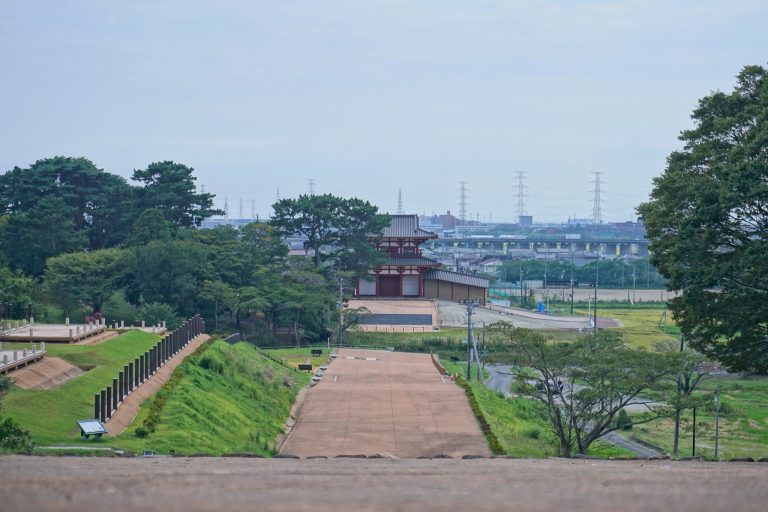
The monument stands in front of the former southern gate of ancient Tagajō and faces west. Its setting traces were found during the 1997 excavation around the stele. The monument is enclosed within a covered shelter, a protective building designed to shield it from weather and environmental deterioration.