Okusawa Shrine: A Historic Hachiman Shrine in Tokyo


Site at a Glance
- Rating
- 4.3
- Popularity
- Low
- Country
- Japan
- Primary era
- Modern
- External website
- Open
- Eras represented
- Early Modern, Modern
- Civilizations
- Japanese, Tokugawa
- Site type
- Religious
- Remains
- Sanctuary
On this page15 sections
History
Okusawa Shrine is a Shinto shrine in Setagaya City, Japan, traditionally founded during the Muromachi period as a place of worship for Hachiman, the guardian deity of eastern Setagaya. Its origins are associated with the construction of Okusawa Castle, when the Ohira family, retainers of the Kira clan, invited Hachiman to the settlement. Formerly called Hachiman Shrine, it became a village shrine connected with Okusawa’s religious, educational, and communal life.
Kira and Tokugawa rule
The surrounding area entered Kira clan territory around 1345 to 1349. The shrine’s traditional foundation belongs to the Muromachi period, which lasted from 1336 to 1573. Hachiman, a major Japanese kami associated with protection and the imperial figure Emperor Ojin, was regarded here as a guardian of the community. Hachiman Shrine was counted among the Kira clan’s group known as the Seven Valleys and Eight Hachiman Shrines.
In 1590, the destruction of the Hojo regime and the decline of Kira power brought a political change to the area. Okusawa became Tokugawa direct territory and was organized as Okusawa Village in Setagaya territory, Ebara District. Later agricultural development divided the settlement administratively. Western village lands were cultivated in 1662 and surveyed in 1669, after which Okusawa Shinden Village, meaning Okusawa New Reclaimed Village, was established in the area corresponding roughly to present-day Okusawa 4 through 8 chome. The older settlement became known as Okusawa Main Village, while Hachiman Shrine served as the guardian shrine of the new village.
Village shrine and Buddhist administration
An early nineteenth-century topographical gazetteer describes the sanctuary, worship hall, torii, and priest’s residence. It also records a festival held on September 15, when villagers performed music. The shrine was supervised by Mitsuzoin of Shimonumabe Village, a Buddhist temple of the Chisan branch of Shingon Buddhism. Under Japan’s former system of combined Buddhist and kami worship, such an administrative temple managed or supervised a Shinto shrine. Mitsuzoin still exists in present-day Denenchofu-Minami.
The Meiji period brought new administrative arrangements and a formal reclassification of the shrine. The area was incorporated into Shinagawa Prefecture and later into the administrative districts of Tokyo Prefecture. A shrine register dated March 1875 identifies the enshrined deity as Emperor Ojin and records the former designation Hachiman Daibosatsu. It also notes that the shrine had been designated a village shrine in the preceding year.
Okusawa Main Village and Okusawa Shinden Village were merged into Okusawa Village in 1878, although some local historical interpretations place the merger earlier. In 1889, Okusawa Village became part of the newly formed Tamagawa Village together with seven neighboring villages. These changes placed the shrine within a broader administrative unit while retaining its local role as the religious center of Okusawa.
Merger and changing shrine administration
In October 1909, Hachiman Shrine merged with Koyasu Inari Shrine, formerly the guardian shrine of Okusawa Main Village. Koyasu Inari stood near present-day Okusawa 1 chome and enshrined Ukanomitama, a Shinto kami associated with food, grain, rice, and agricultural prosperity. After the merger, Hachiman Shrine was renamed Okusawa Shrine. Its principal deity is Hondawake no Mikoto, identified with Emperor Ojin, while Ukanomitama was added through the union with Koyasu Inari.
The shrine also has an affiliated Benzaiten shrine called Fukujubenten. Benzaiten is a Buddhist-Shinto deity especially associated with water, music, eloquence, and good fortune. Around the beginning of the Showa period, the shrine experienced a period without its own priest. Priests came from Hikawa Shrine in former Fumura, corresponding to present-day Himonya in Meguro.
Birthplace of Hachiman Elementary School
Okusawa Shrine also became the birthplace of Hachiman Elementary School. From the end of the Keio era, a teacher from Mukogawara in Shimonumabe Village taught local children reading, writing, and abacus calculation in the shrine’s priestly residence. The work was continued by Kobayashi Daijiro, a former samurai, then by Matsuzawa Hiroyoshi, a member of the former samurai class of Tokyo Prefecture, and later by Ikeda Koichiro, who renamed the school Ikeda School.
On December 20, 1879, village headman Mouri Takizo and others renovated part of the shrine residence, secured official approval, and established Hachiman Elementary School. The school opened with 30 pupils in a building measuring 15 tsubo, approximately 49.6 square meters. A new building was completed on adjoining land in 1884, and the school moved to its present location in Tamagawa-Denenchofu in 1902. A monument commemorating the school’s birthplace was erected in the shrine precincts on November 29, 1970.
Rebuilding and the shrine precinct
The main sanctuary described in the early nineteenth-century gazetteer was moved to Kuhonbutsu Joshin-ji in 1912 and remodeled as a Kannon hall. A sanctuary built in 1913 was also transferred there and dedicated as a hall for five deities. The reasons for these relocations are uncertain. A later explanation attributes them to the shrine’s lack of space, while the relocations do not indicate a special relationship with Kuhonbutsu Joshin-ji. The present main sanctuary was rebuilt in 1970.
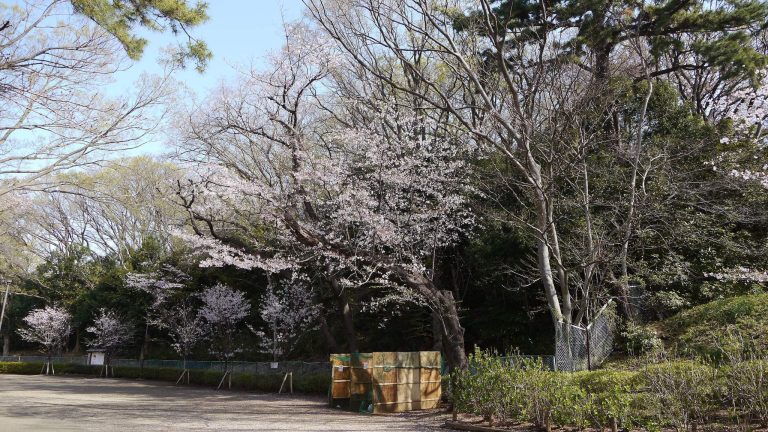
The precinct was designated a Setagaya preserved woodland area on March 1, 1978, under the ward ordinance for protecting and restoring the natural environment. The protected area measures 1,500 square meters. The Great Straw Serpent Procession was designated a Setagaya intangible folk cultural property in 1993 and a Tokyo intangible folk cultural property in the category of customs and folk practices on March 11, 2016.
The Great Straw Serpent Procession
The shrine’s major annual rite is traditionally traced to an epidemic in the middle of the Edo period, which lasted from 1603 to 1868. According to local tradition, Hachiman appeared in a dream to the village headman and instructed villagers to carry a large straw serpent through the settlement. The epidemic soon subsided, and the serpent came to be revered as a protector against misfortune.
The procession was suspended from 1939 to 1957. The stated concern was that the stone torii would make the serpent’s belly cold. In 1958, the priest then serving at the shrine revived the rite, arguing that old traditions should be reconsidered and passed on. The practice is rare nationally, and no other example of carrying a straw serpent through a community is known in Tokyo.
The rite begins at 10 a.m., when the serpent is carried from the main sanctuary and purified by the priest. It circles the large ginkgo tree three times counterclockwise before passing through the torii. The procession visits seven neighborhood sake-offering stations and covers approximately 4 kilometers in about two and a half hours. At each station the bearers receive ritual purification, and the carrying group changes at the boundaries between neighborhood associations.
The procession includes a priest, a bearer of a sacred branch, a bearer scattering paper confetti, four high-lantern bearers, and about ten neighborhood officials. Around four people carry the framed head and approximately ten carry the body. When traffic permits, they shift the serpent from side to side to imitate a crawling snake. Pieces of straw left from its construction are distributed along the route as protective charms.
After the serpent reaches Kanjo 8 road after midday, traffic regulations require it to be transported by vehicle to a junction south of Okusawa Station. It is then carried for approximately 200 meters along Jiyu Street toward the shrine. Following the procession, the serpent remains at the main sanctuary for one year. It is then ritually purified and wrapped around the torii in place of the serpent displayed during the preceding year.
The annual festival was formerly held on September 15. After the Meiji adoption of the solar calendar, it took place on October 15, and from 1974 it returned to September 15 in association with Respect for the Aged Day. Musicians had disappeared from the Okusawa area, so the shrine commissioned the Seta Hayashi Preservation Association to provide festival music.
Community rites and organization
The serpent is made on the first Sunday of September by the priest and about 40 volunteer parishioners, all of whom undergo ritual purification before beginning. The material comes from glutinous-rice plants. The lower leaves are removed two or three days beforehand, after which the straw is bundled. Before the procession was suspended, the three village divisions called Kami, Naka, and Shimo took turns making the serpent and competed over the quality of their workmanship. From around 1935, straw was also brought from Tochigi and Gunma because local supplies were difficult to obtain.
Volunteers from the local shopping district make a smaller straw serpent as well. They attach it to the large portable shrine of the Kyoei neighborhood association, which is built from five four-to rice barrels, and carry it through the neighborhood during the annual festival. This practice passes straw-serpent-making skills to younger parishioners.
Okusawa Shrine’s parish traditionally included all households of Okusawa Village. Around 1935, when the number of households had risen to approximately 3,000 through the arrival of new residents, newcomers were expected to contribute one yen each year toward maintenance. A 1985 survey counted approximately 2,000 parish households paying 600 yen annually. It attributed the later decline in parishioners mainly to the deaths of older household heads, changes in household leadership, and affiliation with particular religions.
Shrine duties rotated annually among the Kami, Naka, and Shimo divisions of the former village. In 1985, parish representatives, also called shrine captains, numbered 14. They had formerly been chosen from Okusawa 1 through 3 chome and later were generally selected at a rate of two from each of Okusawa 1 through 8 chome. Reputation, financial standing, and family background influenced selection, making the office effectively hereditary. Two senior representatives supervised the priest and parish representatives, checked financial statements submitted to the tax office, and reported the accounts to the general meeting.
A local birth rite brought newborn children to the shrine for entry into the parish community. Boys were taken on the 31st day after birth and girls on the 33rd. The accompanying adult was usually the paternal grandmother or the mother of the child’s mother, although the father or a matchmaker’s wife might also attend. Before the Pacific War, mothers could not enter until 75 days after childbirth and waited outside the precincts if they accompanied the child.
Rainmaking traditions
Rainmaking rites continued in Okusawa Village until approximately the middle of the Taisho period, which began in 1912. During a summer drought, swift runners went to Oyama-Afuri Shrine in Kanagawa to obtain water. They crossed the river by boat from the Futako ferry and traveled along the Atsugi Highway. The water was carried in a bamboo tube, and the runners did not stop because stopping was believed to make rain fall at that location.
At Okusawa Shrine, the water was poured into a four-to barrel holding approximately 72 liters. The village duty groups circled the barrel while chanting Buddhist prayers and used a T-shaped straw implement called a tonbo to sprinkle water around the precincts. If rain did not follow the first rite, another area took responsibility and repeated it. Rain afterward was followed by a day without farm work known as Oshimeri New Year.
Remains
Layout and principal buildings
The precinct contains the main sanctuary complex, a sacred music and dance hall, an ablution pavilion, an administrative office, the torii, subsidiary shrines, monuments, stone markers, and older religious objects. An 1875 plan shows the main sanctuary facing south, the kagura hall to its southeast, subsidiary shrines to the west, and the torii at the southeastern corner. The priest’s residence, described in the earlier gazetteer as standing to the right of the sanctuary, had shifted to the sanctuary’s western side by the time of the plan.
The earlier gazetteer gives the former main sanctuary dimensions of three and a half ken by one ken, and the worship hall dimensions of two ken by three ken. It also describes a four-ken-by-two-ken residence beside the sanctuary. A ken is a traditional Japanese unit of architectural length, while a tsubo measures area.
Torii and main sanctuary
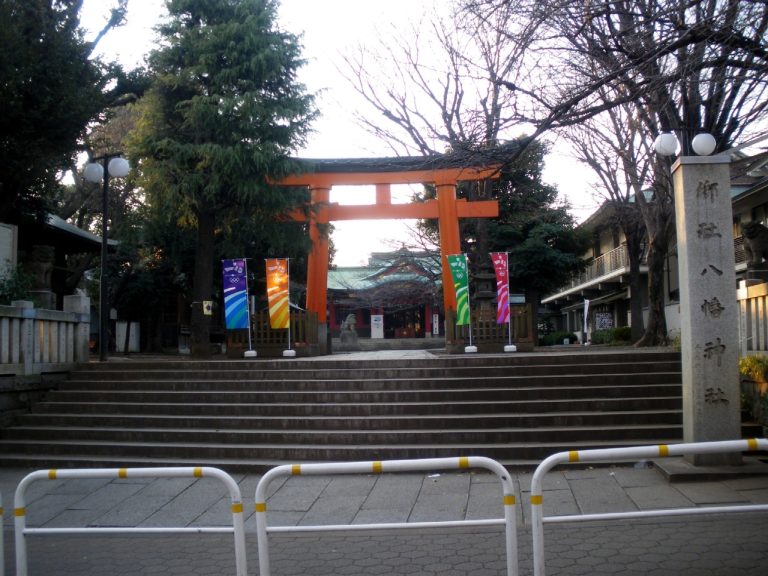
The torii, the gateway marking the approach to the sacred precinct, faces the street. It is wrapped with the straw serpent from the preceding procession. The gateway was changed from wood to stone in 1939, although two earlier publications give 1928 as the date of replacement. The former wooden gateway was a four-legged torii, a form also used for the great torii standing in the sea at Itsukushima Shrine.
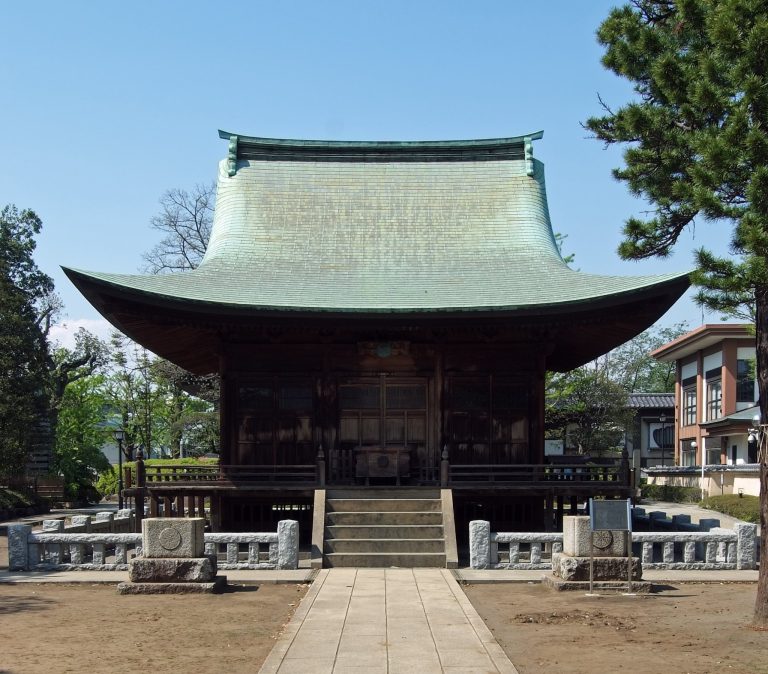
Rebuilt in 1970, the present main sanctuary uses high-quality cypress from the Bishu region and reproduces architectural features associated with the Muromachi period. The sanctuary complex also includes the norito hall and worship hall, while the kagura hall preserves the place within the precinct for sacred music and dance.
Fukujubenten and the Benten tradition
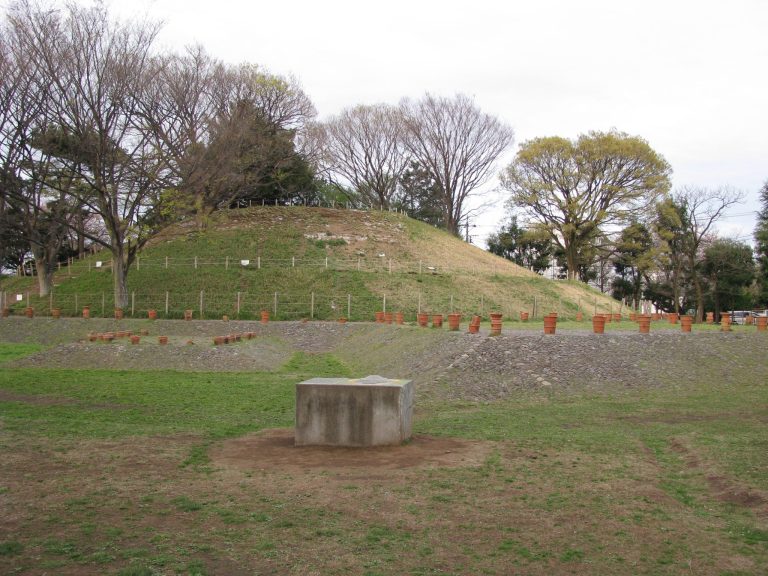
Fukujubenten stands behind or near the main sanctuary and the monument commemorating Hachiman Elementary School’s birthplace. It was transferred in 1950 from a spring-fed pond approximately 100 meters south of Okusawa Station. A landscaped mound was created for the shrine in 1972.
A stone pillar before Fukujubenten bears the date November 11, 1737, together with the names Wada Waemon and his wife Sen. The rear of the shrine’s stone shrine records that its sacred image was rebuilt in 1821 by the lord of Okusawa Main Village and local inhabitants. The earlier shrine building was rebuilt in 1933 after it had become dilapidated.
The former spring-fed pond was known as Okusawa Benten Pond. Local tradition held that a white serpent living in the pond brought the benefits of water to Okusawa’s fields. The pond site later became a shopping district. The Benten tradition survives at the shrine through Fukujubenten and its associated monuments.
Woodland and stone features
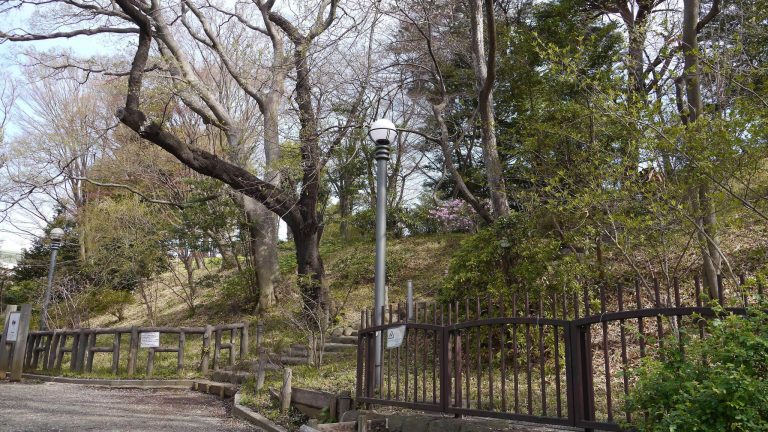
The wooded precinct contains a designated preserved tree, a chinquapin known as the Bark-Only Chinquapin because its trunk is hollow and the tree survives beneath its bark. A 1988 survey recorded the tree at 3 meters high, with a trunk circumference of 1.7 meters.
A pair of guardian dog statues stands just inside the torii. Nearby is the Okusawa Three-Hundred-Year Development Monument, donated by shrine parishioners in October 1962 to commemorate 300 years of development in Okusawa. The offering also included the guardian dogs and stone lanterns. Other features include the monument marking the birthplace of Hachiman Elementary School, a 32-kan power stone weighing approximately 120 kilograms, a guidepost moved from beside Daion-ji Temple to present-day Okusawa 1 chome, and memorial monuments for the Sino-Japanese and Russo-Japanese wars.
The precinct also contains a Jizo statue, a Koshin monument, and a monument inscribed with Namu Daishi Henjo Kongo. Jizo is a Buddhist bodhisattva associated especially with the protection of children and travelers. The child-rearing and longevity Jizo was donated in 1735 by a women’s Jizo association. The Koshin monument carries an inscription dated 1718 to 1719 and belonged to a group devoted to Shomen Kongo. Koshin practices combine Buddhist and folk-religious observances connected with that deity.
The Henjo Kongo monument bears the name of the serving abbot of Mitsuzoin in Shimonumabe Village. Its inscription provides physical evidence of the Buddhist temple’s former administrative role at the shrine. Together with the older religious objects and village monuments, these features preserve the connections between Shinto worship, Buddhist institutions, and local associations.
The straw serpent
The serpent used in the annual procession has a head approximately 80 centimeters long and a body approximately 10 meters long and 25 centimeters in diameter. Its total weight is about 150 kilograms. A wooden frame supports the head, which four people carry, while approximately ten people carry the body. Its construction, procession, annual purification, and later attachment to the torii give the rite a continuing physical presence within the precinct.