Ak-Saray Palace: Timur’s Timurid Residence in Shahrisabz


Site at a Glance
- Rating
- 4.5
- Popularity
- Low
- Country
- Uzbekistan
- Primary era
- Medieval
- Eras represented
- Medieval
- Civilizations
- Timurid
- Site type
- Domestic
- Remains
- Palace
On this page6 sections
History
Timurid Construction
Ak-Saray Palace is a ruined Timurid residence in Shahrisabz, Uzbekistan, commissioned by Timur and begun in 1380. The palace belonged to the early Timurid period, the era established by Timur and his successors, when monumental architecture and elaborate tilework expressed political authority. Construction continued for 24 years, almost until Timur’s death, as the ruler developed his native city alongside other major centres of his realm.
The complex served as a grand residence with areas for private life and public functions. Its scale and decoration reflected Timur’s programme of architectural patronage in Shahrisabz and Samarkand. The palace was later destroyed in the sixteenth century by Abdullah Khan II, the ruler of Bukhara.
Descriptions and Later History
In August 1404, Ruy González de Clavijo, a Castilian diplomat whose embassy travelled to Timur’s court, visited Ak-Saray and described its entrance, courtyards, galleries, pool, and richly decorated main doorway. His account presents the portal as part of an elaborate ceremonial route. A different interpretation based on Babur’s Baburnama, the memoir of the Timurid prince Babur, identifies the great portal as an iwan, a large vaulted hall or recess open on one side and used for audiences, receptions, or ceremonies. On this reading, Timur held audiences there.
Restoration work was carried out on the surviving parts of the palace during Uzbekistan’s period of independence. Ak-Saray forms part of the Historic Centre of Shahrisabz, which entered the UNESCO World Heritage List in 2000 under criteria (iii) and (iv). The historic centre has remained on the List of World Heritage in Danger since 2016.
Remains
Palace Layout and Decoration
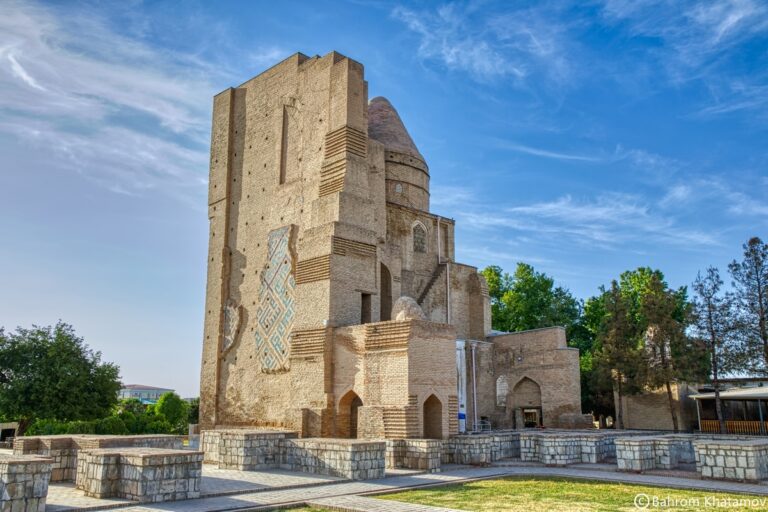
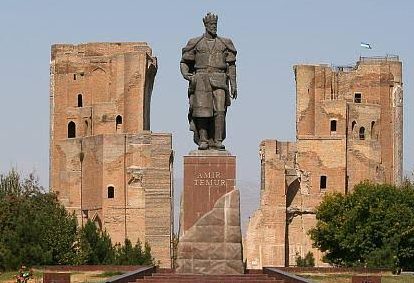
Ak-Saray is now an archaeological ruin, with only two separated monumental portal pylons surviving from the former complex. The palace once contained several courtyards surrounded by residential rooms and spaces for public functions. Its principal inner courtyard measured approximately 120 to 125 metres across and 240 to 250 metres in length, giving the complex an extensive and carefully organized plan.
The façades were covered with coloured tiles, while the courtyards were paved with white slabs. Interior spaces carried gold and blue glazed ornament. A pool was built on the palace roof, and water descended from it in a cascade. A lead gutter conveyed water to the pool from the Takhtakaracha mountain pass, linking the palace’s elaborate design with a managed water supply.
Monumental Portal
The entrance portal originally rose about 70 to 71 metres. Its collapsed vault was approximately 22.5 metres wide and was described as the largest in Central Asia. The surviving towers are cylindrical, rest on octagonal bases, and now reach about 44 metres. They were built by Khwarazmian and Tabrizi craftsmen, whose work combined monumental masonry with extensive ceramic decoration.
The portal was faced with ceramic tiles, much of whose decoration survives only in part. Some designs reproduce the names of Allah and Muhammad in square Kufic script, an angular form of Arabic writing used in monumental inscriptions and architectural ornament. An inscription on the portal declared, “If you doubt our power, look at our buildings.” Above the main doorway, a lion against a sun was depicted, with similar images at the sides. The design was identified as the emblem of the ruler of Samarkand.
Clavijo described a long entrance passage and very high gates, with tiled brick arches on both sides. Small doorless recesses with tiled floors lay beneath the arches, apparently providing seats when the palace lord was present. Beyond the entrance stood further gates and a large courtyard paved in white and bordered by richly decorated arcades. A pool occupied its centre, while the courtyard led to the palace’s largest room through a very large doorway decorated with gold, blue glaze, and tiles.