Dorpskerk Katwijk: A Historic Church in Katwijk aan den Rijn


Site at a Glance
- Rating
- 4.7
- Popularity
- Very Low
- Country
- Netherlands
- Primary era
- Medieval
- External website
- Open
- Eras represented
- Medieval, Modern
- Civilizations
- Dutch, Habsburg, Holy Roman Empire
- Site type
- Religious
- Remains
- Church
On this page8 sections
History
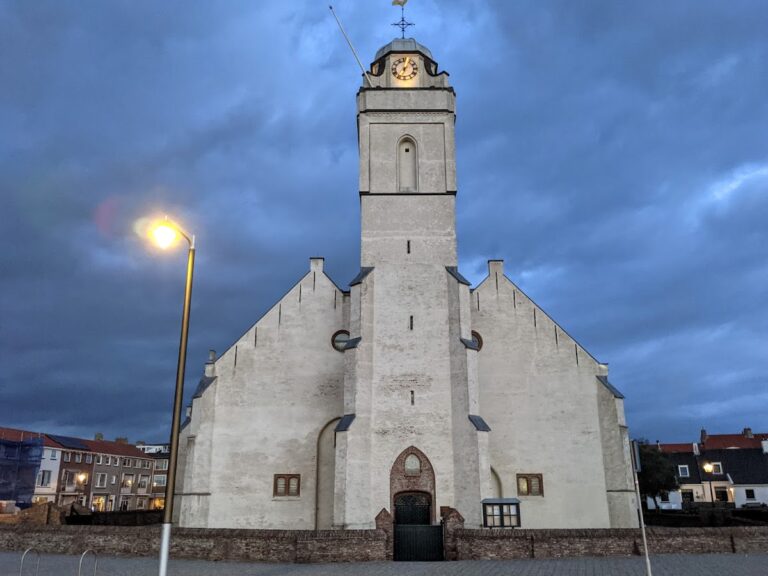
Dorpskerk Katwijk is a historic church in the Netherlands, in Katwijk aan den Rijn, whose origins reach back to the thirteenth century. It is among the oldest churches in the Katwijk area and developed as a pseudo-basilica, a church with a higher central nave and lower side aisles. The church stands on an old beach ridge, probably because its stable ground lay outside the centre of the former village.
Medieval foundation and expansion
A chapel associated with a leprosarium, an institution that cared for people with leprosy and often included a religious facility, was built here in the thirteenth century. It was the first church in Katwijk. The building was originally Catholic and dedicated to John the Baptist, the New Testament preacher and baptizer who baptized Jesus. The tower, main choir, and west façade of the nave belong to the late thirteenth century.
The church grew through several later medieval building campaigns. Its three-aisled nave was built mainly in the mid-fifteenth century. Around 1500, a north side choir and sacristy were added, followed in the first half of the sixteenth century by the baptistery. The Reformation, the sixteenth-century movement that led many western European churches from Roman Catholic affiliation to Protestant forms of worship and organisation, changed the church’s religious setting. It now belongs to an Evangelical Reformed congregation within the Protestant Church in the Netherlands.
Later alterations and protection
The church was restored in 1891 and again in 1919. In 1925 and 1926, the building was plastered and received a new entrance portal on its south side. A complete restoration followed from 1974 to 1977. The church is a Rijksmonument, a nationally protected monument recognised for cultural or historical value in the Netherlands, designated on 18 November 1971 under monument number 23517. The tower belongs to the municipality of Katwijk. The mausoleum and its chapel were formerly state property and have been managed by the National Monuments Organisation since 1 January 2016.
The original pulpit was lost in 1948. After the restoration of 1977, a pulpit from a closed church in Oosterleek was installed at Dorpskerk with assistance from the national monuments service. The church’s continuing religious and musical use also includes annual performances of Johann Sebastian Bach’s St Matthew Passion by the Christian Oratorio Choir Hallelujah, normally on the Thursday and Friday evenings before Good Friday.
The church organ
Katwijk’s first church organ was commissioned from the Leiden organ builder Pieter Assendelft on 28 November 1762 for 1,800 guilders. It was inaugurated on 28 July 1765 and donated to the Reformed congregation by Frederick Hendrick, Baron van Wassenaer, Lord of both Catwijks and ’t Sand. The Lohman brothers repaired it in 1842, and J. van Gelder of Leiden enlarged it in 1888.
Alterations by Van Leeuwen/Pels and Van Leeuwen in the 1950s and 1960s moved the organ to the triumphal arch between the nave and main choir. After the 1974 to 1977 restoration, it was returned largely to its 1765 arrangement on the advice of the national monuments service, although its upper section contains stops from several later periods. Ide Boogaard of Rijssen carried out an extensive restoration in autumn 2007. Almost all the pipes were removed, cleaned, repaired where necessary, and replaced, while the instrument received an independent pedal and a tremulant, a mechanism that creates a controlled wavering in the sound by varying the wind supply. The enlarged organ was formally recommissioned on 14 December 2007.
Remains
Medieval building fabric
Dorpskerk is arranged as a three-aisled pseudo-basilica with a tower, a straight-ended main choir, a north side choir, a sacristy, a baptistery, and a later consistory attached to the church. The oldest surviving fabric is concentrated in the tower, main choir, and west façade of the nave. The tower rises approximately 39 metres and is integrated into the building rather than standing separately. It contains one large bell and one small bell. A clock cast by Gerrit Bakker in 1786 hangs in the tower, and the organ has its own clock whose hour hand is connected to the tower mechanism.
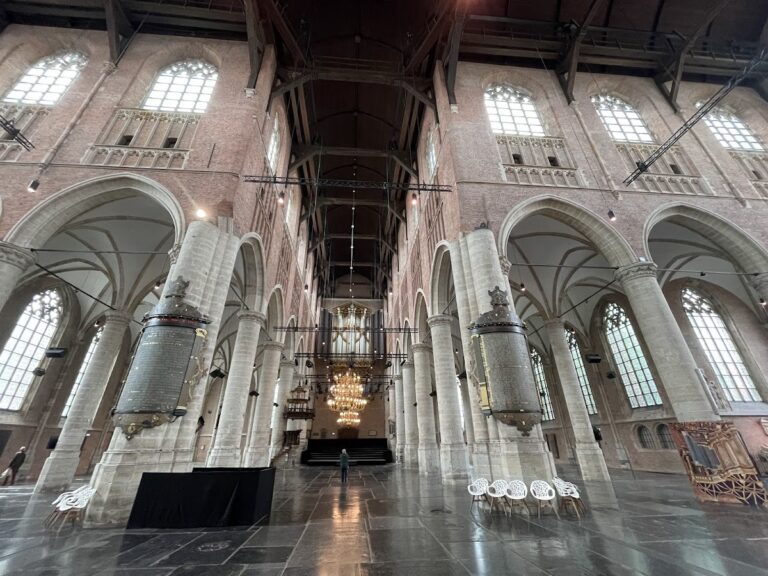
The nave is covered by a wooden barrel vault. The baptistery has a stone star vault and resembles a west choir externally. A late-Gothic brass candle crown hangs in the chapel, with two rows of six arms and a small statue of the Virgin Mary set within a radiating halo. The baptistery is no longer used for baptisms, which now take place before the pulpit in the centre of the congregation. A cemetery lies behind the church.
Mausoleum and commemorative interior
The north side choir contains a marble mausoleum made in 1663 by Rombout Verhulst, a seventeenth-century Dutch sculptor known for monumental sculpture. The monument commemorates the married couple Willem van Liere, who died in 1654, and Maria van Reygersberg, who died in 1673. About ten years before her death, Maria commissioned the mausoleum for both of them and requested that she be represented in it. The monument stands in a chapel associated with the mausoleum.
Several panels from the early seventeenth century bear the Ten Commandments and other religious texts. The present pulpit dates from 1695 and came from Oosterleek. Its back panel carries the inscription “1695 Oosterleek – Katwijk aan den Rijn 1977.” A stained-glass window shows John the Baptist preaching, recalling the church’s former dedication. Above him, the Holy Spirit appears as a dove. The right side depicts the Bible from the communion table, while the left shows masonry and a trowel in reference to the restoration carried out from 1974 to 1977.
Assendelft organ
The church contains Pieter Assendelft’s Rococo organ from 1765. Rococo was an eighteenth-century style marked by light ornament, curved forms, and delicate decorative detail. Later alterations are retained in the upper section. The 2007 restoration added two cases behind and separate from the existing organ case to house the new pedal pipework on C and C-sharp wind chests. A wind chest distributes air from the bellows to the pipes. A hole was made in the wall behind the organ so that it could draw air from the church rather than from the colder tower, improving the stability of the pipework and helping it remain in tune. The instrument has a tremulant affecting the complete organ and a free-standing pedal, a separate pedal division played with the feet.