Andreaskerk in Katwijk: A Late-Gothic Church beside the Sea


Site at a Glance
- Rating
- 4.7
- Popularity
- Low
- Country
- Netherlands
- Primary era
- Medieval
- External website
- Open
- Eras represented
- Medieval, Early Modern, Modern
- Civilizations
- Dutch, Holy Roman Empire
- Site type
- Religious
- Remains
- Church
On this page13 sections
History
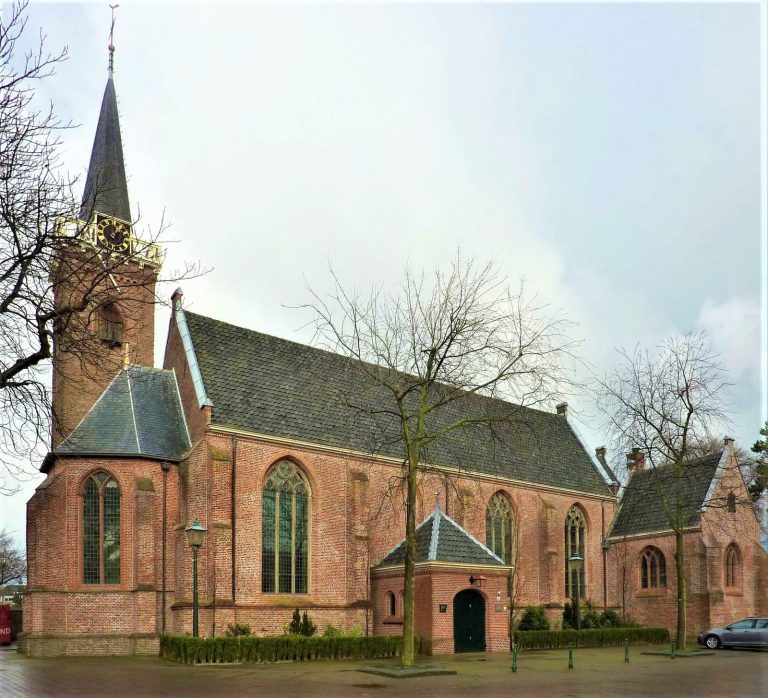
Andreaskerk is a late-Gothic cross church in Katwijk aan Zee, Netherlands, built around 1460–1461 when the coastal settlement became an independent parish. Until the Reformation, it was dedicated to Andrew, one of Jesus’ apostles and traditionally the patron saint of fishermen. The church has also long been known locally as the Oude Kerk, or Witte Kerk.
Parish foundation and wartime damage
The church was plundered by the Watergeuzen on 5 April and 24 May 1571. These Dutch rebel forces were active during the revolt against Spanish Habsburg rule. One of the raiders, Jacob van Billeken, was captured, interrogated, and hanged in the dunes of Katwijk on 23 or 24 June that year.
During the Eighty Years’ War, the broader Dutch revolt and war of independence against Spain, the church suffered major damage. Its roof and the upper parts of its walls were destroyed. The southern aisle was probably rebuilt between 1580 and 1590, but the building was not fully restored until the expansion of 1709. That work added a northern aisle, and the church bell dates from 1594.
Changes in the nineteenth and twentieth centuries
Burials inside the church ended after a new cemetery was established east of the village in 1791. On 29 November 1836, a severe storm badly damaged the pointed roof of the tower. It was demolished, and an octagonal cupola was installed in 1837.
After the Nieuwe Kerk was built on Voorstraat in 1887, the Oude Kerk was sold in 1890 for 6,000 guilders. N.V. Rederij Katwijk then used it until 1921 as a storage and working building for its fleet of bomschuiten, traditional fishing vessels designed to rest on the beach. The church held ship supplies and salt and provided room for repairing nets. This arrangement ended when the slower bomschuiten were replaced by faster loggers, which generally required harbor facilities.
The building was bought back in 1921 for 45,000 guilders. Work was completed on 27 February 1924, and the church returned to religious use. During the Second World War, German occupation authorities ordered the demolition of the church and the houses along the boulevard. A contractor demolished only the tower down to roof level, saving the main building. The interior, including the organ, had already been moved to safety. The tower was restored in the early 1950s, although its rebuilt form differed from the earlier one.
Religious use and modern conservation
Andreaskerk belongs to the Protestant Church in the Netherlands and is used by the Confessional Movement and the Reformed Association within the local Reformed congregation. Services use the 1773 Psalm versification and twelve hymns. The Confessional Movement also uses the 1938 hymnal, while the Reformed Association follows a pietistic Reformed tradition and sings non-rhythmically. The Confessional Movement sings rhythmically.
Extensive renovation took place from 2009 to 2014 under restoration architect Michiel Enderman, in consultation with Dutch heritage authorities, TNO in Delft, and the municipality of Katwijk. The work addressed severe salt damage caused by the marine environment and by impermeable cement and rubber-based exterior paint applied in the 1950s. The church and tower are Rijksmonumenten, buildings or sites officially protected in the Netherlands as monuments of national importance. The church is listed as monument number 23535.
Remains
Layout and construction
Andreaskerk stands directly beside the Boulevard on the seafront at Katwijk aan Zee. It originally occupied the village center, but the All Saints’ Flood of 1570 washed away the houses west of the church and left it beside the coast. The building is described as the only church in the Netherlands standing directly beside the sea.
The church follows a late-Gothic cross plan, with a central nave flanked by two narrower side aisles. Its substantial transept is as long as the nave and choir, while the choir ends in three sides. The transept and three-sided choir were rebuilt in brick during the restoration of 1923–1925.
Tower and interior
Bell tower
The bell tower is integrated into the church rather than standing separately. It originally carried a pointed roof, which was replaced by the octagonal cupola in 1837. After the wartime demolition, its upper sections were rebuilt in a different form. The tower contains a carillon, a set of tuned bells played from a keyboard.
Interior and organ
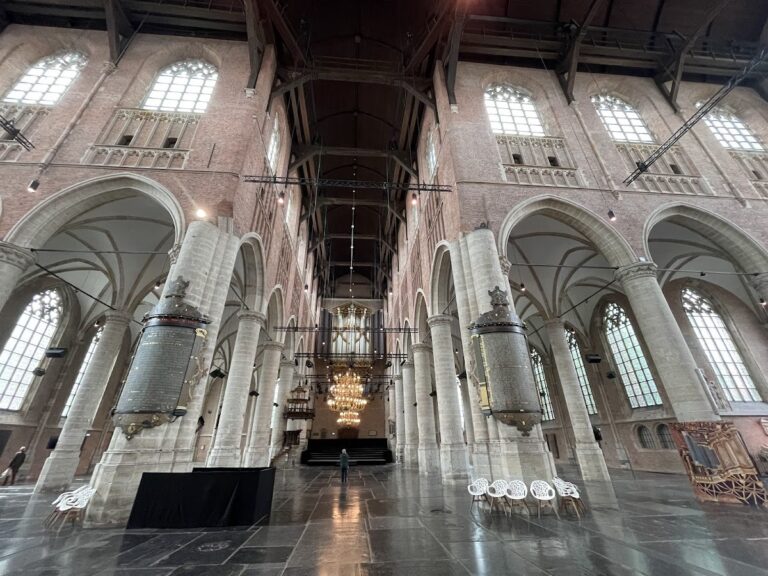
The interior contains a pulpit and baptismal font and provides approximately 1,400 seats. The present organ was built in 1995 by J. L. van den Heuvel of Dordrecht. It has 25 stops, two manuals, and a pedal. Its mechanical playing action connects the keys to the valves, while its electrical stop action operates the registers through slider chests, a wind-chest design in which sliders control the stops.
Conservation and commemorative monument
Masonry and plaster
The exterior had formerly been covered with white paint. During the later conservation campaign, the paint was removed so that the saturated brickwork could dry. Salt crystallization beneath the brick surface had caused the outer layer to detach. The walls were left untreated and then covered with a thin sacrificial lime plaster designed to release salt without damaging the masonry underneath.
Interior treatment
The tower had the greatest concentration of salt and was in the worst condition at its base. It was treated with a desalination paste developed by TNO. Salt had also caused the interior plaster to deteriorate and fall away in sheets, so a three-layer salt-buffering system was applied inside the church.
Fisherman’s Widow with Son
In front of the church stands Fisherman’s Widow with Son, a statue by Louis van der Noordaa. It commemorates fishermen from Katwijk aan Zee who died after naval mines caused their deaths during the First World War. The monument bears an inscription honoring fishermen who died during the war years 1914–1919. It also records that Princess Juliana presented the statue to Katwijk in gratitude for her two-year stay in the municipality from 1927 to 1929.