Pfarrkirche Mariä Himmelfahrt: A Gothic Parish Church in Austria


Site at a Glance
- Rating
- 5
- Popularity
- Very Low
- Country
- Austria
- Primary era
- Medieval
- External website
- Open
- Eras represented
- Medieval, Early Modern, Modern
- Civilizations
- Habsburg, Holy Roman Empire
- Site type
- Religious
- Remains
- Church
On this page10 sections
History
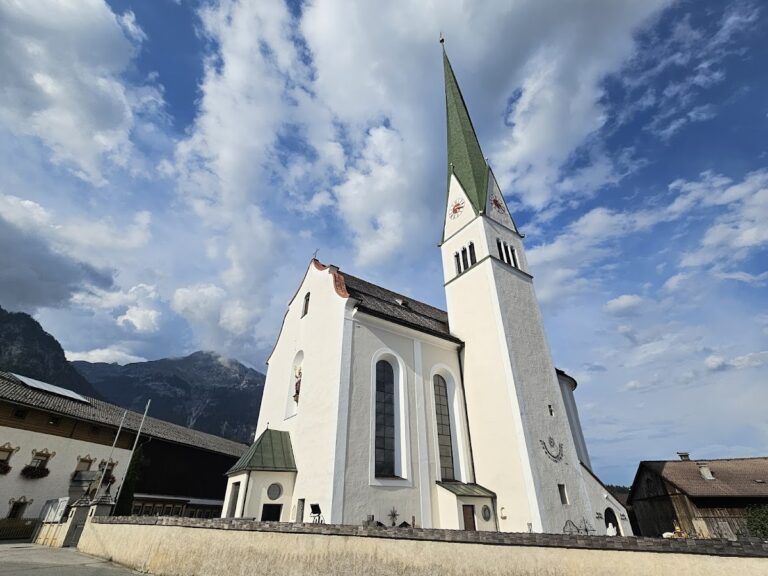
Pfarrkirche Mariä Himmelfahrt is a Roman Catholic parish church in Fügen, Austria, dedicated to the Assumption of Mary, the Christian belief that Mary was taken into heavenly glory. The church is a Gothic building of Romanesque origin and stands in the center of Fügen in the Zillertal, Tyrol. It belongs to the Fügen-Jenbach deanery of the Diocese of Innsbruck and is protected as a historic monument.
Medieval parish church
A church at Fügen was documented in 1183, followed by a reference to a parish church in 1212. The parish was usually served by canons from Brixen, a major ecclesiastical center in the Alps. These canons, members of the cathedral chapter, could hold parish offices or serve parish churches. The choir and nave walls were recorded in 1330, providing evidence for the medieval fabric that underlies the present building.
The church developed during the transition from the Romanesque period to the Gothic period. The nave was altered between 1494 and 1497, and the north tower was built in 1495. The Gothic phase gave the church its principal medieval character, while retaining elements of an earlier Romanesque structure.
Later alterations and artistic additions
The choir originally had a Gothic vault. During the seventeenth century, it received a new vault with stucco ribs, changing the appearance of the liturgical area around the altar. Further additions and changes accumulated over the following centuries, including the organ acquired from the Haller Damenstift, a women’s religious foundation in Hall in Tyrol.
In 1747, Andreas Mitterreiter of Altötting built a two-manual organ with a short octave in both manuals and in the pedal for the foundation. A short octave was an older keyboard arrangement that omitted or reassigned some low notes. According to a letter written by his father, Wolfgang Amadeus Mozart is said to have played the instrument there. Fügen purchased the organ in 1787 for Pfarrkirche Mariä Himmelfahrt.
The instrument underwent several external restorations. It received a Neo-Gothic case in 1880 and was completely remodelled by Rieger of Schwarzach in Vorarlberg in 1965, although most of the original organwork remained. In 1980, Rieger Orgelbau built the present organ in an entirely new case, reusing the earlier instrument. The console of the so-called Mozart organ is now displayed in the Fügen local-history museum.
Bells and twentieth-century conservation
The church’s bells were confiscated during both world wars. A new peal of five bells was cast by the Oberascher foundry of Salzburg and consecrated on 30 March 1947. The electric ringing system installed in 1951 was renewed in 2022 and 2023. A small death bell from the 1930 peal survived the Second World War after local residents buried it in sawdust. Another small bell, cast in Innsbruck in 1763 by Augustin Vital, came from the pilgrimage church on Marienberg in Fügen and was later transferred to the parish’s Widum, a parish residence or administrative building.
Twentieth-century artistic work continued the church’s changing visual history. Toni Kirchmayr created ceiling frescoes showing the Life of Mary in 1943, and Karl Hauk produced the stained-glass windows in the same year. The church, its cemetery, chapel, crypt church, parish buildings, and cemetery structures are included in the Austrian architectural inventory.
Remains
Church building
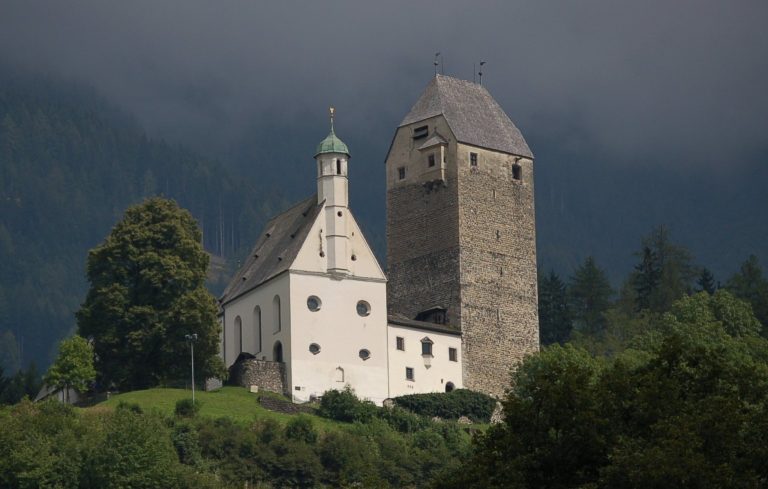
The surviving church is a Gothic structure with Romanesque origins, surrounded by a cemetery. Its north side has a wooden porch attached to the nave. The north tower ends in a pointed spire, and its portal bears a coat of arms dated 1605. The small death bell is positioned in the middle of the red tower spire. Inside, the four-bay nave is covered by a barrel vault with lunettes, a tunnel-like vault interrupted by smaller arched openings. The original nave had a flat ceiling. The two-bay Gothic choir now carries the seventeenth-century vault with stucco ribs.
Painted decoration
Architectural frescoes survive on the north wall of the nave and on the chancel arch, the opening separating the nave from the choir. Paintings in the western part of the nave date from around 1330 to 1350 and show episodes from the legends of Saint Sebastian and Saint Nicholas. Two female saints in the choir date from around 1370. A painting of the Raising of Lazarus on the south wall of the nave was made in 1597. Behind the organ is an eighteenth-century heraldic fresco depicting Kaspar Künigl, bishop of Brixen. The ceiling frescoes showing the Life of Mary and the stained-glass windows date from 1943.
Associated buildings
The church complex includes the Michaels- or Hacklturn Chapel, attached to the north side of the church. Beneath the choir is a crypt church dedicated to Saints Philip and James. The associated parish buildings include the Widum, a separate Widum outbuilding behind the rectory, and the cemetery surrounding the church. These structures form part of the architectural group recorded in the Austrian inventory.
Organ
The organ built in 1980 has 20 stops, meaning sets of pipes with distinct tonal characters. Its pipes are arranged on mechanical slider chests, windchests in which sliding strips control the supply of air to the ranks, and are distributed between two manuals and the pedal. The second manual can be enclosed behind shutters so that its volume can be varied with a swell pedal. The couplers are II/I, I/P, and II/P. The earlier remodelled instrument had 24 stops on two manuals and pedal and included a breast positive, a small organ division placed near the player.
Bells
The five bells consecrated in 1947 are divided between two levels of the tower. The two larger bells hang in the lower bell chamber, while the three smaller bells occupy the upper chamber. The lower pair sounds somewhat louder than the upper three. Their metal mixture included 4,505 kilograms of cannon metal, 240 kilograms of 80-percent tin, 402 kilograms of 87-percent tin, 10 kilograms of fat, 5 kilograms of hemp, and 7 kilograms of beeswax.
The small bell kept in the Widum was cast in Innsbruck in 1763 by Augustin Vital and is identified as one of the few surviving works by that bell founder. Together with the death bell in the tower, it preserves material evidence of the parish’s earlier bell history.