St. Gabriel (Haseldorf): A Late Romanesque Brick Church in Germany
Site at a Glance
- Rating
- 4.7
- Popularity
- Very Low
- Country
- Germany
- Primary era
- Medieval
- External website
- Open
- Eras represented
- Medieval, Early Modern, Modern
- Civilizations
- German, Holy Roman Empire
- Site type
- Religious
- Remains
- Church
On this page9 sections
History
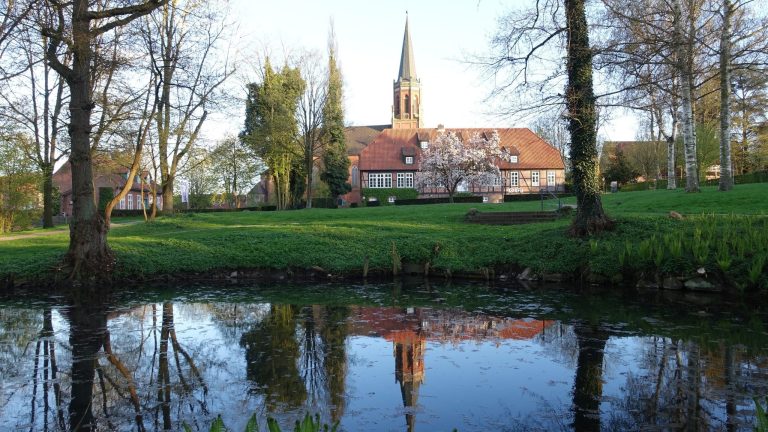
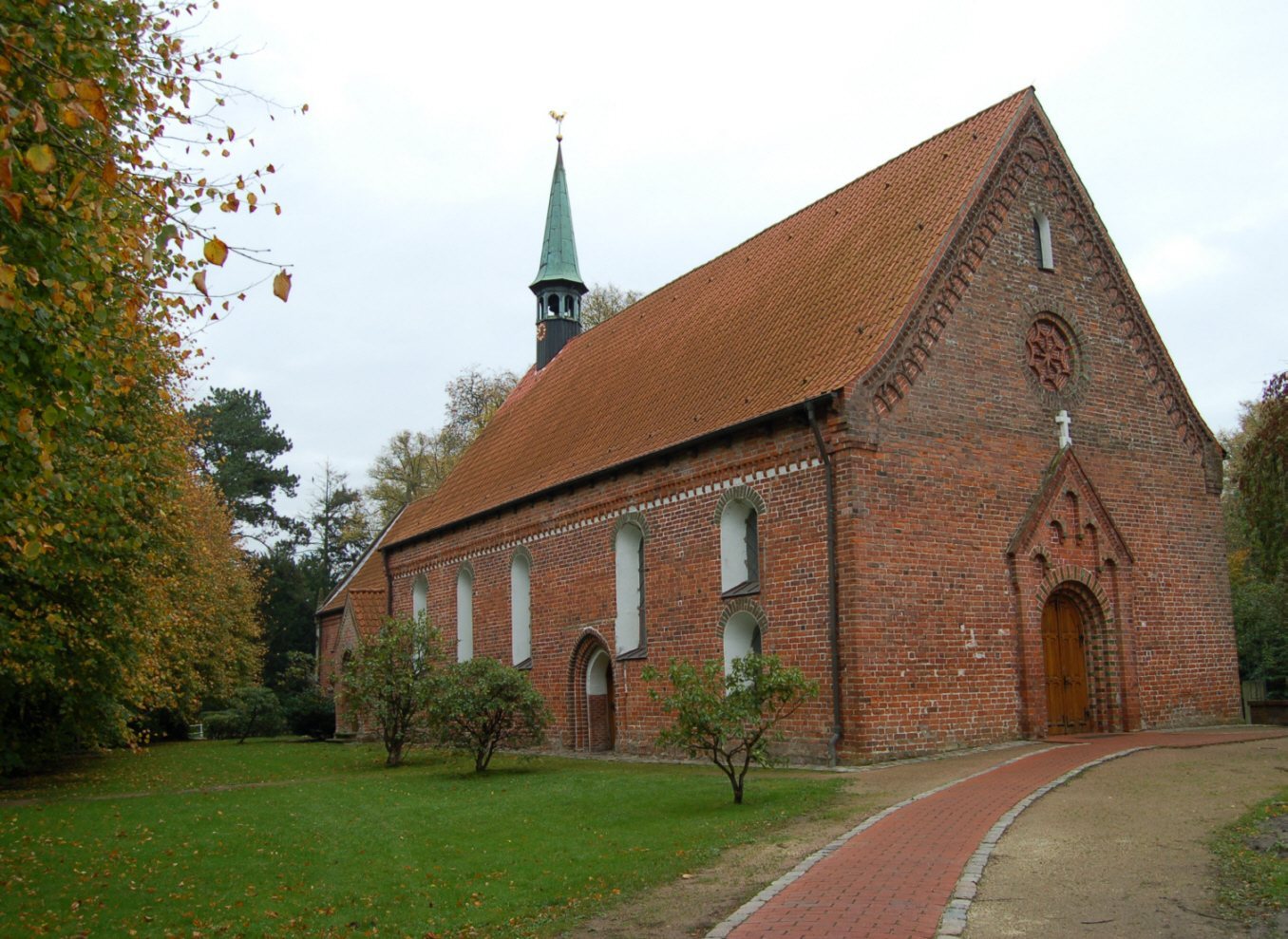
St. Gabriel (Haseldorf) is a medieval church in Haseldorf, Germany, built by the Christian community of the Elbe marshes between 1200 and 1250 in the late Romanesque tradition. Standing at the entrance to the park of Haseldorf manor house, it belongs to the St. Gabriel Haseldorf- Hetlingen parish within the Evangelical Lutheran Church in Northern Germany. The church is dedicated to the archangel Gabriel, a major messenger figure in Christian tradition.
Medieval foundation
The church was established during the Romanesque period, a medieval architectural tradition known for heavy masonry, rounded arches, and compact forms. Its surviving Romanesque triumphal arch, which separates the altar area from the nave, preserves evidence of this earliest building phase. Later work introduced Gothic elements, reflecting the transition toward pointed arches and more vertically oriented decoration.
The Ahlefeldt memorial chapel
In 1599, a crypt chapel was added to the eastern side of the choir for the murdered estate owner Detlef von Ahlefeldt. His death brought a tragic family feud to a climax. Two large stone plaques at the rear of the church also recount the events. The chapel became the setting for the Ahlefeldt family epitaph, which commemorates several members of the family and related noble houses.
War, patronage, and later alterations
The earlier pulpit was destroyed during the Thirty Years’ War, the major European conflict fought mainly between 1618 and 1648. In 1643, the congregation paid for a replacement pulpit, which remains one of the church’s principal early modern furnishings.
In 1731, the estate patron Heinrich Andreas von Schilden commissioned the patronage gallery. Such a gallery was a private or reserved seating area associated with the person or estate holding church patronage rights. The gallery remains reserved for the respective owners of the Haseldorf estate.
The church received its roof turret and clock in 1883-84. During the same work, the recessed choir and the Ahlefeldt crypt chapel were enclosed in new masonry casings. The exterior walls and the Ahlefeldt epitaph were restored according to monument-preservation requirements in 2007-08. A complete interior renovation followed in spring 2009, including the installation of underfloor heating. St. Gabriel is protected as a cultural heritage monument in Schleswig-Holstein.
Remains
Medieval brick fabric
The nave walls remain largely in their original condition. Red monastery bricks are laid in a Gothic bond, and several decorative friezes run through the upper wall zones. On the south wall, a cross-arch frieze is accompanied by green-glazed bricks above the window arches. The former south portal, once the main entrance, has been bricked up. The north wall follows a similar decorative scheme, but its pointed-arch portal still leads toward the patronage gallery. Its corbel frieze uses vertically laid brick headers with rounded lower ends, while a horizontal brick band above it is formed on a course of stretchers.
The roof turret carries the church clock and rises above the later masonry casings around the recessed choir and attached crypt chapel. Beneath the Romanesque triumphal arch hangs the church’s oldest object, an Early Gothic triumphal cross dating to approximately 1300-1310. It is about one metre high, and the ends of its arms take the form of quatrefoils.
Altar and baptismal font
The simple altar was made in 1958. Its elaborate Baroque superstructure, dating from around 1700, consists of an acanthus frame, meaning a frame decorated with stylized foliage derived from the acanthus plant. Two angels flank a somewhat older painting of the Resurrection. The painting was originally made on a door leading from the altar area to the crypt chapel, while the ornate frame was acquired from a museum in 1958.
A late Gothic bronze baptismal font dates from 1445. Its supporting ring is decorated with a round-arch frieze and four coats of arms. Four figures support the kettle-shaped basin, which carries a continuous inscription and small reliefs. These depict crowned representations of Mary, Saint George with the dragon, and a Crucifixion group accompanied by the moon and sun.
Pulpit, galleries, and organ
The pulpit commissioned in 1643 is made of heavily varnished oak in a restrained Baroque style. Reliefs between the columns of its basket show the Annunciation, the Adoration of the Shepherds, Gethsemane, the Crucifixion, the Resurrection, and the Ascension. Its sounding board has cartilage-style ornament, figures representing the four virtues, and a crowning angel.
The patronage gallery stands against the north wall of the nave on Ionic wooden columns. Its side parapet panels display hanging cloths, while the central panel bears a painted coat of arms. Above it, a curved gable with a medallion forms the central upper termination.
The organ occupies the western gallery. Its Baroque case, dating from around 1700, has a tall lower structure, a raised central section, and sharply angled side sections. Wilhelm von Ahlefeld, a member of the Ahlefeld noble family, initiated its construction. The instrument was completely renewed in 1986 after numerous renovations and now has 16 stops divided between two manuals and a pedal. The case was restored to its original form. Nine Muses appear on it, five as free-standing figures and four as reliefs among carved acanthus foliage.
Lighting and memorial sculpture
A seventeenth-century yellow-brass chandelier hangs in the church. Yellow brass is an alloy containing approximately 56-80 percent copper. The chandelier has two tiers and a female figure at its top. Two large altar candelabra date from the late seventeenth century.
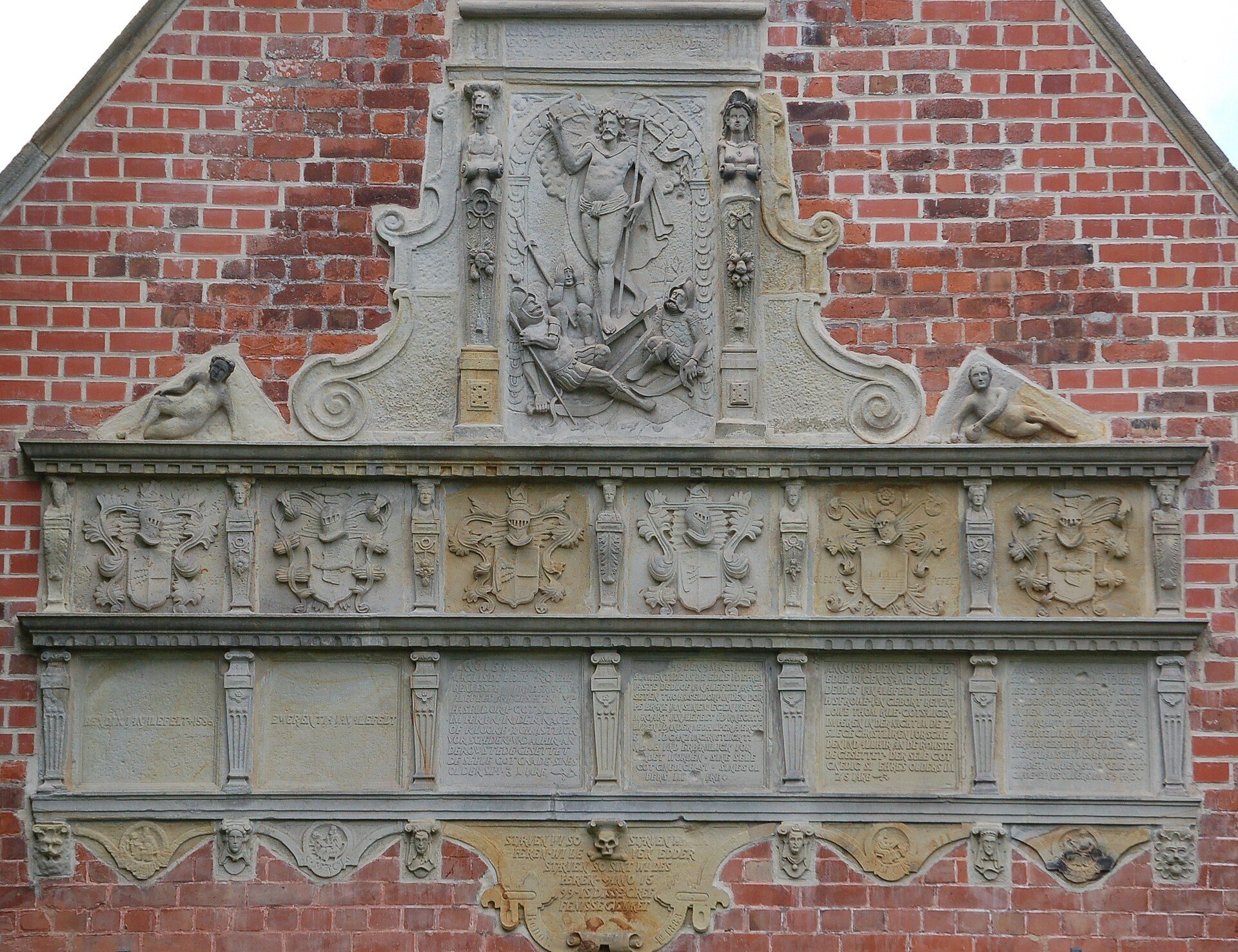
The Ahlefeld family epitaph of 1599 is mounted on the eastern wall of the crypt chapel. Hans Steinhauer made the sandstone monument, whose central relief depicts the Resurrection of Christ. Pilasters frame the scene, and a gable with an entablature frieze crowns it. God the Father appears in the triangular pediment, above which stands a partly draped female figure. Reclining nude figures occupy the outer sides.
The epitaph has two tiers of pedestal panels. Coats of arms fill the upper panels, while the lower panels contain inscriptions commemorating Bendix von Ahlefeldt, Emerentia von Ahlefeldt of the Brockdorff family, Friedrich von Ahlefeldt, Detlef von Ahlefeldt, Clelia von Ahlefeldt of the Reventlow family, and Hans Brocktorp, son of Friedrich Brocktorp. The texts record deaths in 1586, 1598, and 1599, including the murders of Detlef von Ahlefeldt and Hans Brocktorp in the village of Brake by Marquart von Ahlefeldt, his servants, peasants, and other accomplices. Medallions beneath the hanging elements represent the four Evangelists, Matthew, Mark, Luke, and John. A skull at the lower center bears an inscription from 1599 concerning death and life in the Lord and identifying the making of the tomb monument.