Brockdorff-Palais: An Aristocratic Residence and Museum in Glückstadt


Site at a Glance
- Rating
- 4.6
- Popularity
- Very Low
- Country
- Germany
- Primary era
- Early Modern
- External website
- Open
- Eras represented
- Early Modern
- Civilizations
- Holy Roman Empire
- Site type
- Domestic
- Remains
- Elite Residence
On this page7 sections
History
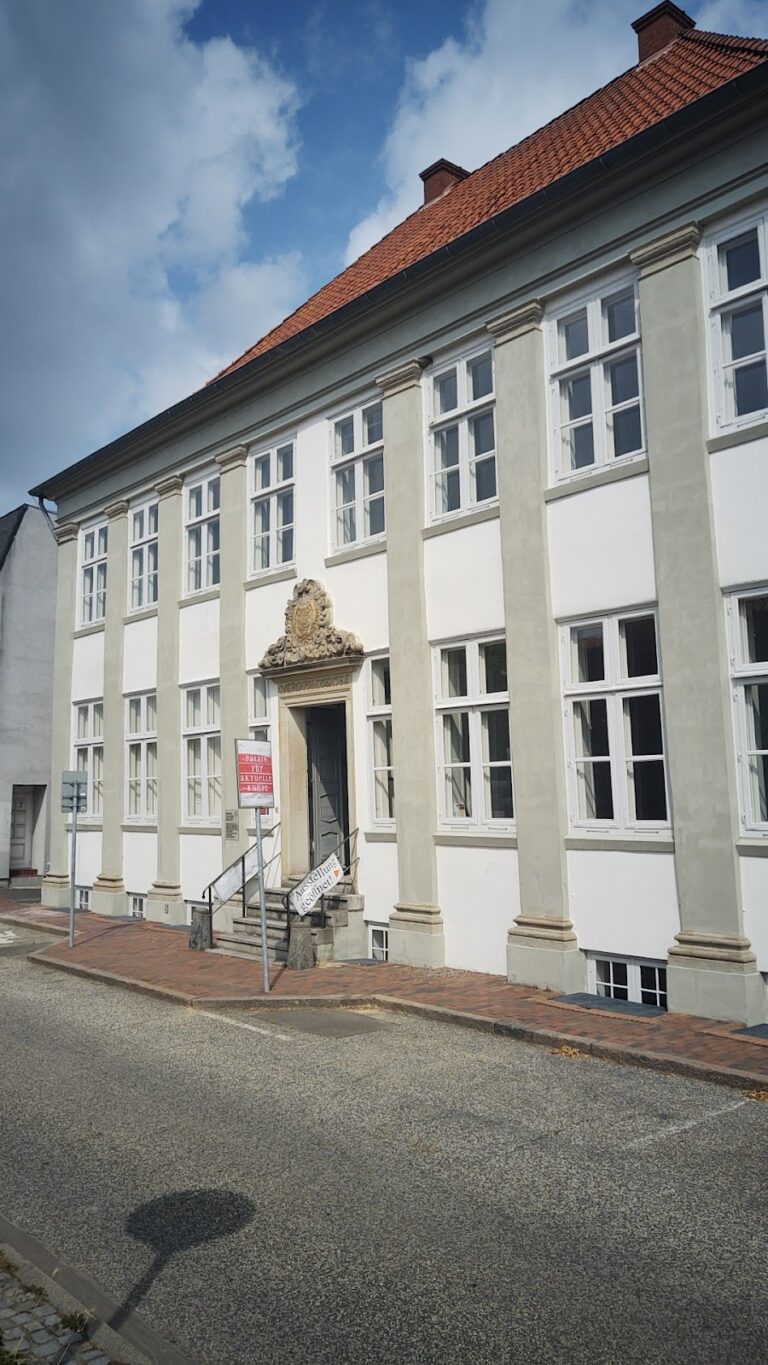
Brockdorff-Palais is a seventeenth-century aristocratic residence in Glückstadt, Germany, built in 1631–1632 during the Thirty Years’ War and later transformed from a late-Renaissance town house into a Baroque palace. Together with Wasmer-Palais, it is regarded as one of Glückstadt’s most important secular buildings.
Construction for Christian Graf von Pentz
The palace was built for Christian Graf von Pentz, commander of Glückstadt’s fortress. During the Thirty Years’ War, a European conflict fought from 1618 to 1648 through religious, dynastic, and political struggles, Pentz defended the town against Wallenstein’s troops in 1627–1628. Wallenstein was a leading imperial commander in the conflict.
Pentz’s successful defense won the favor of Christian IV, king of Denmark and Norway from 1588 to 1648. The king arranged Pentz’s marriage to Sophie Elisabeth, a daughter from his morganatic marriage to Kirsten Munk. In a morganatic marriage, the spouse and children did not receive the higher partner’s full dynastic rank or inheritance rights. The palace provided Pentz with a prestigious town house in the prosperous Glückstadt of the period.
Pentz was later dismissed from all his offices because of alcoholism and died in imprisonment at the age of 51. The building subsequently changed owners several times as its form and status developed.
Baroque transformation and later uses
In 1727, the palace passed to Chancellery Councillor Rheder. That year it was enlarged westward, and a rear wing was added. The courtyard-side chapel and stair tower were demolished, while a representative staircase with a wooden stairway was installed behind the main portal. The portal was also given Baroque ornament, reflecting the building’s transformation from its late-Renaissance origins.
The old-established Holstein noble family Brockdorff owned the palace from 1802 to 1877, across three generations. Cay Lorenz von Brockdorff, head of the Schleswig-Holstein chancellery in Glücksburg and later president of the Higher Court of Appeal in Schleswig, gave the house its present name.
From 1900 to 1935, the building housed the Glückstadt District Court. Deterioration of its fabric brought a threat of demolition in 1962, followed by an initial renovation. A further restoration took place in 1992.
The Detlefsen Museum
The Detlefsen Museum has occupied Brockdorff-Palais since 1969. Its collections began in 1893 through the initiative of the Glückstadt teacher Detlef Detlefsen, whose name the museum bears.
The museum presents the artistic and cultural history of the Kremper and Kollmar Elbe marshes. Its interpretation of the Elbe region around Glückstadt addresses the town’s roles as the residence city of Christian IV, a city of religious tolerance, a fortress city, and the capital of Holstein. Lectures, concerts, theatrical performances, readings, permanent displays, and temporary exhibitions form part of its cultural program.
Remains
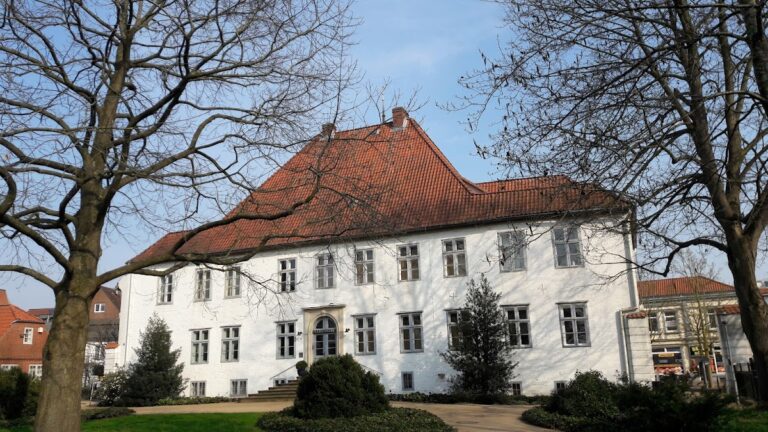
Brockdorff-Palais survives as a long, thirteen-bay building with its eaves side facing the Fleth, a canal characteristic of the marshland towns of northern Germany. The present form combines the original late-Renaissance house with the westward extension and rear wing added in 1727.
Exterior and construction
Willem van Steenwinckel and H. Bolten built the palace in 1631–1632. The original structure had nine bays and was entirely unplastered, with walls formed from alternating layers of red and yellow brick. The brickwork is now visible on the courtyard side. The later four-bay extension lengthened the building along the Fleth and altered its original scale.
Interior and museum collections
Three rooms along the Fleth side form an enfilade, a sequence of rooms arranged on one axis with aligned doorways. These rooms contain painted wooden ceilings dating from 1695. Behind the main portal, the representative staircase inserted in 1727 replaced the earlier stair tower and forms part of the palace’s Baroque interior arrangement.
The building’s present museum collections include graphics, paintings, textiles, and cultural-historical objects associated with Glückstadt and the surrounding region. They cover handicrafts, shipping, the military, trade and industry, and rural and urban life.
Nearby sites