Burg Horneburg: A Late-Medieval Archiepiscopal Water Castle in Germany


Site at a Glance
- Rating
- 3.9
- Popularity
- Very Low
- Country
- Germany
- Primary era
- Modern
- External website
- Open
- Eras represented
- Medieval, Modern
- Civilizations
- Holy Roman Empire
- Site type
- Domestic
- Remains
- Manor House
On this page11 sections
History
Burg Horneburg is a late-medieval archiepiscopal water castle in Germany, established in 1255 by the Archbishop of Bremen in the present town of Horneburg. Built in the lowland landscape of the Lühe, it controlled access from the Altes Land to the Stade Geest and stood near routes linking Buxtehude and Stade. Its position also placed it within the border zone between the Archbishopric of Bremen, the Bishopric of Verden, and the Duchy of Brunswick-Lüneburg.
Foundation and Episcopal Rule
The archbishop founded Horneburg on land belonging to Harsefeld Monastery. Earlier references to a place called Horneburg have been associated with confusion involving Horneburg in Westphalia or Harburg. The new castle responded to the reconstruction of Harburg in 1253 by the Duchy of Brunswick-Lüneburg. That work breached an agreement made in 1236 between Duke Otto I and the Archbishopric of Bremen, increasing the need for a position from which the archbishop could protect his interests.
Its garrison consisted of episcopal ministeriales, medieval service nobles who carried out military and administrative duties for a lord. These men held property on the nearby Geest and in the Altes Land, while their castle fiefs connected them to Harsefeld Monastery. The families associated with the castle included the Schulte, Bliedersdorf, von Borch, von der Osten, Marschalck von Bachtenbrock, Zesterfleth, and Düring families. In later generations, inheritances joined several of these holdings, including the Bliedersdorf property with the von Borch family holdings and the von Borch holdings with the Düring family.
Castle Community and Conflict
After Buxtehude was founded in 1285, Horneburg became less important as a defensive bulwark against the Principality of Lüneburg, but its castle men gained greater autonomy. They converted their formerly feudal castle seats into collective property and formed a close community. Mutual-assistance and friendship oaths, renewed at regular intervals, helped maintain this association. Its common seal showed an upright hunting horn curving to the left on a shield decorated with unequal engraved lozenges.
Conflict with the archbishop followed. In 1311, Archbishop Jens Grand of Bremen besieged Horneburg with the support of Otto of Lüneburg and the Bishop of Verden. Heinrich von Borch, known as Isern Hinnerk, had taken refuge at the castle after being driven from his castle at Dannsee during a dispute with the archbishop. Horneburg was captured, Heinrich was imprisoned, and the castle men were expelled as punishment for supporting him. They returned after a short time.
The community then pursued increasingly independent policies and became involved in feuds and raids. In 1361, Archbishop Albert II promised the city of Stade assistance against raiding Horneburg men. The Lüneburg dukes Albrecht and Wenzel secured a reconciliation treaty in 1380, but it did not end the conflict. During the Mandelsloh Feud and the Lüneburg War of Succession in 1385, the Horneburg community raided the Bishopric of Verden.
The Horneburg Feud
In 1425, Archbishop Nikolaus attacked the Duke of Brunswick-Lüneburg, whose headquarters were at Verden, in an unsuccessful attempt to seize the Bishopric of Verden by surprise. The dukes responded by besieging Horneburg for an extended period in July 1426. The attack was abandoned unsuccessfully on Saint Anne’s Day after relief forces arrived from Stade, Buxtehude, and the Altes Land. Prayers of thanksgiving for the relief continued until the First World War.
The failed siege began the Horneburg Feud. Seeking revenge, the castle men invaded the Bishopric of Verden and the Duchy of Brunswick-Lüneburg, leading to repeated raids by both sides. The fighting reached a provisional end in 1432, when negotiations began and lists of damage were exchanged. On 7 April 1443, mediation by Lübeck, Hamburg, Bremen, Stade, and Buxtehude led the Horneburg men to swear an oath renouncing further hostility. This formal oath, known as an Urfehde, ended the immediate feud, although the later renewal of agreements indicates that Horneburg continued to threaten regional trade routes.
In 1446, Bremen, Stade, and Buxtehude pawned one of the castle men’s seats for a substantial sum. The arrangement allowed the three cities to participate in the castle community and guarantee security for one another.
Decline and Destruction
Around 1510, the castle families gradually left their houses in the outer bailey and moved into newly built manor houses in the surrounding area, including Esteburg. Horneburg was no longer garrisoned. Its castle fief and associated lands were later divided into five knightly estates.
The Thirty Years’ War, a European conflict fought from 1618 to 1648 amid dynastic, territorial, and religious struggles, brought renewed destruction. The imperial commander Tilly captured Horneburg on 11 October 1627, and King Gustav Adolf of Sweden recaptured it in 1632. Large parts of Horneburg burned during both operations, although the Schulte castle-men’s house survived the second fire. Swedish forces occupied Horneburg in 1645. New weapons had made the castle obsolete, and it probably no longer had an important defensive function. After the conquest, the Swedish commander Hans Christoph von Königsmarck ordered its demolition.
The later estate landscape retained parts of the former castle setting. A manor complex was established west of the former castle grounds in 1840 and expanded upward in 1886. Much of the resulting estates is now owned by the family of the Barons von Düring, while other portions belong to the municipality of Horneburg or remain in private ownership.
Remains
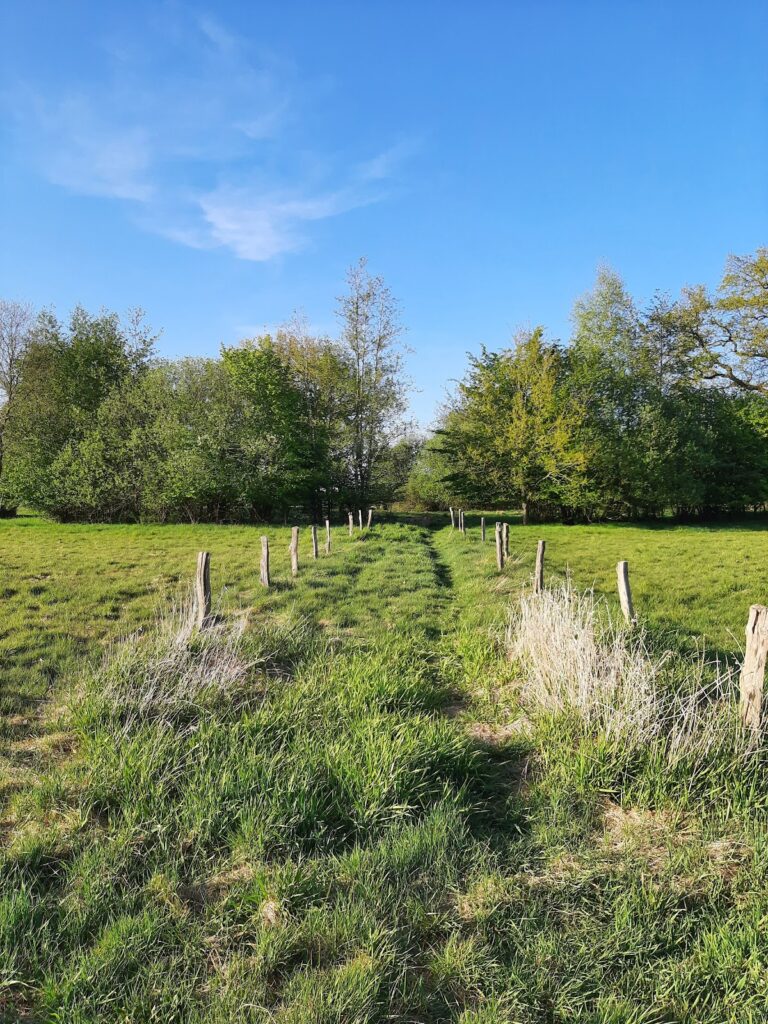
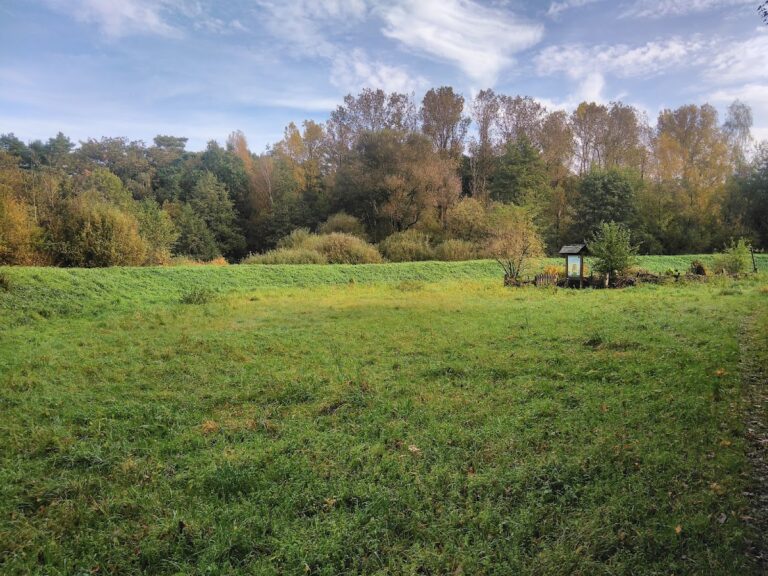
The former castle site is now a park within the lowland Sietland of the Lühe, a marshy landscape shaped by surrounding water. The castle occupied a raised lens of firm clay soil projecting above the marsh, a feature formerly called “de Horne” in Low German and reflected in the name Horneburg. Its surviving landscape includes the former moat, water-management features, estate buildings, and later manor elements.
Fortified Castle
Inner Castle
The roughly circular inner castle measured about 30 by 40 metres. An arm of the Lühe formed a moat approximately 8 metres wide around it. An earthwork and palisades defended the enclosure, which contained a stone tower. A drawbridge connected the inner castle with the outer bailey.
Outer Bailey
The outer bailey, an enclosed area adjoining the main fortified enclosure, contained a separate house for each castle-man family. Stables and storehouses stood among these residences. A second watercourse, the Dovelühe, enclosed and fortified the outer bailey, which could itself be reached only by a drawbridge. Three causeways provided access to the castle, and craftsmen and merchants gradually settled along them. This settlement developed into the present town of Horneburg.
Water and Estate Landscape
The park preserves the moat together with a drainage ditch, a former millpond, and a pumping station. Subsidiary buildings and a horse stable with a watering trough also survive as elements of the later landscape. These features preserve parts of the water-management system and service environment associated with the former castle grounds.
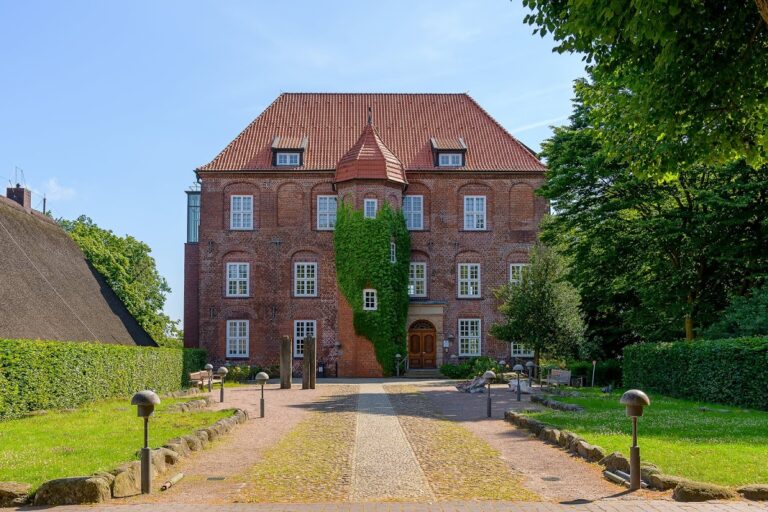
Gut Horneburg I
Gut Horneburg I forms part of the later estate complex west of the castle site. The manor house was built in 1840 and raised in 1886. It belongs to the post-castle development of the grounds, where the divided castle fief and its associated lands were reorganized as knightly estates.
Nearby sites