Grauerort Fortress: A Prussian Artillery Fort on the Elbe


Site at a Glance
- Rating
- 4.3
- Popularity
- Medium
- Country
- Germany
- Primary era
- Modern
- External website
- Open
- Eras represented
- Modern
- Civilizations
- German, Kingdom of Prussia
- Site type
- Military
- Remains
- Fort
On this page8 sections
History
Grauerort Fortress is a Prussian artillery fort in Germany, built near Abbenfleth and Barnkrug during the late 1860s and 1870s in the standard fortification style of the second half of the nineteenth century. Positioned beside the Elbe shipping channel, it was intended to protect the Port of Hamburg from hostile ships.
Construction and the Franco-Prussian War
The high Altmarsch beside the Elbe had previously been used by the Swedes and was considered suitable for a permanent defensive installation. Construction was interrupted as tensions with France increased. To make the port defensible quickly, the fort and a second temporary battery called Grauerort II were provisionally completed. Grauerort was operational during the Franco-Prussian War of 1870 to 1871, a conflict between France and the North German Confederation led by Prussia and its allies, but it never entered combat. Improvements to the ramps and ammunition supply followed in 1875 and 1877.
Changing military functions
Advances in artillery reduced the fort’s military value, and Grauerort was removed from the list of active fortifications in 1888. From 1917, it was converted into a provisional naval mine depot, a military facility for storing and handling explosive devices placed in water against ships, for the Imperial German Navy. A separate ammunition storage area was later created northwest of the fort, beyond its defensive walls. After the Cuxhaven-Groden mine depot exploded in 1922, the Grauerort facility became permanent and continued operating until the end of the Second World War.
Two anti-aircraft guns were installed at the fort during the Second World War. At the war’s end, the British Army requisitioned the intact site, which remained under British control from 1945 to 1958 and was used as emergency accommodation until the end of the 1950s. From 1959 or 1960 until 1985, ammunition was dismantled there. This work rendered explosive ordnance unusable, and the company Kaus & Steinhausen moved its operation to the former Dragahn explosives factory in 1985 for safety reasons.
Restoration and environmental concerns
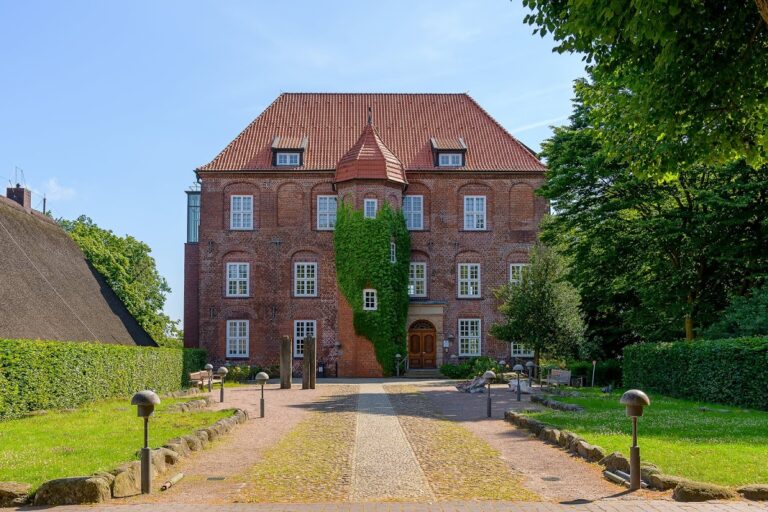
After the ammunition operation ended, the fort deteriorated. Beginning in 1997, the Friends of Grauerort Fortress association restored the protected monument and removed later installations to bring it closer to its nineteenth-century condition. It has been open as a museum since 1998 and is also used as a cultural and event venue. Soil analyses in 1992 and 1995 found substantial concentrations of polychlorinated naphthalenes, TNT, RDX, and cadmium to depths of up to 3 metres, raising concern that hazardous substances could reach the local groundwater.
Remains
Grauerort is a high-wall fort whose six-sided, roughly diamond-shaped plan follows both the terrain and the line of the existing Elbe levee. A roughly 10-metre-high earth rampart forms the main enclosure. The Elbe-facing side contains fortified chambers, while the other ramparts are bordered by a ditch about 20 metres wide. The fort was built mainly from cement and brick, with concrete introduced from 1885 onward. The walls of the fortified chambers were once lined with peat and gypsum plaster to improve thermal insulation.
Defensive enclosure
Each of the two 68-metre-long flanks carried five modern 28-centimetre breech-loading guns. These weapons were loaded from the rear of the barrel and used recoil to assist their firing mechanism and carriage. The armament also included four 12-centimetre guns and six 9-centimetre guns. The guns have been removed. On the Elbe side, a 3-metre-high escarp, or Carnot wall, provided masonry protection along the ditch. Two bunkers at the rear passage could cover this area with guns and rifles.
Entrance and internal features
A bridge leads to the entrance and continues through a covered passage into the fort. The original wooden drawbridge was later replaced by a concrete structure. A defensive grille, a rifle caponier projecting into the ditch to cover it with fire, and guard bunkers protected the passage. The main bunker entrance retains nineteenth-century iron staircases on both sides. Its facade has newly restored windows, and a twentieth-century gun remains in the fortress yard. A narrow-gauge railway once carried naval mines through the installation.
Elbe pier
A 250-metre pier extending into the Elbe was built in 1926 so that ships could be loaded and unloaded directly with naval mines. After the Second World War, the pier became the site of the Klein Helgoland restaurant. It attracted day visitors from Hamburg during the period when passenger ships were prohibited from visiting Heligoland until 1955, following the pier’s earlier military use.