Benediktinerkloster Auhausen: A Former Benedictine Abbey in Germany


Site at a Glance
- Rating
- 4.7
- Popularity
- Very Low
- Country
- Germany
- Primary era
- Medieval
- External website
- Open
- Eras represented
- Medieval, Early Modern
- Civilizations
- Holy Roman Empire
- Site type
- Religious
- Remains
- Church
On this page7 sections
History
Benediktinerkloster Auhausen was a former Benedictine abbey in Auhausen, Germany, founded in the first third of the twelfth century by the local noble family of Auhausen under the Hirsau Reform, a movement that sought stricter observance of Benedictine discipline. Dedicated to Saint Mary and Saints Godehard and George, it stood on the Wörnitz River between Oettingen and Wassertrüdingen, within the Diocese of Eichstätt. The abbey later became directly subordinate to the Holy Roman Empire and played a lasting religious and political role in the region.
Origins and foundation
A foundation legend placed the monastery’s beginnings in the tenth century, presenting it as an expiatory foundation by Count Ernst of Truhendingen and Hartmann von Lobdeburg, who died in 958. The story probably grew from a document of 959 that mentioned a Count Ernst and a Hartmann. Friedrich Jacobi instead considered Hartmann von Lobdeburg the sole founder, pointing to the former Knights’ Chapel and its burials. A further tradition said that Ernst’s sister married Hartmann, joining the two noble families.
The historical foundation took place later, in the first third of the twelfth century. The founding charter has not survived, and the monastery that supplied its first monks is unknown, although Neresheim has been proposed. The founding family descended from a Hartmann recorded in 959. After a Hartmann of Auhausen appeared at Naumburg in 1133, one branch established itself at Lobdeburg in Thuringia, while another held Alerheim Castle in the Nördlinger Ries.
Pope Innocent II first mentioned the monastery in a privilege of 1136, showing that its foundation had already occurred. In 1157, Pope Hadrian IV confirmed its possessions, including the church at Auhausen and estates at Heckpoint, Wachfeld, Zirndorf, probably Pfeifhof, Ratheristhal, possibly Steinbühl, Herblingen with rights to its chapel, and Wiebelsheim. Donations, purchases, and exchanges later enlarged these holdings. Before 1181, Berthold von Thannbrunn gave the abbey a farm at Frickenhausen am Main and eventually his ancestral seat at Thannbrunn in the later Upper Palatinate.
Growth and imperial standing
Around 1160, or according to a later chronology in 1228, Marcward and his brother Adilbert of Cronheim accepted an arbitration by Count Ludwig of Oettingen in the monastery’s favor. In the thirteenth century, Adelheid von Absberg, from the House of Hürnheim, donated estates around Gunzenhausen to the monastery’s poor hospital. The annual Great Donation distributed bread and money to poor people on the fourth Sunday of Lent, drawing many needy people to Auhausen. The practice continued under the later monastery administration after the abbey had been dissolved.
Under Abbot Sifrid, Pope Gregory IX incorporated the parish church of Auhausen into the monastery in 1232. Bishop Heinrich III of Eichstätt approved the arrangement in 1235, while requiring the abbot to remain answerable to him and his successors in spiritual matters. In 1273, the three Lobdeburg lines in Thuringia issued matching charters confirming rights and liberties granted to the abbey by their ancestors.
By this period, Auhausen had become an imperial abbey, a religious institution directly subordinate to the emperor rather than to a territorial prince. Between 1334 and 1337, it received several indulgences, formal remissions of temporal punishment associated with sin in medieval Western Christianity, for its miraculous image of the Annunciation. In 1354, Emperor Charles IV granted privileges that made the abbot and his successors imperial chaplains, ecclesiastical officials attached to the emperor’s chapel.
Pressure, Reformation, and dissolution
Toward the end of the fourteenth century, the abbey encountered financial difficulties for reasons that are not known and was forced to sell estates. During the fifteenth century, it became involved in legal disputes with the counts of Oettingen. The burgraves of Nuremberg and later the margraves of Brandenburg-Ansbach also pursued the monastery’s property as part of their territorial policy.
These pressures, together with the loss of the abbey’s imperial liberties, culminated in the Reformation and the German Peasants’ War, a 1524–1525 uprising involving rural communities across much of the German lands. Marauding peasants attacked and plundered Auhausen in May 1525.
Abbot Georg Truchseß von Wetzhausen, regarded as the last and most important abbot, fled in 1530 to the Dominican monastery in Eichstätt. He became a leader of the Catholic opposition in the Margraviate of Brandenburg-Ansbach after Margrave Georg the Pious adopted the Reformation. Georg had almost completely rebuilt Auhausen and furnished it richly with works of art.
In 1534, the monastery was effectively placed under the margrave’s administration. The remaining monks continued their communal life for three more years, until regulations introduced in 1537 ended monastic life and Catholic worship. The last prior, Johann Fabri, followed Georg into exile at Eichstätt and died there in 1556. After the dissolution, the abbey church became the Protestant parish church of Saint Mary. In 1608, Protestant princes of the Empire met at Auhausen to form the Protestant Union, a political and military alliance of Protestant princes and territories of the Holy Roman Empire.
Remains
Abbey church
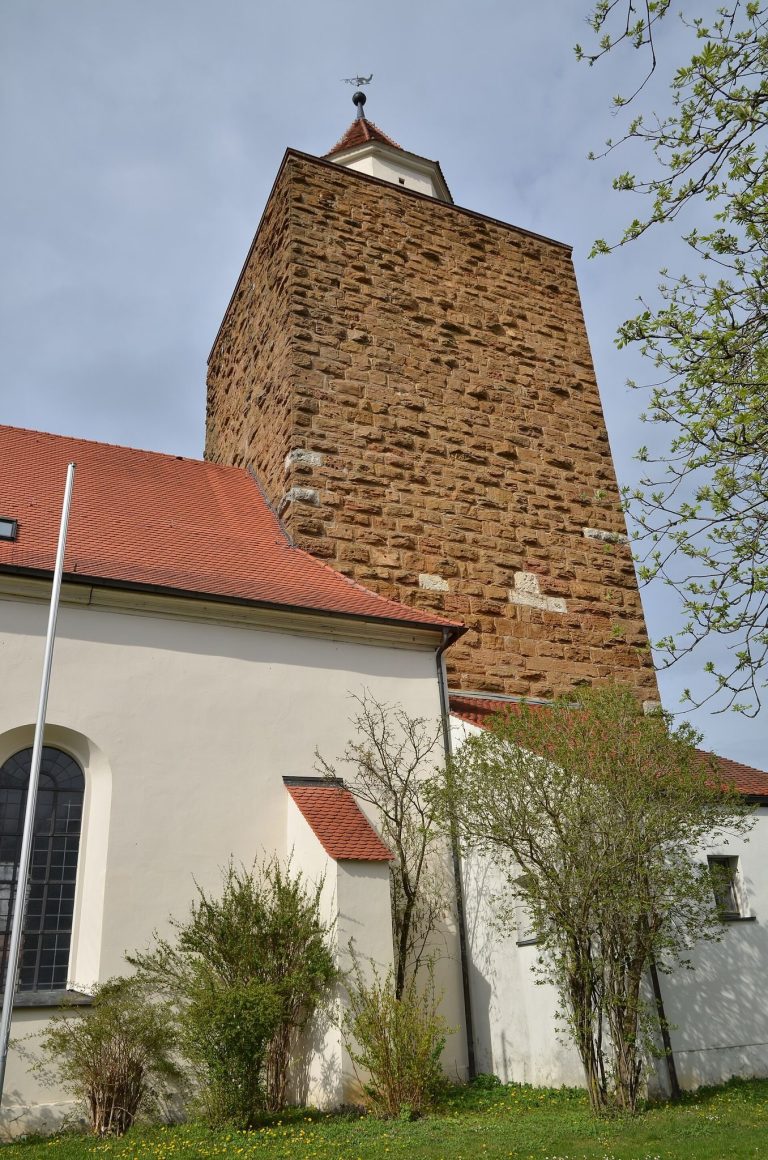
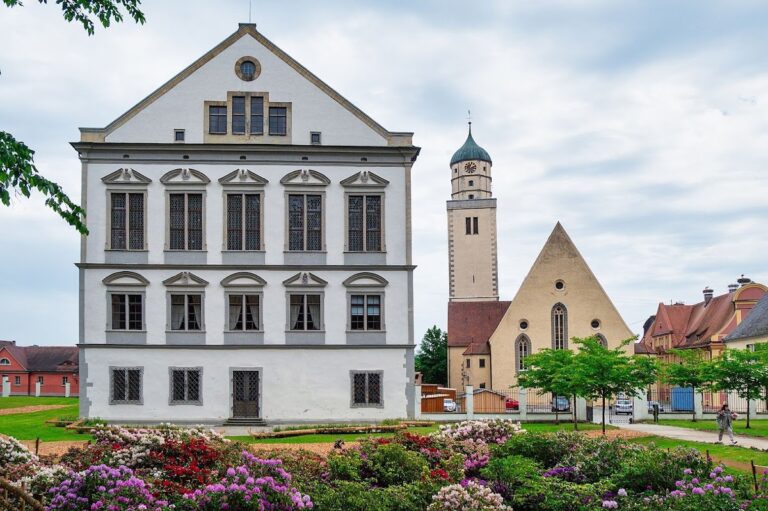
The former abbey church of Saint Mary stands on present-day Klosterstraße and serves as Auhausen’s village landmark. It is represented on the municipal coat of arms. An existing Marian church was probably taken over as the abbey church when the monastery was founded, and the surviving building is Romanesque in style.
The south tower was built in 1334. Inside the church are choir stalls dating from 1420 and a high altar made by Hans Schäufelin in 1513. These elements preserve material evidence of the abbey’s medieval and early sixteenth-century religious life, including the period of Abbot Georg Truchseß von Wetzhausen’s rebuilding and artistic furnishing.
Former monastery complex
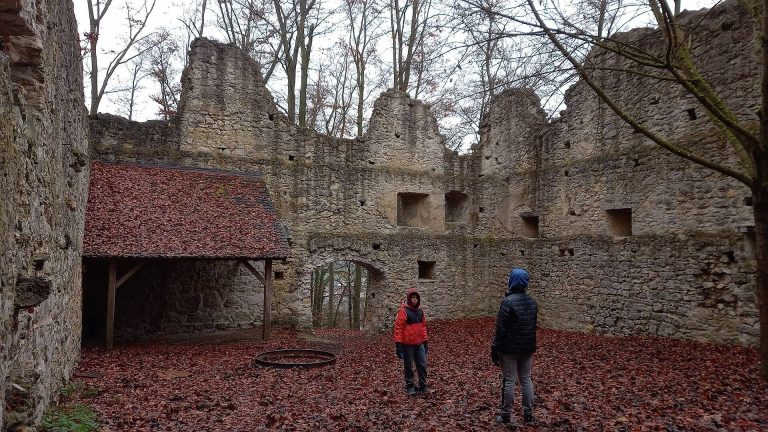
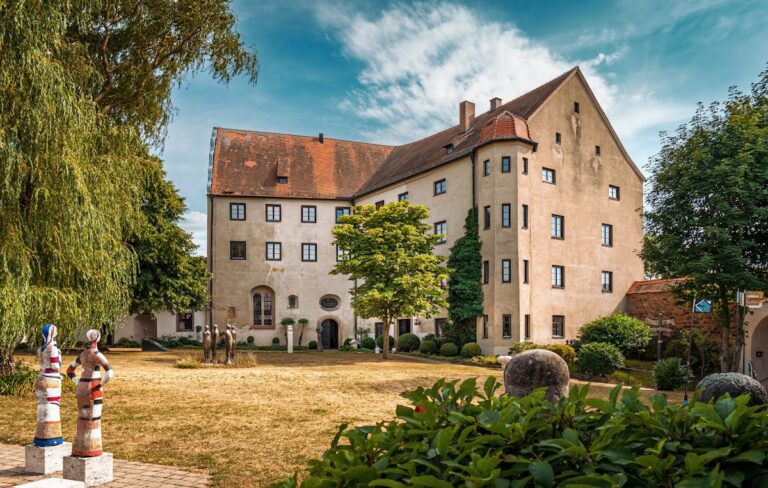
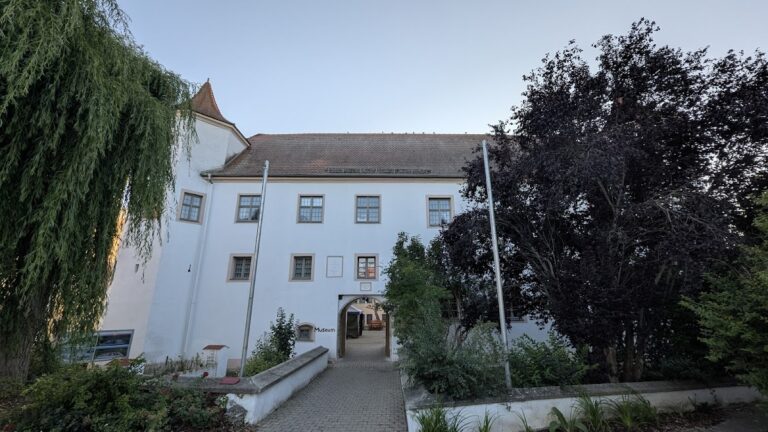
The former Knights’ Chapel contained life-sized kneeling representations of the founders and served as a burial place for minor noble families from the surrounding area. The monastery buildings and the Knights’ Chapel were largely demolished during the nineteenth century, leaving the abbey church as the principal surviving architectural expression of the former complex.