St. Sylvester: A Historic Parish Church in Munich


Site at a Glance
- Rating
- 4.6
- Popularity
- Very Low
- Country
- Germany
- Primary era
- Modern
- External website
- Open
- Eras represented
- Medieval, Early Modern, Modern
- Civilizations
- Duchy of Bavaria, Electorate of Bavaria, German, Holy Roman Empire
- Site type
- Religious
- Remains
- Church
On this page8 sections
History
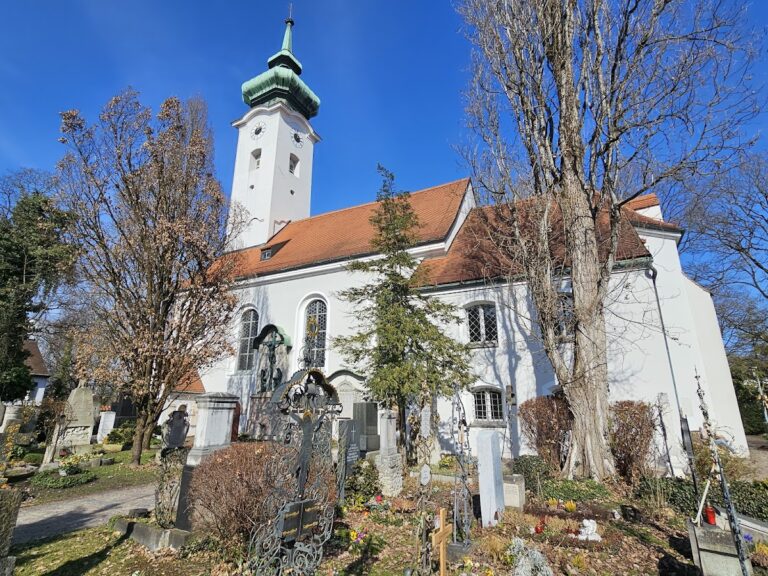
St. Sylvester is a Roman Catholic church in Munich, Germany, whose medieval village church was expanded in the Gothic style around 1300 and remodelled in the Baroque period. It stands in the historic center of Schwabing, now known as Alt-Schwabing, near the Englischer Garten, and belongs to the Archdiocese of Munich and Freising, a major Catholic diocese headed by an archbishop. The site preserves two principal phases of development: the older medieval and Baroque church, and the early twentieth-century expansion built for Schwabing’s growing population.
Medieval origins
A church probably stood at the present site by 782, when Schwabing was first mentioned. The church itself first appears in written records in 1315, when it was a filial church, meaning a subordinate church rather than the main seat of an independent parish, belonging to the parish of Sendling. Its earliest dedication was probably to John the Baptist.
The building was enlarged in the Gothic style around 1300. Parts of this medieval church remain within the older structure, including the lower massive section of the tower, which dates to around 1200 and survives to approximately 12 metres in height.
Baroque transformation and parish status
Between 1654 and 1664, the village church underwent a major Baroque remodelling. The nave was raised, new altars were installed, and the interior received stucco decoration. Around this period, Saint Ursula probably replaced John the Baptist as the principal patron, while Pope Sylvester I became a secondary patron. Sylvester, bishop of Rome from approximately 314 to 335, is recognized as a saint in the Catholic Church and is traditionally associated with the Christianization of the Roman Empire under Constantine the Great.
In 1811, the church became the parish church of the independently established parish of Schwabing, which then had approximately 650 members. After the new parish church of St. Ursula was consecrated at Kaiserplatz in 1897, the Ursula dedication was transferred to that building. The former village church consequently returned to the status of a filial church.
Twentieth-century expansion
A curacy, an ecclesiastical unit administered by a curate rather than functioning as a full parish, was established at the old St. Ursula church in 1920. The following year, the parish was divided and a new parish dedicated to St. Sylvester was created.
Population growth led to the construction of a second church on the north side of the older building in 1925 and 1926. Hermann Buchert designed the new octagonal hall in a modified Baroque Revival style, and it was connected directly to the older church. Archbishop Michael Cardinal von Faulhaber consecrated it on 24 October 1925. St. Sylvester remains an active Catholic church. Its exterior also served as the location for Charlie Bucket’s school in the 1971 film musical Willy Wonka & the Chocolate Factory.
Remains
The site consists of the older medieval and Baroque church together with a larger octagonal church built parallel to it on the north side. The two buildings are directly connected, bringing together the surviving fabric of the village church and the expanded parish complex of the twentieth century.
The medieval and Baroque church
The older church incorporates the remains of the medieval building enlarged around 1300. Its tower includes a lower, massive section dating to around 1200 that reaches approximately 12 metres. The nave was raised during the Baroque remodelling of 1654 to 1664, when new altars and stucco decoration were added to the interior.
The high altar dates from 1655. Its principal painting by Kaspar Amort the Elder depicts the martyrdom of Saint Ursula and her companions. Sculptures of Saint Sylvester and Saint Benno were made by Matthias Schütz, probably in 1673. Saint Benno is venerated as the patron saint of Munich.
The church also contains an Annunciation group attributed to Ignaz Günther or his school. It was acquired in 1770, together with a figure of Judas Thaddaeus and busts of Saint Benedict and Saint Barbara associated with the same workshop. Statues of Saint Nicholas and Saint Elisabeth by Constantin Pader, dated 1647, were transferred to the church in 1898 from the demolished Leprosy Church of Saint Nicholas in Schwabing.
The octagonal parish church
The later church is an octagonal hall built in a modified Baroque Revival style. Its octagonal bell tower contains a four-bell cast-steel peal made by Bochumer Verein in the 1920s. The bells sound in the sequence D, F, A-flat, and B-flat.
The high altar bears Matthäus Schiestl’s 1927 painting Pope Sylvester Kneeling in Intercession for Schwabing. Its side figures represent Saint Nicholas and Saint Corbinian, the patron saint of the Archdiocese of Munich and Freising, and are probably eighteenth-century works by Meinrad Guggenbichler. The superstructure of the altarpiece contains a figure of God the Father, probably made by Christian Jorhan the Elder in the eighteenth century.
Ernst Kozicz painted the ceiling and upper-wall decorations in casein, a milk-protein binder used to attach pigments to a surface, in 1939 and 1940. The paintings depict the vision of Constantine the Great, six scenes from the Passion and Resurrection of Jesus, and scenes from the life of Jesus. In Christian tradition, Constantine’s reign coincided with the pontificate of Pope Sylvester I, and he was the Roman emperor who legalized Christianity within the Roman Empire in the early fourth century.
Organs and musical equipment
The new church contains a pipe organ built by the Spath organ workshop in 1980. It has mechanical key action, electrically operated stops, 30 stops, and 2,161 pipes divided among the Hauptwerk, Swell, and Pedal sections. The 1980 console can also control the organ of the older church, built in 1907, as a remote division.
Munchner Orgelbau Johannes Fuhrer installed a new console with additional functions in 2019. Its controls include couplers linking the second and third manuals with the first manual and pedal, together with couplers for the remote division to the first manual, second manual, and pedal. The console also has a coupler manual, hand registers, combination settings, a setter system installed in 2019, full-organ and reed-off controls, a swell pedal, and a crescendo roller. It is freestanding and uses rocking stop controls. A 1 1/3-foot chorus stop in the small pedal is currently out of service.