Burg Hohentrüdingen: A High Medieval Hilltop Castle in Germany


Site at a Glance
- Rating
- 4.7
- Popularity
- Very Low
- Country
- Germany
- Primary era
- Medieval
- Eras represented
- Medieval
- Civilizations
- Holy Roman Empire
- Site type
- Military
- Remains
- Castle
On this page7 sections
History
Burg Hohentrüdingen is the remnant of a high medieval hilltop castle in Germany, above Hohentrüdingen in the municipality of Heidenheim. The imperial counts of Truhendingen built it in the late eleventh century, and an Eichstätt charter of 1129 provides its first documentary mention. The counts held the land as a fief, meaning a grant from a superior lord in return for service or allegiance, from the bishop of the Prince-Bishopric of Eichstätt.
The Truhendingen Lords
During the mid-twelfth century, the Truhendingen family also acquired the bailiwick over the possessions of Heidenheim Monastery. A bailiwick was an office through which a bailiff exercised jurisdiction over an institution’s lands and possessions. Around 1200, the minstrel Wolfram von Eschenbach, a major medieval German poet associated with courtly literature, was linked with the hospitality of the Truhendingen counts. He praised it through references to the “Truhendingen pan” and its good pastries.
Changes of Ownership
By the fourteenth century, the castle had changed hands several times. The counts of Schaumberg held it around 1340, followed by Albrecht von Wartenberg in 1359 and Count Ludwig of Oettingen in 1363. It passed to the Burgraves of Nuremberg in 1404 as the Truhendingen family became increasingly indebted. The family died out in 1424.
Decline and Later Use
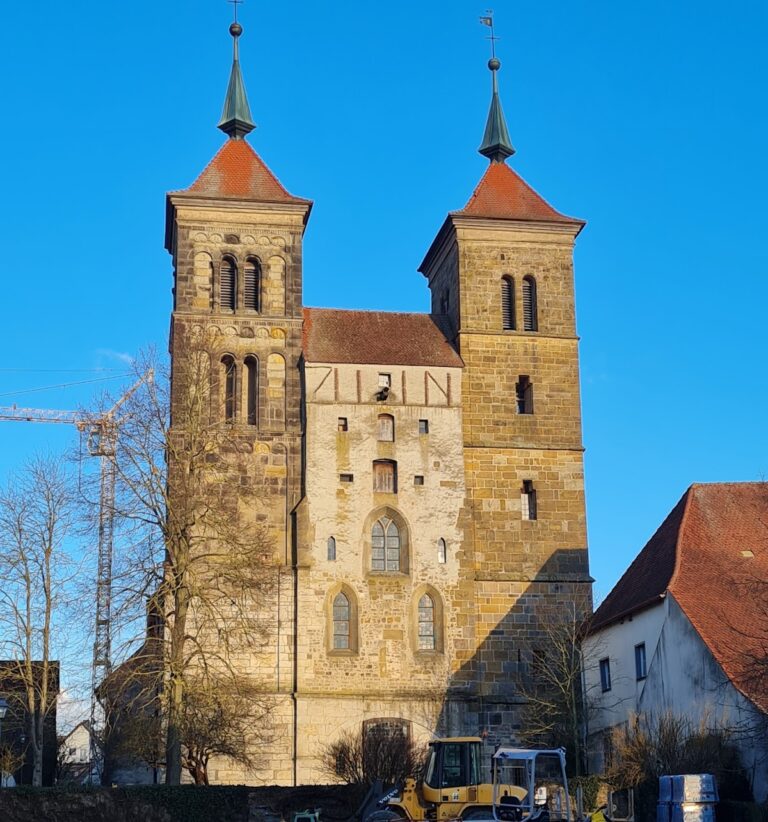
The upper part of the tower was demolished in 1716. By 1732, the castle was described as a very old building and contained only the residence of the chief administrative official. Most of the complex was demolished in 1812. Since 1819, the surviving keep has served as the church tower of St John the Baptist, the Christian figure regarded as the forerunner of Jesus.
Burg Hohentrüdingen was regarded as the largest high medieval fortification between the middle Wörnitz and Altmühl rivers. Its archaeological remains are legally protected as an archaeological monument, while the surviving keep has listed-monument status.
Remains
The former noble castle occupies a hilltop spur at approximately 560 metres above sea level above Hohentrüdingen, a district of Heidenheim in Bavaria’s Weißenburg-Gunzenhausen district. The complex combined a fortified central area with extensive outer defenses, including baileys, which were enclosed areas outside the main castle core used for additional buildings, working areas, storage, and defense.
Surviving Keep
The rectangular keep rises 27 metres and is built from bossed ashlar masonry. This construction uses carefully cut stone blocks with projecting or roughly finished outer faces, giving the walls a strongly textured surface. The walls measure approximately 4 metres thick at the base and 2.5 metres at the top. Its entrance is positioned 9 metres above ground level, an arrangement that made direct access more difficult. The tower now forms the church tower of St John the Baptist and also functions as an observation tower. Views extend toward the Hesselberg and across the Ries.
Outer Fortifications
The castle complex included a western outer fortification, a first outer bailey extending 180 metres eastward, and a second trapezoidal outer bailey measuring approximately 300 by 200 metres. Rampart systems formed part of these defenses, preserving the scale of the former fortified site beyond the surviving tower.
Nearby sites