Stadtkirche St. Laurentius: Nürtingen’s Principal Protestant Church


Site at a Glance
- Rating
- 4.5
- Popularity
- Very Low
- Country
- Germany
- Primary era
- Medieval
- External website
- Open
- Eras represented
- Medieval, Early Modern, Modern
- Civilizations
- Duchy of Württemberg, German, Holy Roman Empire
- Site type
- Religious
- Remains
- Church
On this page12 sections
History
Stadtkirche St. Laurentius is Nürtingen’s principal Protestant church in Germany and the parish church of the Evangelical Stadtkirchengemeinde Nürtingen. Built by the late-medieval architect Hans Buß, it is the third church erected on this hill spur above the Neckar and has become a landmark of the town.
Late-medieval construction
Construction began with the west tower around 1470. Work on the choir followed from about 1480, and the nave was completed around 1488. The church was built as a late-Gothic hall church, a form in which the nave and side aisles have closely related heights and create a unified interior. The original nave had a flat ceiling, while the choir received a late-medieval vault.
The former Nürtingen Altar was created in 1516 by the artist known as the Master of the Nürtingen Altar. Its signature, “C. W.”, has led to a possible identification with Conrad Weiß, who was born in Rottweil and worked in Augsburg. The altar has been in the State Gallery in Stuttgart since 1841.
Early modern alterations
A lightning strike in 1572 led to a major change in the tower. An additional storey was added, together with the Renaissance hood that gives the tower its present upper profile. The rood screen, a partition separating the choir from the nave, was erected in 1624. Heinrich Schickardt built the north-west stair tower in the same year, while Hans Hering built the stair tower beside the main tower in 1625–26.
The church’s interior also preserves later early-modern memorial and decorative work. Four Baroque angels made around 1725 came from an older organ case, and several sixteenth- and seventeenth-century epitaphs, commemorative funerary monuments, remain in the church. A tower library occupies the second storey of the tower.
Neo-Gothic and modern renewal
The nave received its present Neo-Gothic vaulting in 1895–96. The pulpit, baptismal font, and altar were newly made during the same period. The former Nürtingen Altar continued its life outside the church, while a replica has stood in the choir since 2010.
A fire destroyed the organ in 2000. In 2004, the Goll organ-building company of Lucerne installed the present instrument. It is the fifth organ placed in St. Laurentius and replaced the predecessor built in the 1970s.
Remains
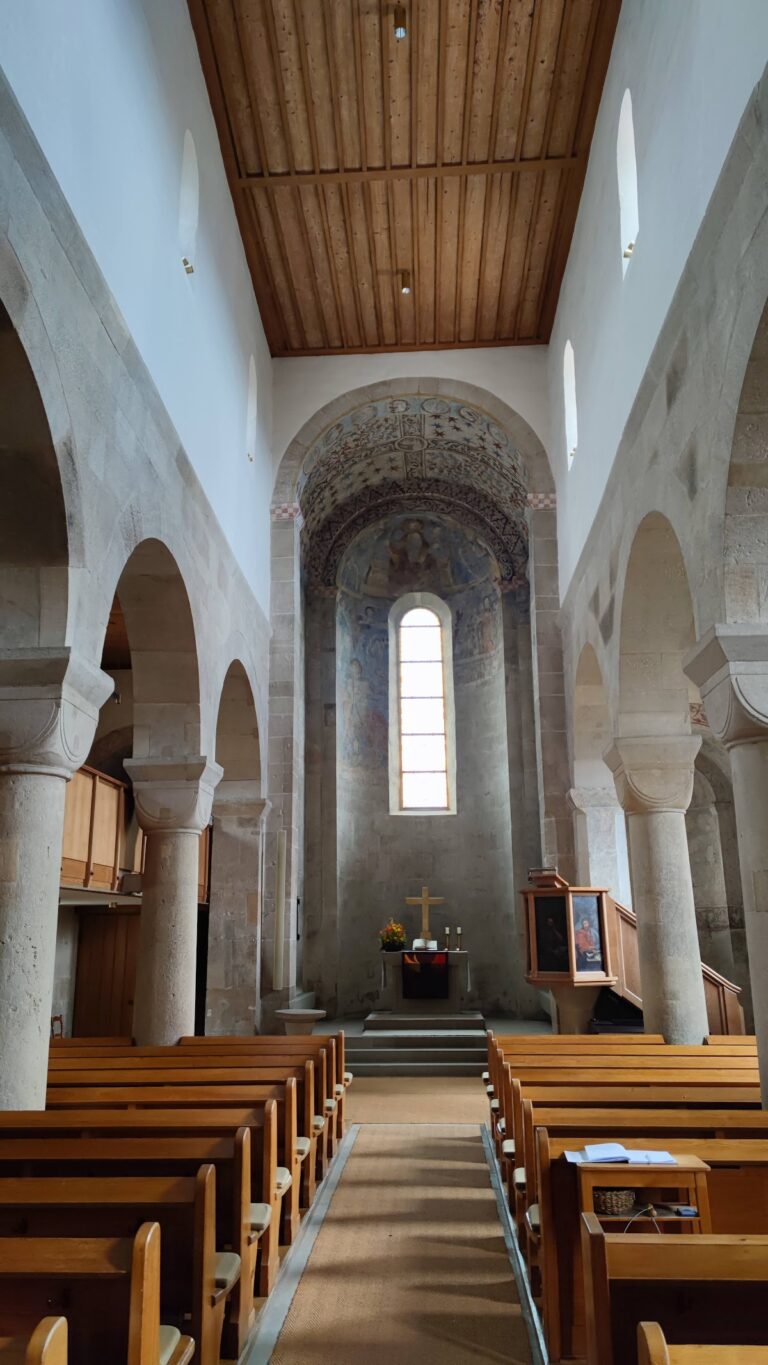
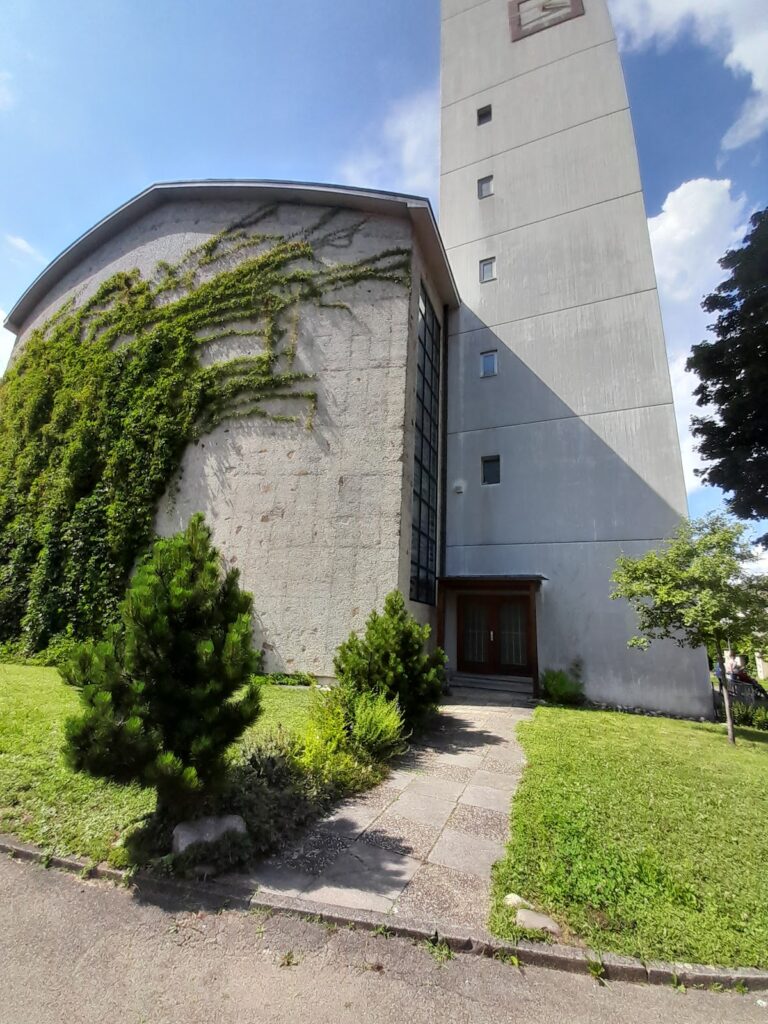
Stadtkirche St. Laurentius is a three-aisled late-Gothic hall church without a transept, meaning that its main axis has no projecting cross-arm. The four-bay nave is spacious and carefully proportioned, with a narrower choir set back from it. Exposed-stone socles support the tower and nave, while the walls are plastered light pink. Gothic windows rise above a simple cornice that continues around the stepped buttresses, and the wall edges remain exposed.
Nave and choir
Nave structure
The central aisle is slightly wider than the two side aisles. Its middle bays are deeper than the outer bays, producing a varied sequence of rectangular spaces. Octagonal piers divide the nave from the aisles, and the arcade arches rise directly from them without capitals. Rounded attached shafts face both the main nave and the side aisles, carrying the vault ribs without imposts. Along the outer walls, the ribs spring from small consoles.
An organ gallery fills the western bay. Its exposed-concrete construction is deliberately restrained beside the older masonry. Three stair towers adjoin the nave and contain spiral staircases. The north-west tower has a seven-sided plan, while the stair tower beside the main tower is octagonal.
Choir and rood screen
Walls narrow the entrance from the nave into the choir. The choir ends in five sides of an octagon. Its south wall contains the Lambert Door, with the sacristy door diagonally opposite. The sacristy adjoins the choir on the north, while a newly created access area adjoins it on the south.
The wrought-iron rood screen dates from 1624 and is attributed to Bernhard Keysser or Kaiser. Above the choir arch, a crossbeam carries a crucifix carved around 1622 by Simon Schweizer of Balingen. Schweizer also made the former Nürtingen pulpit cover, which is now in Neuffen.
West tower and bells
The west tower has a square ground plan and six storeys separated by horizontal string courses. Pointed-arch sound openings occupy the sixth storey. A projecting corbel cornice supports a gallery with a balustrade, and the curved tower hood is topped by a slender lantern.
The bell peal contains five bells. The oldest, Domenica, was cast in 1493, came from Blaubeuren, and sounds the note e′. Another bell dates from 1622 and sounds c″. The remaining three were made in 1948 and sound g′, a′, and d″.
Organ and altar
Present organ
The present organ has a solid oak case and 42 stops. A stop, or register, is a group of pipes with a particular sound character, so the instrument has 42 separately controllable tonal ranks. Its installation followed the destruction of the earlier organ in the 2000 fire.
Nürtingen Altar
The original Nürtingen Altar measures 153.8 by 151.8 centimetres and is held in the State Gallery in Stuttgart. Its central subject is Saint Anne with the Virgin Mary and the Christ Child, a composition known as Anna selbdritt. Joseph and Joachim stand at the sides, angels appear behind them, and God the Father is enthroned on a cloud surrounded by angel heads. The replica installed in the choir reproduces this composition.