St. Alexis Parish Church in Hellmonsödt: A Late-Gothic Catholic Church
Site at a Glance
- Rating
- 4.7
- Popularity
- Very Low
- Country
- Austria
- Primary era
- Medieval
- External website
- Open
- Eras represented
- Medieval, Early Modern, Modern
- Civilizations
- Habsburg, Holy Roman Empire
- Site type
- Religious
- Remains
- Church
On this page13 sections
History
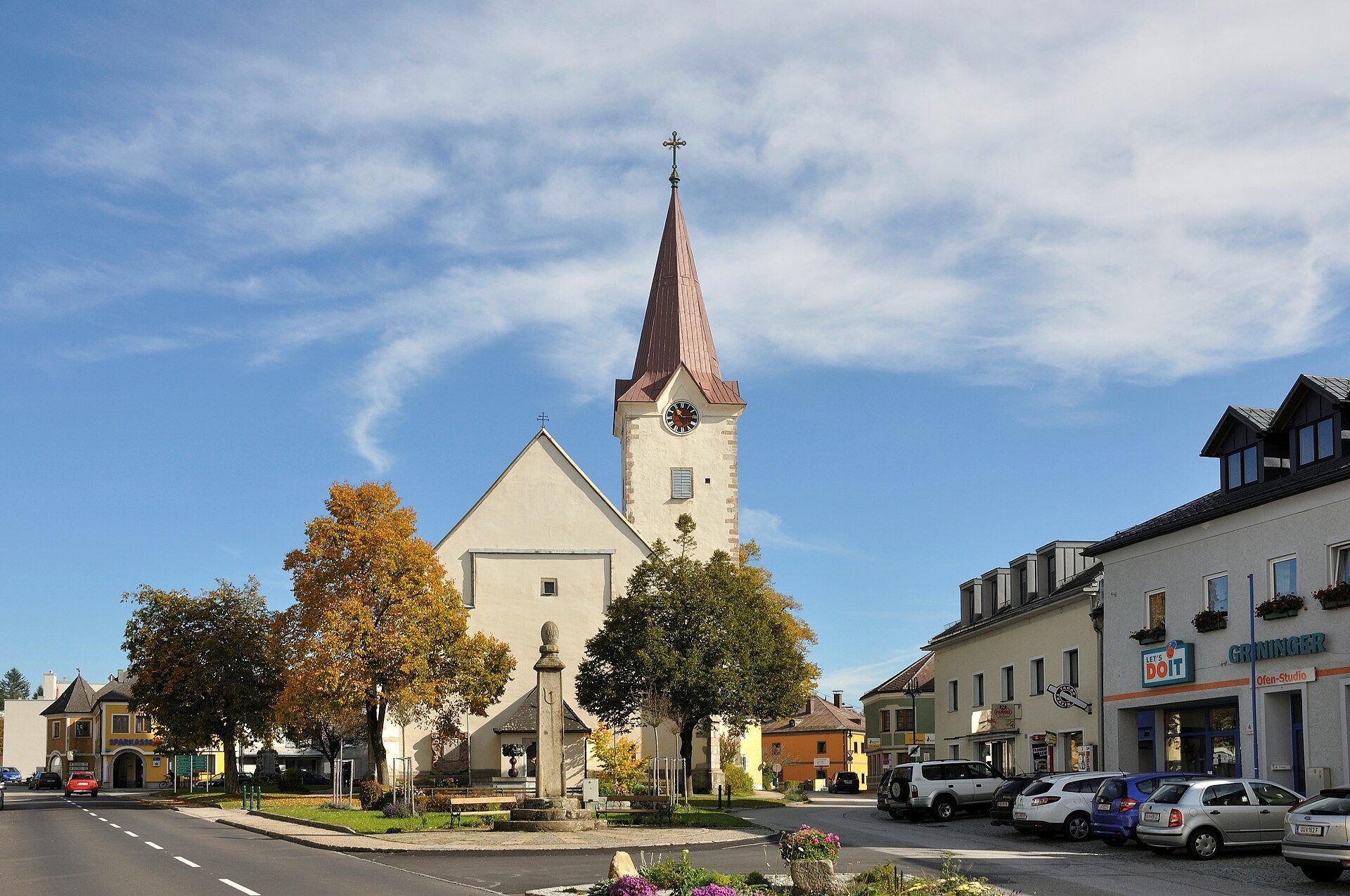
St. Alexis Parish Church is a Roman Catholic church in Hellmonsödt, Austria, built by the Starhemberg family in the late medieval period on the site of an earlier church. The present late-Gothic building belongs to the parish structure of the Gallneukirchen Deanery, an administrative grouping of parishes within the Diocese of Linz, and is protected as a monument.
Foundation and late-Gothic rebuilding
The church’s history is closely linked with the Starhembergs, an Austrian noble family whose estates and political influence included Hellmonsödt, the surrounding area, and Wildberg Castle. Gundaker Starhemberg, the first specifically known member of the family, had a church built at Hellmonsödt around 1212.
Hussite forces destroyed this Romanesque church during the military campaigns associated with the religious reform movement connected with Jan Hus. Hanns IV von Starhemberg commissioned a replacement in 1441. This rebuilding created the present late-Gothic church, while construction of the choir continued at the beginning of the sixteenth century.
Starhemberg memorial history
The Starhemberg burial chapel was added in 1499 and enlarged at the end of the sixteenth century. During the sixteenth and seventeenth centuries, it served as the principal burial place of the family. The family crypt beneath the chapel received its final burial in 1825.
The burials and memorials reflect changing religious and political connections within the family. Heinrich Wilhelm von Starhemberg converted from Calvinism to Catholicism and advanced in imperial service under Matthias, Ferdinand II, Ferdinand III, and Leopold I. Erasmus IV the Younger von Starhemberg was a Calvinist who lived in Vienna.
The older Starhemberg family crypt had been at Garsten Abbey from 1261. The family later established five further crypts at Sankt Florian Abbey, the Capuchin Church in Linz, Eferding Parish Church, Wartberg ob der Aist Parish Church, and Hellmonsödt.
Changes after the eighteenth century
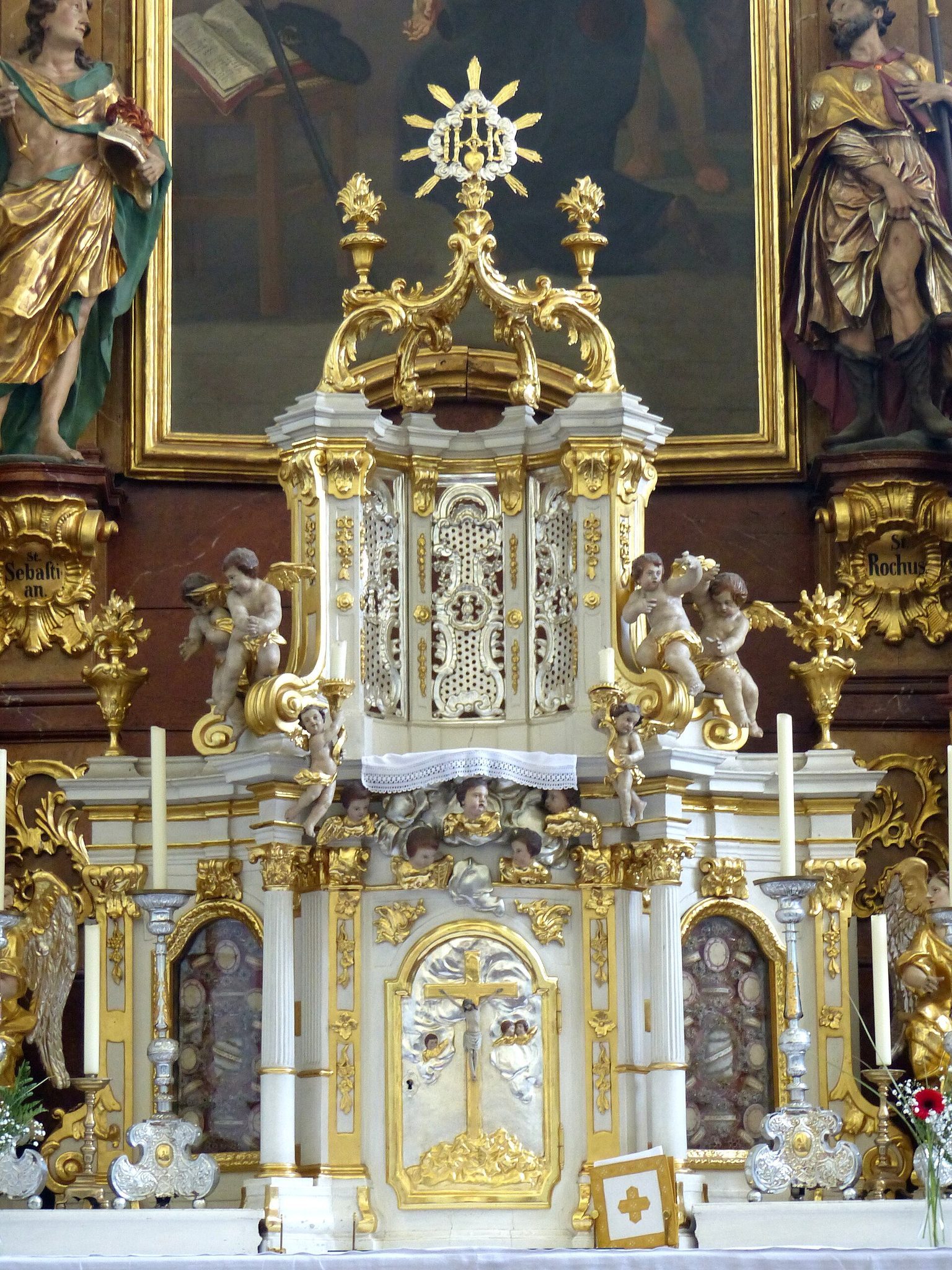
The cemetery that had surrounded the church was newly laid out outside the market in 1787. A fire in 1804 destroyed the entire interior furnishings. The church was subsequently equipped with a late-Baroque high altar and late-Baroque side altars, reflecting the eighteenth-century Baroque style.
Reichardt von Starhemberg had an almshouse built beside the parish house in 1604 for between 14 and 21 needy people. In 1609, he rebuilt Riedegg Castle after a fire. The ossuary beneath the church tower was rediscovered in 1951. During the 1977 renovation, the child mummy in the Starhemberg family crypt was fitted with a glass cover. The pillory in front of the church was moved there in 1983 and bears the date 1566.
Remains
St. Alexis Parish Church has a three-aisled nave of four bays and a two-bay choir. The nave is covered by a cross-rib vault, formed by intersecting masonry ribs. The choir ends in a 5/8 termination, a polygonal ending with five sides of an octagon, and has an elaborate net-rib vault formed by a more complex network of ribs. Its longitudinal axis makes a deliberate deviation toward the north rather than continuing in a straight line from the nave.
Church interior and choir
The four-bay nave and two-bay choir preserve the principal spatial arrangement of the late-Gothic church. The choir’s net-rib vault and northern axis kink distinguish it from the nave’s cross-rib vault. The interior furnishings now include the late-Baroque high altar and side altars installed after the fire of 1804.
Starhemberg burial chapel
Memorial slabs
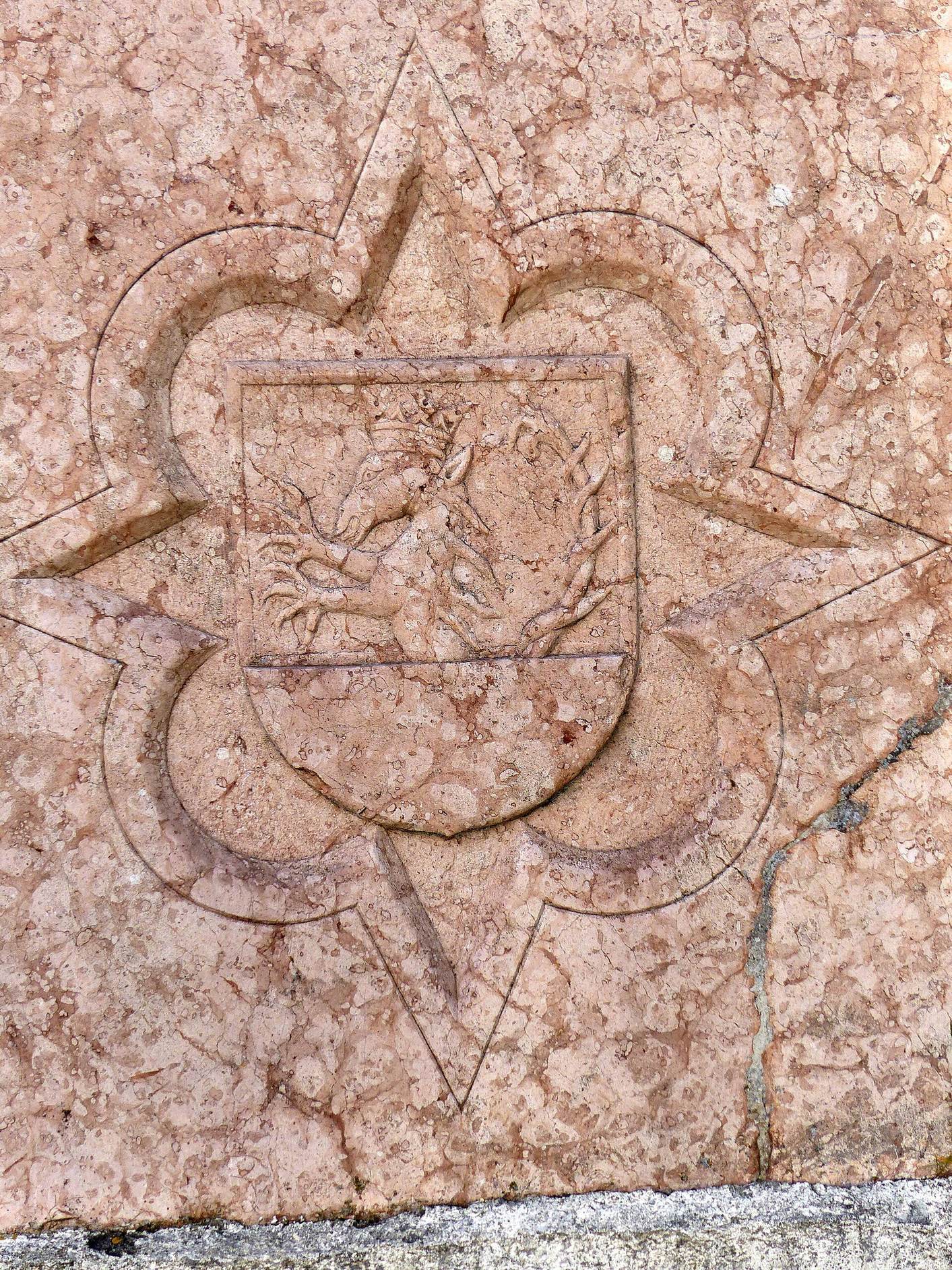
The burial chapel adjoins the church and contains eight tomb slabs mounted on its walls. Seven are made of red marble. The slab commemorating Paul Jakob I von Starhemberg and Paula von Ortenburg is the only one made of white marble.
The wall memorials commemorate Hanns IV von Starhemberg, who commissioned the church’s rebuilding, Bartholomäus I von Starhemberg and Magdalena von Losenstein, Erasmus I von Starhemberg, Paul Jakob I von Starhemberg and Paula von Ortenburg, Heinrich von Starhemberg, Hedwig von Starhemberg born Rosenberg, Gotthard von Starhemberg, and Reichardt von Starhemberg. Gotthard’s slab has no inscription.
Exterior memorials
Four further memorials are set on the chapel’s exterior. They include an epitaph for Elisabeth von Starhemberg, born Hohenberg of Wolkersdorf and Raspach, who died in 1418; a memorial plaque for Hanns IV von Starhemberg; Hedwig von Rosenberg’s tomb slab, installed upside down with its heraldic rose at the center; and a tomb slab for Heinrich Wilhelm von Starhemberg, who died in 1675.
Family crypt
The crypt beneath the chapel contains ten coffins belonging to members of the Starhemberg family. They include Gregor von Starhemberg, Reichardt von Starhemberg, Erasmus III the Elder von Starhemberg, Juliana von Rogendorf, Heinrich Wilhelm von Starhemberg, Erasmus IV the Younger von Starhemberg, Susanne von Starhemberg, Magdalena von Starhemberg, Maria von Sprinzenstein, and Alois Erasmus von Starhemberg.
Gregor von Starhemberg’s coffin contains a child mummy more than 450 years old. The coffin stands on that of his nephew, Erasmus IV the Younger, and the mummy was given a glass cover during the 1977 renovation. The crypt received its last burial in 1825, when Maria von Sprinzenstein was interred there.
Tower ossuary and pillory
Ossuary
The ossuary beneath the tower contains the bones of people who died by 1784. An ossuary is a place where human bones are collected and stored after burial remains are moved or consolidated. It forms the counterpart to the Starhemberg family crypt beneath the adjoining chapel.
Pillory
The pillory standing before the parish church is dated 1566. A pillory was a public punishment structure to which offenders could be exposed as a legal penalty. The monument was moved to its present position in 1983.