St. Michaelis (Hof): An Evangelical Lutheran City Church in Germany


Site at a Glance
- Rating
- 4.6
- Popularity
- Very Low
- Country
- Germany
- Primary era
- Medieval
- External website
- Open
- Eras represented
- Medieval, Early Modern
- Civilizations
- Holy Roman Empire
- Site type
- Religious
- Remains
- Church
On this page8 sections
History
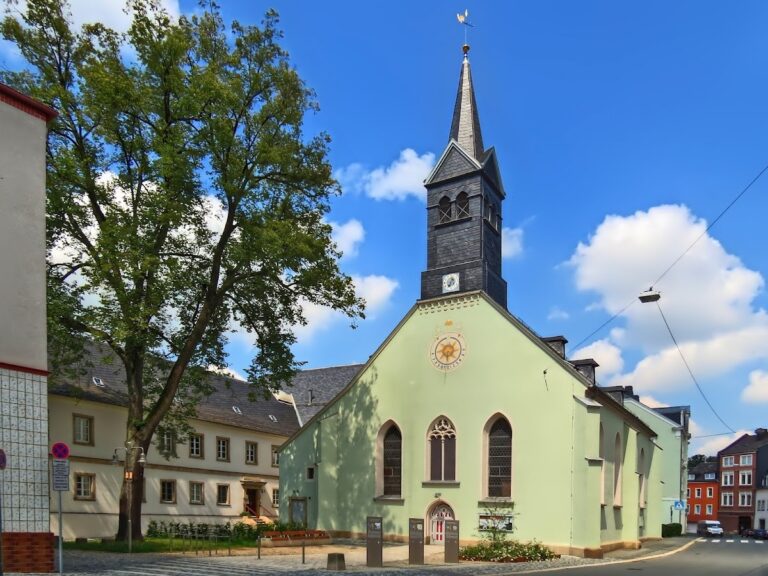
St. Michaelis (Hof) is an Evangelical Lutheran city church in Hof, Germany, whose origins lie in a chapel built around 1230 and whose late-fourteenth-century form became a three-aisled hall church. It serves as the parish church of the St. Michaelis congregation and as the seat of the dean. The Evangelical Deanery Office of Hof, the parish office, and the congregation’s community hall stand beside it at Maxplatz, with the hall built directly onto the church choir.
Medieval origins and expansion
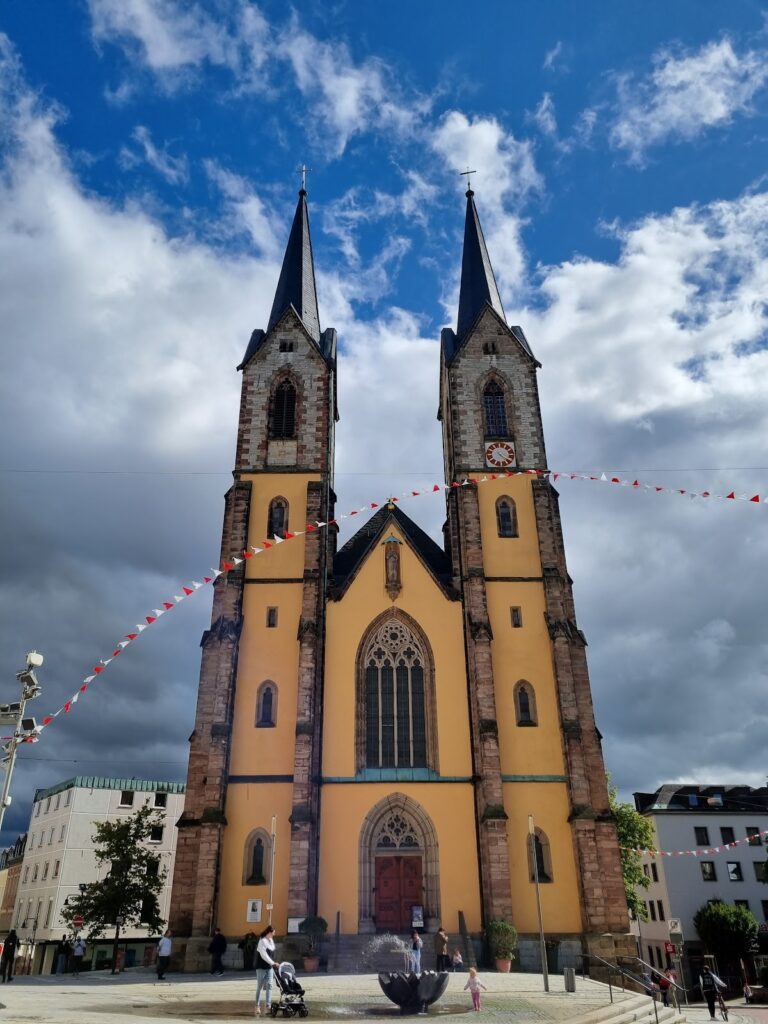
The chapel established at St. Michaelis around 1230 was later replaced by a three-aisled hall church constructed at the end of the fourteenth century. The building was enlarged and extended repeatedly in the following periods, reflecting its continuing place within the religious life of Hof. Its double-tower facade gained an octagonal upper structure in 1581–1582.
Reformation in Hof
St. Michaelis became a base for the Reformation in Hof during the sixteenth century. Kaspar Löner, the city’s first Protestant preacher, began his reforming work there with the support of Nikolaus Medler. On 5 September 1529, Löner introduced Protestant worship in Hof, prepared an order for the services, and wrote a catechism. These actions established the church as a central setting for the city’s transition to Protestant practice.
Fire and rebuilding
A great city fire in 1823 destroyed most of medieval Hof and burned St. Michaelis down to its enclosing walls and towers. The church was rebuilt during the years that followed. The earlier organ was completely lost in the fire, while the surviving walls and towers formed the principal physical framework for the rebuilt church.
Congregational development
Until the beginning of the twentieth century, Hof had one unified Evangelical congregation even though the city possessed several churches. In 1926, that congregation was divided into nine pastoral districts, each assigned to a responsible pastor. Six districts became independent congregations in 1947, and the remaining three achieved independence by 1966. St. Michaelis was among the newly established congregations. Tauperlitz became independent in 1983.
The offices of organist and town cantor at St. Michaelis have been continuously documented since 1520. From 1906, the town cantor also served as organist at Hof Hospital Church. The recorded officeholders include Leonhard Heinel from 1906 to 1938, Otto Meyer from 1938 to 1949, Hans Gebhard from 1949 to 1959, Helmut Scheller from 1959 to 1969, Reinhard Wachinger from 1969 to 2000, and Georg Stanek from 2001.
The medieval Hof Altarpiece was commissioned by Hertnid von Stein and made by Hans Pleydenwurff in 1465. It has been held by the Alte Pinakothek in Munich since 1811. A later altar made by Anselm Sickinger was installed in St. Michaelis in 1884.
Remains
Church fabric and facade
St. Michaelis retains the basic character of a three-aisled hall church, a design in which the nave and side aisles are approximately equal in height and form a unified interior space. The building’s medieval development began with the earlier chapel and continued with the late-fourteenth-century church and later enlargements. The double-tower facade is distinguished by the octagonal upper structure added in 1581–1582.
The 1823 fire left the enclosing walls and towers standing. The remainder of the church was rebuilt in the years after the destruction, so the present building combines surviving medieval elements with the fabric of the nineteenth-century reconstruction. The community hall beside Maxplatz is attached directly to the choir and forms part of the current institutional setting of the church.
Organ tradition
The first organ at St. Michaelis was built around 1450 by a traveling monk. A second instrument followed around 1516, probably made by Leonhard Lilgenweiß of Bamberg and financed by the Hof town council. It was repaired and enlarged in 1543 with a smaller division positioned behind the organist. Further repairs took place in 1566 after damage in 1553, when the instrument was also expanded with a division located near the player’s chest. With three hand-played keyboards, it was described at the time as having a unique standard in southern Germany.
At the beginning of the seventeenth century, Timotheus Compenius built a new organ into the case of the earlier instrument. It had 21 controllable sets of pipes, two hand-played keyboards, a foot-operated division, and period effects including a buzzing-pipe stop, a bird-song effect, and a rotating bell effect known as a Zimbelstern. The instrument was damaged during the Thirty Years’ War, the European conflict of 1618–1648, when Albrecht von Wallenstein’s imperial army of about 30,000 men severely plundered Hof. Repairs followed in 1642 by Bartholomäus Leube, in 1680 by Severin Holbeck, in 1714 by Johann Peter Pönicke, and in 1727 by Tobias Dressel. In 1819, Hof organ builder Friedrich Heidenreich prepared a condition report for the Hof magistrate concerning a proposed overhaul.
The present organ was built for the reconstructed church between 1828 and 1834 by the Heidenreich brothers of Hof. It originally contained 34 stops on two hand-played keyboards and a pedal division operated by the feet, with mechanical action linking the keys and pedals to the valves that control the pipes. Later alterations, partly influenced by the Organ Reform Movement, led to the loss of some historical pipe material.
Orgelbau Schmid reconstructed the instrument in 1967, adding an enclosed division whose volume could be altered and a further small pedal wind chest. Karl Schuke of Berlin carried out a comprehensive restoration in 2006–2007 and created another enclosed division. The organ now has 63 stops on three manuals and pedal, couplers connecting the divisions as II/I, III/I, III/II, I/P, II/P, and III/P, and a combination system capable of storing 4,000 settings.