St. Marien: The Catholic Town Church of Hof, Germany


Site at a Glance
- Rating
- 4.6
- Popularity
- Low
- Country
- Germany
- Primary era
- Modern
- External website
- Open
- Eras represented
- Modern
- Civilizations
- German
- Site type
- Religious
- Remains
- Church
On this page12 sections
History
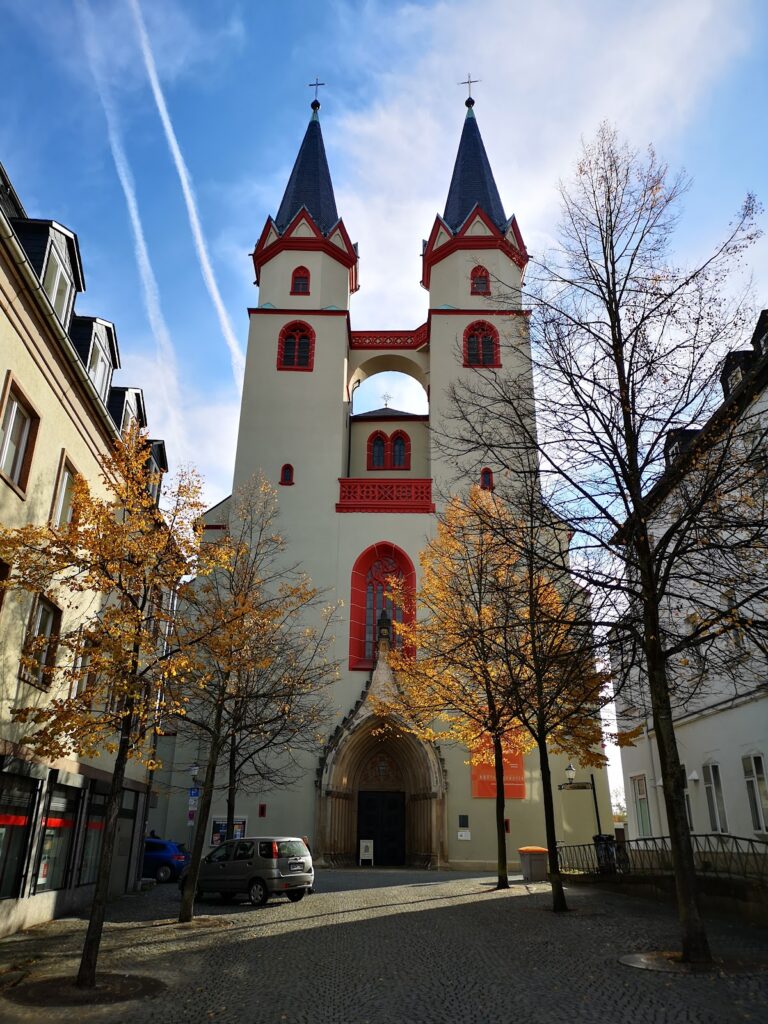
St. Marien is the Roman Catholic town church of Hof, Germany, built by the Catholic community in the Neo-Gothic style during the second half of the nineteenth century. It stands on the site of a medieval pilgrim hospice connected with the Way of St. James, the network of Christian routes leading to the shrine of Saint James at Santiago de Compostela in northwestern Spain. Today, it is the principal Catholic church of Upper Franconia.
The medieval hospice and the Reformation
The church site was associated with pilgrimage before the present building existed. In 1487, citizens of Hof who had returned from Santiago de Compostela founded an altar to Saint James in St. Michaelis Church. They also financed a hospice near St. Niclas Church, where pilgrims who carried a pilgrim credential, a document used to identify travelers and record their journey, could stay without charge and receive simple meals. The hospice later became the Gasthof zur goldenen Sonne. Its former location is commemorated by Sonnenplatz to the west of St. Marien.
Hof became Protestant after the Reformation was introduced in 1529 by Nikolaus Medler and Kaspar Löhner. St. Niclas Church ceased to function as a church in 1542 and was converted into a grain store. It burned during the siege of Hof on 7 August 1553. The Franciscan monastery soon dissolved, and the Clarissan monastery was abolished in 1564. Catholic life in Hof then largely disappeared for about 250 years.
Revival of Catholic life
Catholic communal life revived after Hof and the Margraviate of Bayreuth became part of Bavaria in the early nineteenth century. Catholic workers and officials from Bohemia and the Franconian Forest contributed to the growth of the community. About 120 Catholics lived in Hof and the surrounding area in 1820. They initially worshipped in a house chapel at the customs office, which Father Deinzer of Marienweiher consecrated on 15 April 1820. Franciscans from the pilgrimage monastery at Marienweiher provided pastoral care.
A Catholic curacy, a small pastoral unit served by a priest under a larger ecclesiastical authority, was established in 1837 under the Deanery of Stadtsteinach. Johann Baptist Neuner became Hof’s first Catholic priest after the Reformation on 2 December that year. He promoted church music, founded a Catholic elementary school in 1840, and directed the construction of a small Catholic church in Karolinenstrasse in 1844.
Construction and completion
By the late 1850s, the Catholic congregation had grown to 539 members, and the Karolinenstrasse chapel could no longer accommodate it. In 1858, the parish decided to build a larger church in the city center. Parish priest Nikolaus Eichhorn designed the plans in the Neo-Gothic style. The Catholic community acquired the former inn and surrounding property in the late 1850s for the project.
Construction began on 4 April 1864. The new church was dedicated to the Virgin Mary, and the first service took place in the nearly completed building on 2 June 1867. The two towers, the vault, and the high altar were still unfinished at that time. The parish office moved to a new building on Lorenzstrasse in 1868. After the towers were completed, their bells were consecrated in 1882, and the Steinmeyer organ was completed in 1885. All building work ended with the solemn consecration of the church in October 1891.
War, restoration, and later parish life
St. Marien received its first major external and internal renovation between 1923 and 1925. It survived the first and only air raids on Hof, in April 1945, without damage. A later sanctuary redesign by Klaus Backmund followed the reforms of the Second Vatican Council in 1987. Structural defects led to a comprehensive external and internal renovation in 2000 and 2001, when the church and its furnishings were restored.
St. Marien has remained associated with the Way of St. James. Routes from Sweden, Norway, Finland, and Poland pass through Hof, and Santiago de Compostela lies approximately 2,330 kilometers away. A commemorative stone for the former hospice was installed and consecrated on the west facade in 1999.
The church also commemorates Bernhard Lichtenberg, the Berlin cathedral provost who died in Hof on 5 November 1943 after the Nazi regime arrested and imprisoned him for defending persecuted people. His remains were transferred to Berlin on 11 November 1943. In 1992, a copy of a bust by Klaus Backmund was consecrated at St. Marien, representing the connection between Lichtenberg’s place of ministry and his place of death. Pope John Paul II beatified Lichtenberg in 1996. St. Marien and Berlin’s St. Hedwig’s Cathedral are both memorial sites associated with him, and the square before the church was renamed Bernhard-Lichtenberg-Platz in 2013.
The church and its complete Neo-Gothic furnishings, including its Romantic mechanical organ with cone chests, are protected as historic monuments. Since the merger of Hof’s two Catholic pastoral areas, St. Marien and St. Konrad have belonged to the Bernhard Lichtenberg parish, established on 1 July 2017. St. Marien serves as the liturgical and concert church, while St. Konrad focuses on pastoral care.
Music and ecumenical connections
St. Marien is one of Upper Franconia’s church-music centers. A concert series founded in 1995 presents Romantic repertory on the Steinmeyer organ, along with new sacred music and premieres. The parish also maintains ecumenical contacts with Hof’s Protestant churches. After 1989, it renewed connections with Catholic parishes in Plauen, Weida, and Cheb through clergy exchanges, concerts, and joint activities.
Remains
St. Marien is a three-aisled Neo-Gothic hall church with a net-rib vault, whose intersecting ribs form a net-like pattern. Its complete Neo-Gothic interior survives. The building was originally placed at Hof’s southern edge, but the expanding city has left it in the present-day center, in a pedestrian zone within a valley at approximately 500 meters above sea level. Two towers rise to 65 meters. The bells hang in the east tower, while the west tower contains a room formerly used by a watchman for fire-watch duties.
Interior arrangement and sacred furnishings
Choir and altars
The choir contains the high altar, above which a statue of the Virgin Mary rises to the level of the choir windows. Four side altars, two in each aisle, carry figures associated with Hof’s Franciscan tradition from the thirteenth to the sixteenth centuries. They represent Saints George, Lawrence, Nicholas, Anthony, Aloysius, Mary Magdalene, Bernard of Clairvaux, the Immaculate Heart of Mary, Bernardino of Siena, Otto of Bamberg, Margaret Mary Alacoque, and the Sacred Heart of Jesus. Other images and statues depict Catherine of Alexandria, Barbara of Nicomedia, Francis of Assisi, the Archangel Michael, the Immaculate Virgin Mary, and the Crucifixion.
Sanctuary and devotional art
A baptistery with a font and altar stands to the right of the sanctuary, while the sacristy is on the left. The pulpit is positioned before a projecting column on the left side of the seating area and is reached by stairs near the sacristy door. The choir windows show the Apostles Peter and Paul together with the diocesan patrons, Emperor Henry II and Empress Cunigunde. Wilhelm Vierling, a Bavarian artist, made the Christ cross in the arch closing the choir, while Leo Götz produced the interior furnishings.
Klaus Backmund created the celebration altar, ambo, and processional cross for the 1987 sanctuary redesign. The altar incorporates ears of grain, a medieval symbol associated with Mary, who was often shown wearing a grain-decorated garment. Its altar stone contains relics, physical remains or associated objects preserved for religious veneration, of Blessed Rupert Mayer and Saint Godehard of Hildesheim. The processional cross represents the Tree of Life, while its Sacred Heart motif expresses the focal point of God’s love. The ambo bears a stylized representation of the Parable of the Mustard Seed. Countess Hippolyte Rechberg painted the fourteen Stations of the Cross in oil.
The Steinmeyer organ
The Romantic Steinmeyer organ was completed and consecrated in 1885 as the builder’s Opus 268. It is a mechanical cone-chest organ, a system in which cone-shaped valves are opened mechanically to admit air to the pipes. The instrument has two manuals and pedal. Its original manuals, pedal keyboard, case, and Neo-Gothic decoration survive. A free-standing console faces the altar, with stop controls arranged in three levels on either side of the keyboards.
The case and console form a unified Neo-Gothic design. The facade contains the Principal 8-foot stop from the first manual. A large double-fold magazine bellows with two suspended feeders occupies the lower case and can be operated mechanically or electrically. The upper case contains the 4-foot windchest of the main manual and, above it, the 8-foot windchest of the first manual. The windchests of the second manual lie behind them, while the pedal windchest is at the rear.
Georg Friedrich Steinmeyer conceived the organ on the model of instruments by Walcker. The design allowed for the later addition of the Octavin and Mixtur stops, and a Cornet stop was added during a later restoration. Its couplers are II/I, I/Pedal, and II/Pedal, with collective settings for Piano, Mezzoforte, and Pleno. Orgelbau Klais of Bonn restored the organ between April 1994 and February 1995, exactly on its 110th anniversary. Orgelbau Eisenbarth of Passau now maintains it.
Before the Steinmeyer instrument was finished, St. Marien used a seven-stop organ built in 1847 by the Hof firm Heidenreich for the Catholic church in Karolinenstrasse. It was later sold for 300 marks to Bug near Bamberg. The predecessor church had also received an Äolodikon in 1838 after Friedrich Heidenreich repaired it. Parliamentarian Christian Laubmann had donated that instrument for temporary use.
Bells and commemorative features
The predecessor Catholic congregation possessed two bells described in 1843. Friedrich Heinz of Bayreuth cast them, with the lower bell sounding B and weighing 370 pounds and the higher bell sounding F and weighing 200 pounds.
Three bells for the present church were cast in 1882 after negotiations with the Heinz foundry. French cannon metal supplied by King Ludwig II of Bavaria and old copper coins were melted for the casting. The bells were first rung at Christmas after their inspection on 22 December 1882. The Marienglocke, or Mary Bell, sounds E and weighs 21.12 hundredweight. Its inscription means, “Under your protection and shelter we flee.” The Josephsglocke, or Joseph Bell, sounds G, weighs 10.29 hundredweight, and bears the words, “All saints, intercede for us.” The Katharinenglocke, or Catherine Bell, also called the Mass Bell, sounds B, weighs 6.2 hundredweight, and carries the inscription, “Hear my voice as I am drawn; I call you, come to the sacrifice.”
The Marienglocke was requisitioned during the Second World War but returned undamaged from the Hamburg bell cemetery in 1949. The bell frame was renovated during the general restoration of the church in 2000. The west facade bears the commemorative stone for the former pilgrim hospice, while the interior contains the memorial bust associated with Bernhard Lichtenberg.
Nearby sites