Kaufungen Abbey: A Benedictine Nunnery and Imperial Foundation in Germany


Site at a Glance
- Rating
- 4.7
- Popularity
- Low
- Country
- Germany
- Primary era
- Medieval
- External website
- Open
- Eras represented
- Medieval, Early Modern
- Civilizations
- Holy Roman Empire
- Site type
- Religious
- Remains
- Monastery
On this page8 sections
History
Kaufungen Abbey in Kaufungen, Germany, was founded in 1017 as a Benedictine nunnery by Empress Cunigunde of Luxembourg, the wife of Henry II, Holy Roman Emperor. Its foundation belongs to the early eleventh-century Ottonian period, while the abbey church begun soon afterward was built as a Romanesque basilica. The institution became an imperial abbey, a religious foundation subject directly to the Holy Roman Emperor, and remained an important religious and noblewomen’s community for centuries.
Foundation under Cunigunde and Henry II
In May 1017, Cunigunde was staying at the imperial estate of Kaufungen, which Henry had granted to her as widow’s property in 1008. According to Thietmar of Merseburg, a German bishop and chronicler, she vowed during a serious illness to establish a monastery. After recovering, she began the foundation, and Henry endowed it in 1019.
The abbey church was begun in 1018 and consecrated on 13 July 1025, the first anniversary of Henry II’s death. After Henry died in 1024, Cunigunde entered the new Benedictine community as a simple nun. Later canonized as a saint, she died at Kaufungen on 3 March 1033. Her niece Oda, also recorded as Uta, became the first abbess from 1018 and died in 1035.
Henry granted the nuns the right to hold a weekly Saturday market, along with fairs on the Feast of John the Baptist and the Feast of the Exaltation of the Holy Cross. The abbey’s secular protectors, known as advocates, represented and defended the institution. This office was held by the Counts of Maden or Gudensberg, with Werner I recorded as advocate from 1024.
Imperial abbey and secular foundation
Kaufungen remained directly subject to the emperor until 1089, when Henry IV placed it under the authority of the Bishop of Speyer. It regained its independence in the twelfth century. During that century, the Benedictine community changed first into a small body of secular canonesses, noblewomen who lived under a religious rule without necessarily taking monastic vows. It ultimately became a free secular foundation for unmarried noblewomen, known as a Frauenstift. This institution continued until the reform of 1509.
The abbey’s long succession of leaders included Hildegard, recorded in 1040–1041; Diemuda, also called Dimuda or Diameda, in 1102; Gisela from 1109 to 1132; and later abbesses such as Bertrada von Rosdorf, Luckardis or Lutgardis III, Jutta von Katzenelnbogen, Bertha von Sayn, and Elisabeth von Waldeck. Agnes von Anhalt served as administrator from 1495 to 1504, followed by Elisabeth von Plesse from 1504 to 1509.
Reform, dissolution, and institutional succession
At the instigation of William II, Landgrave of Hesse, Kaufungen was incorporated into the Bursfeld Congregation, a Benedictine reform movement that promoted stricter observance among monasteries. A first visitation took place in February 1509, and Abbess Elisabeth von Plesse was forced to resign. Eight Benedictine nuns from Gehrden Abbey were then installed. After a further visitation later that year, Anna von der Borch was confirmed as abbess, although the foundation remained under Bursfeld observance only briefly.
The Reformation in the Landgraviate of Hesse brought the monastery’s dissolution in 1527. Fourteen named lay sisters left with financial settlements, while the canonesses Anna von Dalwigk and Sophie von Hebel received settlements in 1528. The remaining members of the reform convent, including Abbess Alfradis von der Borch, Prioress Elisabeth Hake, and cellarer Helena Freseken, returned to Gehrden in 1531.
In 1532, Landgrave Philip I of Hesse transferred the monastery’s property, together with that of Wetter Abbey, to the Hessian Knighthood. This association of noble families administered foundations that supported female members of affiliated families. The post-Reformation institution continues as the Ritterschaftliches Stift Kaufungen.
The former canonesses sought to recover their property from Gehrden. After Alfradis von der Borch died in 1534, her successor Helena Freseken continued the claim before the Imperial Chamber Court against Philip of Hesse. Emperor Charles V ordered Philip in March 1537 to return the monastery and its possessions, but he refused. In 1540, Helena Freseken, Elisabeth Hake, and Iseke von der Becke renounced further proceedings. Helena Freseken, who remained abbess in exile, died in 1565.
The former abbey now lies in the Diocese of Fulda and is protected as a historic monument in Hesse. Its continuing institutional successor, the Ritterschaftliches Stift Kaufungen, preserves the foundation’s post-Reformation history.
Remains
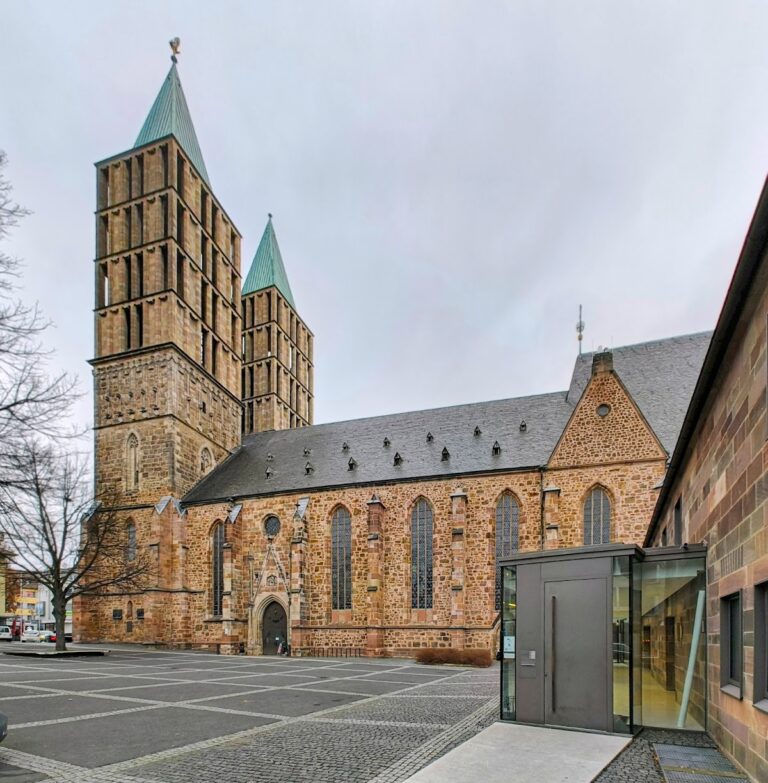
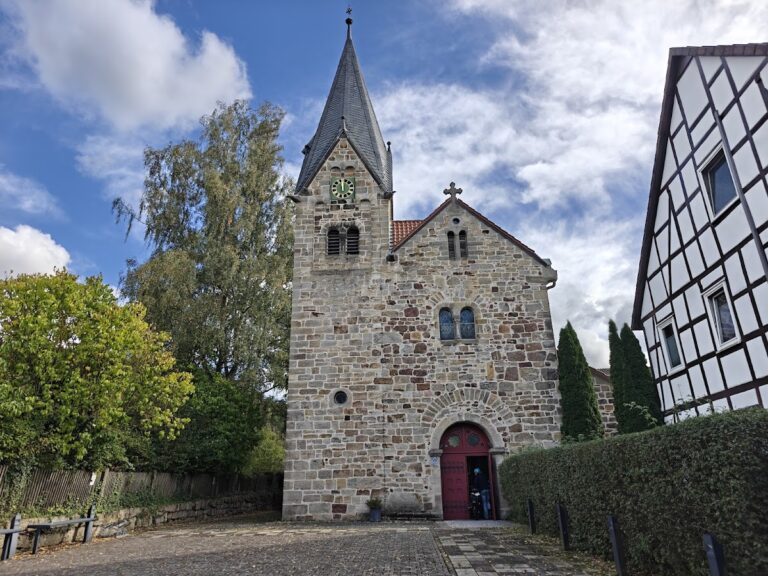
The surviving complex is centered on the former abbey church, now called the Stiftskirche and used as the parish church. The building preserves successive phases from its early eleventh-century Romanesque basilica through Gothic transformation, later fire damage, and sixteenth-century enlargement. It is regarded as the most significant late Ottonian building in northern Hesse.
Abbey church
Romanesque and Gothic fabric
The original church was a Romanesque basilica completed and consecrated in 1025. Severe damage around 1175 led to the vaulting of the choir. During the thirteenth century, the building began to be converted into a Gothic hall church. Most windows and doors were renewed in 1422, and the side-aisle walls were raised in the Gothic style. Gothic wall paintings were added during the fifteenth century. After another fire, the church was enlarged in 1564 and fitted with painted wooden ceilings.
Westwork and later commemorations
The church’s westwork, the monumental western section of the building, contains the Imperial Gallery, an elevated gallery associated with the ruler or imperial representation. Also called the Kaiserempore, it was uncovered again in 1938. A bronze sculpture of Queen Cunigunde by Karin Bohrmann-Roth was unveiled at the Stiftskirche on 11 July 2025 for the church’s millennium anniversary.