Hospital church in Hof: A Lutheran Church Founded with a Medieval Almshouse


Site at a Glance
- Rating
- 4.6
- Popularity
- Very Low
- Country
- Germany
- Primary era
- Early Modern
- External website
- Open
- Eras represented
- Medieval, Early Modern
- Civilizations
- Holy Roman Empire
- Site type
- Religious
- Remains
- Church
On this page12 sections
History
The Hospital church in Hof, Germany, was built alongside the Heilig-Geist Hospital around 1260 as a charitable church and almshouse foundation outside the medieval city walls. It is Hof’s second-oldest church after St. Lorenz, founded in 1214, and stood at the Lower Gate beside the Saale. The church was also dedicated to Our Dear Lady and served the hospital’s elderly and poor residents, who had their own entrance into the building.
Foundation and medieval development
The foundation sought to support poor citizens through works of mercy while helping its benefactors obtain forgiveness of sins and eternal salvation. On 1 April 1264, Pope Urban IV, a thirteenth-century pope of the Roman Catholic Church, issued an indulgence letter for the Hof almshouse. An indulgence was understood as a remission of the temporal punishment due for sins whose guilt had already been forgiven. The letter entrusted support for the hospital to the dioceses of Bamberg, Würzburg, and Mainz.
On 23 May 1268, Berthold, Bishop of Bamberg, authorized the rector and hospital brothers to have the hospital cemetery consecrated. He granted participants an indulgence of 40 days of purgatory for mortal sins and 100 days for venial sins. The church was renewed on Martinmas in 1464, after Hussite forces entered Hof on 25 January 1430. The Hussites followed the reform movement associated with the Bohemian theologian Jan Hus, whose religious and political movement fought several wars in the fifteenth century.
Reformation, destruction, and rebuilding
Hof’s Protestant church system began with a German-language mass celebrated by Magister Kaspar Löner at St. Michaelis on 5 September 1529. The Hospital church consequently became Lutheran. Its late-Gothic Marian altar, carved in 1511 by the sculptor Michael Heuffner, had originally been made for the first chapel of St. Michaelis. It came to the Hospital church after the Reformation. Heuffner’s identity was established in 2007 when Rudolf Strössner connected the initials “MH” on the altar’s coat of arms with Heuffner’s coat of arms on the Holy Sepulchre in Zwickau’s Marienkirche. Heuffner, a contemporary of the sculptor Peter Breuer, is said to have died in Zwickau in 1511 at the age of 28.
During Margrave Albrecht Alcibiades’ war against Bamberg, Würzburg, and the Burgrave of Nuremberg in 1553, Heinrich Reuss of Plauen besieged Hof with two companies. Albrecht Alcibiades was a sixteenth-century margrave of Brandenburg-Kulmbach who conducted military campaigns in Franconia. Reuss, a nobleman and military commander, held the title Burgrave of Meissen. The Hospital church was used as a military camp, and the margrave’s troops then shot it to pieces, leaving only its foundations. The church was renewed in 1557.
Later history and preservation
In 1675 the church was described as neglected and largely ignored by Hof’s prominent residents. Its position outside the city helped it avoid the destruction suffered by other historic Hof churches in urban fires. The rich furnishings later gave it the local nickname “little treasure chest.” It was also known as “Siemakerng,” referring to its principal service, which began at 7:00 a.m. until a few years ago.
In 1947, the parish of Hof, formerly centered on St. Michaelis, was divided into separate congregations, creating the independent congregation of Hof-Hospital church. The church belongs to the Evangelical-Lutheran Deanery of Hof, and its parish district includes northern Hof and the northwestern Hof district of Zedtwitz, including the Church of Peace. The Hospital Foundation of Hof is administered by the city and continues to focus particularly on care for elderly people. The Hospital church is regarded as one of Hof’s important sights.
Conservation work has repeatedly renewed the church’s historic fabric and furnishings. The altar, pulpit sounding board, and Epitaph of the Pool of Bethesda were cleaned and restored in 2005. The two red-brass chandeliers from 1710 and 1711, together with the gallery wall lights, were treated in 2007. The timber tower was restored in 2013, but its poor condition required reconstruction based on the historic tower of 1836. The forecourt, owned by the Hof Hospital Foundation, was redesigned in 2015.
Remains
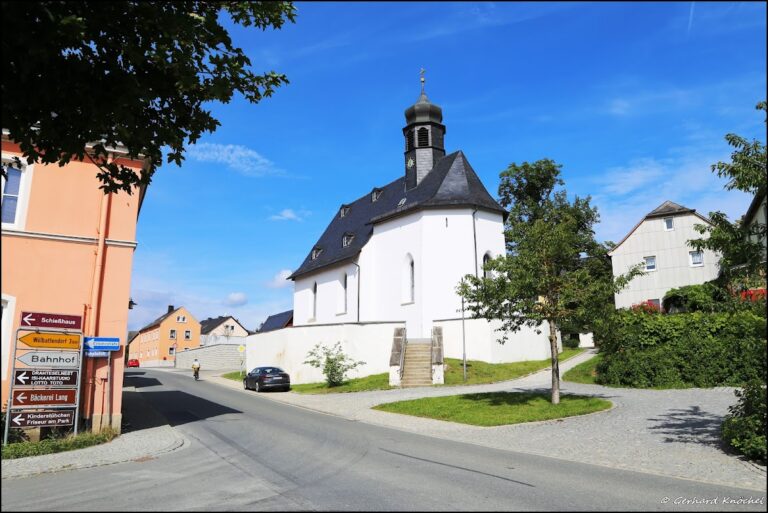
The surviving church stands beside the Saale at Hof’s former Lower Gate, outside the medieval walls. Its physical arrangement preserves the connection between the church and the hospital, including a separate entrance for hospital residents. Inside, the building is shaped by a late-Gothic Marian altar, painted galleries and ceiling panels, a historic pulpit, chandeliers, stained glass, and a modern organ that continues the church’s long musical tradition.
Altarpiece and painted interior
Late-Gothic Marian altar
The Marian altar, made in 1511 by Michael Heuffner, has a central shrine with Mary and the Christ Child. Saint Catherine, holding a Bible and sword, stands on the viewer’s left, while Saint Barbara, holding a chalice, stands on the right. The two wings contain scenes from the Christmas story. A coat of arms bearing the initials “MH” appears on both sides of the predella, the lower section of the altarpiece. The altar was restored in 2005.
Coffered ceiling and galleries
The coffered ceiling contains 90 painted panels by the Hof painter Heinrich Andreas Lohe. The panels depict stories from the Old and New Testaments and follow images in the Merian Bible and an Osiander Bible of 1665, which used engravings by the Dutch artist Cornelis Visscher. Lohe completed the paintings between July 1688 and August 1689. He later decorated the organ gallery with musical angels and the upper gallery with scenes from the Passion.
The lower gallery contains a cycle painted during the 1905 renovation by Anton Bischof of Weißenhorn, a history painter. These paintings are less well preserved than the church’s other images because modern lacquer paints had already been used. Four lighting fixtures installed after the 2007 work illuminate the ceiling, while the two red-brass chandeliers date from 1710 and 1711. The gallery wall lights were also restored in 2007.
Pulpit and music
Pulpit and stained glass
The pulpit basket dates from 1561. Johann Nikolaus Knoll carved the figures on its sounding board in 1693, including Aaron. Two angels by Helmut Ammann stand at the foot of the pulpit stairs. Ammann also made the east-side stained-glass windows and the new pulpit stairway installed in 1938. The sounding board was cleaned and restored in 2005.
Organ gallery and instruments
The church received a music gallery and a small positive organ, an organ designed to stand in a fixed position, around 1550. A new instrument replaced it in 1608. An organ built by Severin Hollbeck, a Danish-born builder who had taken over the Leube workshop in Zwickau, was consecrated on 27 February 1680. It cost 125 Reichsthalers.
Heidenreich of Hof installed another organ in 1851 for 1,180 gulden, three years after the city council approved a separate organist’s post at the church. In 1905, the church acquired an instrument by G. F. Steinmeyer & Co. of Oettingen. The present organ was built in 1968 by Ekkehard Simon of Landshut. It has 1,187 pipes and 17 stops, each stop being a selectable group of organ pipes. Benedikt Friedrich of Oberasbach restored it in 2005 and added a donated Zimbelstern, a rotating accessory that produces a bell-like sound. Its playing aids include couplers I/P, II/P, and II/I, one free combination, and a reed-stop cut-off.
Tower and forecourt
The timber tower was restored in 2013. Because the historic structure had deteriorated, it was reconstructed after the model of the former tower dating from 1836. The church forecourt, which belongs to the Hof Hospital Foundation, was redesigned in 2015.