Burgruine: The Ruins of Gattendorf Castle in Germany


Site at a Glance
- Rating
- 4.6
- Popularity
- Very Low
- Country
- Germany
- Primary era
- Medieval
- External website
- Open
- Eras represented
- Medieval, Early Modern
- Civilizations
- Holy Roman Empire
- Site type
- Military
- Remains
- Castle
On this page7 sections
History
Burgruine, the ruins of former Gattendorf Castle, is a hilltop fortification in Gattendorf, Germany. The site probably began as a rampart complex with a defensive tower during the territorial expansion associated with the Counts of Vohburg. It was first mentioned on 6 March 1294, while its construction is also dated to around 1356.
The von Sparneck era
From 1356 to 1562, Gattendorf Castle belonged to the von Sparneck family, a Franconian noble house that held several castles and estates. Two branches of the family were based at Gattendorf. Robber activity caused destruction at the castle in 1366, after which it was rebuilt.
The castle also became connected with the conflicts of fifteenth- and sixteenth-century Franconia. In 1430, Hans von Sparneck negotiated with the Hussites at Hof. The Hussites were followers of the Bohemian religious reformer Jan Hus, whose movement was involved in conflicts across central Europe.
During the early sixteenth century, Hans Thomas von Absberg abducted merchants travelling through Franconia and Swabia and demanded ransoms. The von Sparneck family supported his feud. After an imperial official was attacked at the Knittlinger Steige in 1522, Gett von Sparneck was reportedly among the force that assisted Absberg.
Destruction and later use
In 1523, the Swabian League attacked 23 strongholds belonging to nobles accused of robbery and feud violence. This military and political alliance united imperial territories and cities in southwestern Germany. Five of the destroyed castles belonged to the von Sparneck family. Gattendorf Castle was burned on 10 July 1523, and its remains were blown up to prevent the owners from returning.
The castle was mentioned in a border settlement between Saxony and Brandenburg the following year, but it was not completely rebuilt. Around 1562, the remains received provisional repairs, although their deterioration continued. The site was later used as a warehouse, granary, and brewery. The dilapidated brewery burned down in 1895 and remained a ruin.
In 1700, the margravial tax administrator Wolf-Christoph Schmidt bought the associated knightly estate from Margrave Christian Ernst and began building a Baroque castle. Schmidt’s family remained there until 1779. The Baroque castle now serves as a restaurant, while the present Gattendorf manor or castle stands on the foundations of the former knightly seat.
Remains
Fortification layout
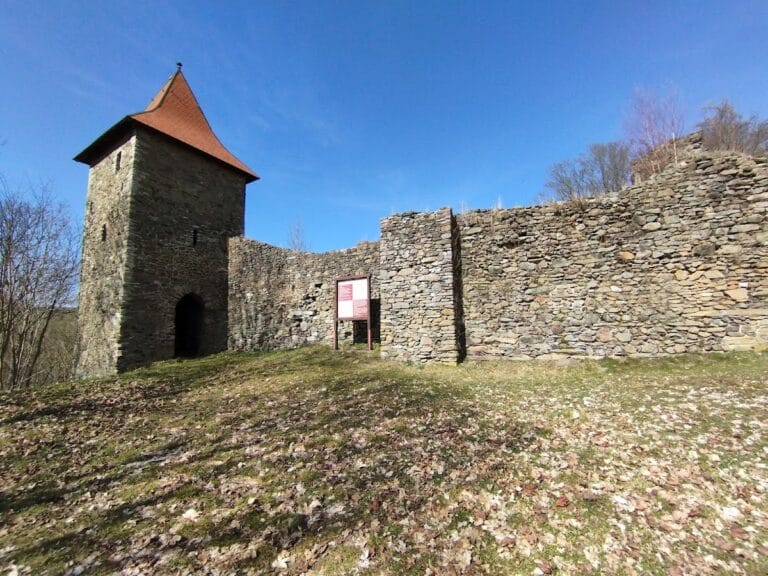
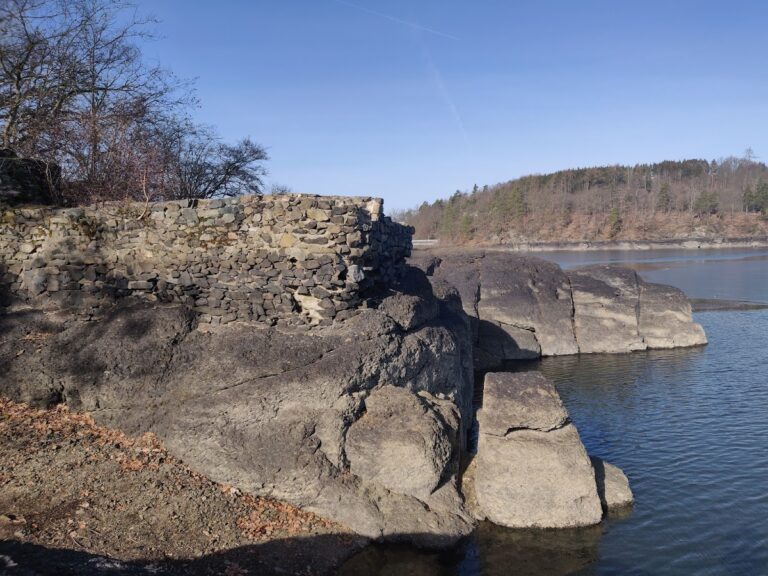
The surviving remains occupy a prominent hill above the village, where steep slopes protected the fortification on several sides. Observations from 1792 indicate an approximately oval ground plan. A ditch enclosed the small castle courtyard, and a bridge provided access across it to the main building at the far end.
Watchtower and enclosure
Parts of a watchtower survive outside the main enclosure, beside the bridge and immediately next to the steep slope. The physical remains therefore include the courtyard, sections of the watchtower, and the surrounding ditch.
A historical depiction presents the castle as an earthen rampart with a palisade fence, a defensive barrier made from upright stakes, and a wooden bridge. A circular curtain wall enclosed at least one main building and a tower. The upper part of that tower used half-timbering, a construction method based on a structural timber frame filled with another material. The depiction shows the castle burning during the attack of 1523, with the von Sparneck coat of arms above the entrance.
Brewery remains
The former brewery building has a lined ditch and a large cellar vault. These features indicate medieval origins within the building’s fabric and connect the later industrial use of the site with its earlier history.
Nearby sites