Monastery of Santa María del Roure: An Augustinian Sanctuary in Catalonia


Site at a Glance
- Rating
- 4.3
- Popularity
- Very Low
- Country
- Spain
- Primary era
- Medieval
- External website
- Open
- Eras represented
- Medieval, Early Modern
- Civilizations
- Crown of Aragon, Spanish
- Site type
- Religious
- Remains
- Monastery
On this page10 sections
History
The Monastery of Santa María del Roure is a ruined religious complex northwest of Pont de Molins, Spain, whose Romanesque church probably originated in the eleventh or early twelfth century. Dedicated to the Virgin Mary, it developed into an Augustinian sanctuary and later a pilgrimage centre, with a second church added in the seventeenth century. Its history combines communal religious life, feudal administration, Marian devotion, war damage, and the gradual decline of its resident community.
Foundation and Augustinian administration
The consecration date of the original church is unknown, but a legacy made in 1195 shows that it was already standing. During the thirteenth century, donations from Cabanes and Figueres increased, reflecting devotion to the Romanesque image of the Virgin Mary. The church was then administered by Augustinian canons, clergy who followed the Rule of Saint Augustine, a Christian rule requiring communal prayer, meals, and residence. They professed religious vows, celebrated the offices together, and shared their daily living arrangements.
The head of the community was the prior, who also acted as a pavorde, an ecclesiastical administrator responsible for the produce and income of assigned properties. These possessions came through various legacies, particularly those of the Castenallo family of Montmarí, local lords connected with a nearby castle. Francisca de Castenallo ordered the establishment of a benefice, an endowment supporting a cleric or religious service, at Santa María, where her ancestors were buried.
The church maintained an important relationship with Montmarí Castle during the twelfth century. A record dated 5 August 1290 states that the community collected rents, indicating that Santa María del Roure operated as a priory with feudal characteristics. Pastoral visits from the thirteenth through the sixteenth century name several priors, including Bernardo in 1286, Joan Prat in 1291, and Jaime de Serrat in 1294. Priors were expected to keep a bed available for poor people, although this duty was not consistently observed.
Community life and damage in the fourteenth century
The Carreres family had close ties to the monastery. A canon named Gaufral was the brother of Arnau de Carreres and the cousin of Guillem de Canadal. In 1314, three of the community’s four canons were Carreres: Marcos, Ramón, and Bernardo. Bernardo served as candler, responsible for candles and related devotional provisions, and was permitted to manage beehives.
The plague weakened the community sharply. In 1365, only three religious members remained: the prior or provost Bernat Carrera, the candler Bernat Negre, and Pere Guerau, the sacristan who cared for sacred furnishings and ritual arrangements. Some work was undertaken on the church during this period. The church and its image were devastated in 1389, an event later associated with the creation of a new Gothic image of the Virgin.
From 1392 to 1481, the community received annual licenses to collect alms throughout the Diocese of Girona for repairs after the Armagnac devastations. These military incursions caused damage in the region during a period of wider late-medieval conflict. A local tradition also places the disappearance of the Virgin’s image during the Remença War, a Catalan conflict involving peasant serfs and feudal obligations. According to the story, the community fled or was expelled, and the monks hid the image beneath a large oak.
Pilgrimage and the two images
After peace was restored in 1486, the monks were said to have returned but could not find the hidden image. The legend relates that a bull from the nearby Mas Jordà repeatedly pawed at the ground beneath the oak, guiding them to it. The image thereafter became known as the Virgin of the Oak. This account is a local tradition rather than an established historical event, but it shaped the sanctuary’s later identity.
Pilgrimage grew around the sanctuary after the damage of 1389. In 1413, Pope Benedict XIII authorized the collection of alms, referring to the sanctuary’s destruction, reported miracles, and large numbers of pilgrims. Bishop Andreu Bertran granted indulgences to those who came to pray and allowed the canons to hire assistant priests. In 1415, priests from neighboring parishes were permitted to celebrate twice on the same day and to officiate beneath a porch with a portable altar when the congregation exceeded the church’s interior capacity.
In 1440, the community comprised Ramón Sans, its prior, Mateu Sans, a canon, and Bernat Pujol, a serving priest. In later years, the Sans family came to control all membership of the community. The Gothic Virgin, an alabaster standing sculpture commissioned after the devastation, expressed contemporary Gothic taste and was not intended to displace the earlier seated Romanesque image.
Secularization and later care
The community continued to contract. Only one canon remained in 1534, and Pope Clement VIII secularized the church in 1592. Secularization removed the church and its superior from regular religious administration. The Augustinians had already abandoned El Roure, so the decree formalized an existing condition rather than ending an active communal foundation.
At the beginning of the seventeenth century, devotion to the Virgin of the Oak declined. A cleric named Jaume Puig financed a new church at the place where the image was believed to have been discovered. In 1638, the Gothic image was moved into that church and placed inside the old oak trunk. Processions began in 1639, and devotees removed splinters from the trunk because they believed them to have miraculous powers.
Reports of miraculous sweating intensified the sanctuary’s reputation. The image was said to have sweated during Mass on 24 March 1640 before people from Llers, and again on 29 January 1641 before people from Figueres. People from Llers reportedly witnessed the phenomenon on 6 and 7 February 1641, when the image of the Christ Child was also said to have sweated. The Chapter of Girona Cathedral sent a twelve-person delegation from its War Council to investigate. The group, comprising four canons, four beneficed priests, and four Capuchins, did not see the image sweat, but examined it for a concealed mechanism.
Both churches and their separate images remained in existence at the beginning of the eighteenth century. The complex was then cared for by a single pavorde, its only inhabitant. Anton Lavall was the last resident. He reformed and enlarged the newer church by adding lodging space, and after his death in 1765 he was buried at El Roure. The complex subsequently passed to the priests of Llers. Santa María del Roure is listed as a local cultural-interest property in the Catalan heritage register and is also identified on the Heritage Red List, with recorded declaration dates of 22 October 2008 and 20 January 2009.
Remains
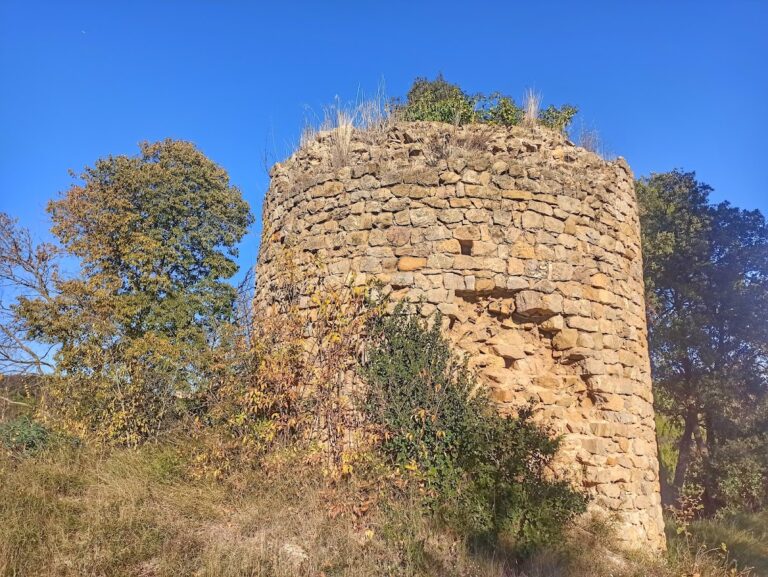
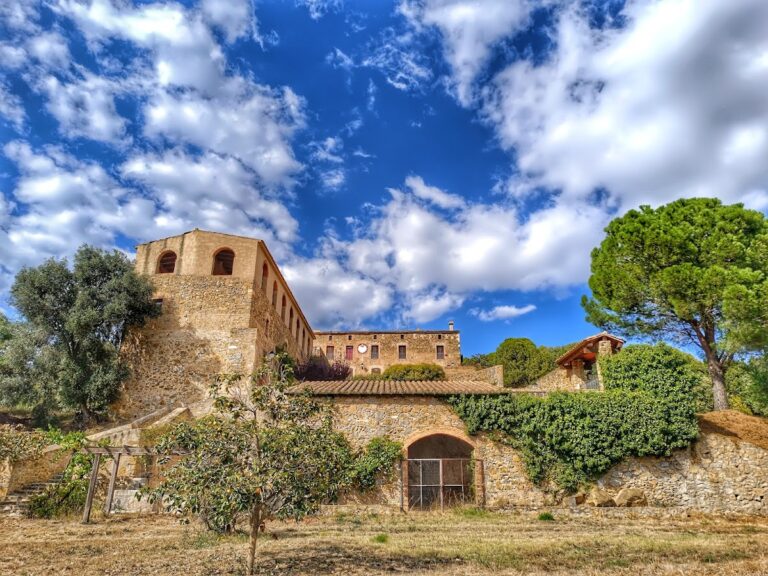
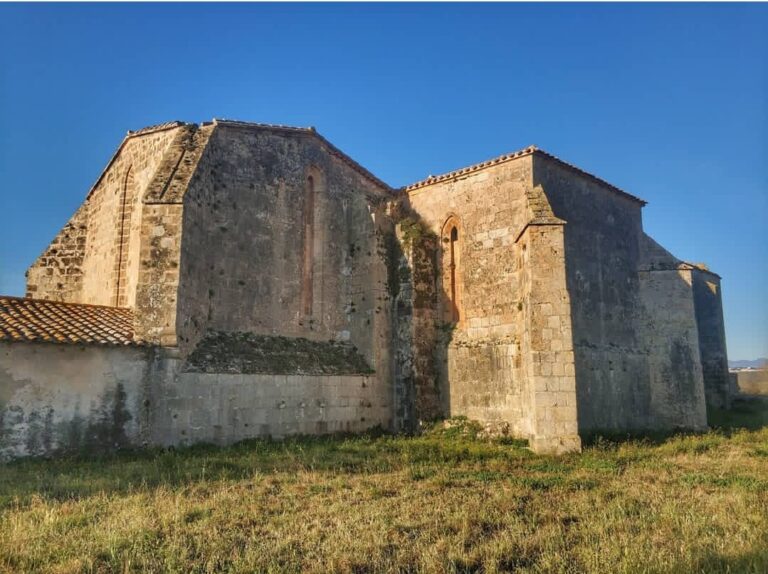
The ruined monastery stands at the summit of the Serra dels Tramonts, northwest of Pont de Molins in Alt Empordà, in a landscape described as covered with pine and olive trees. The surviving complex is predominantly Gothic, although its origins lie in the earlier Romanesque church. Its physical remains include the enlarged older church, a porch associated with large pilgrim gatherings, and the newer church built around the oak connected with the sanctuary’s devotional tradition.
Churches and devotional furnishings
Older church
The original Romanesque church was enlarged during the fifteenth century, producing the expanded fabric that survives among the predominantly Gothic remains. In 1326, its three altars included the high altar dedicated to Saint Mary, where the seated wooden Romanesque Virgin was kept, along with altars for Saint Luke and Saint Mary Magdalene. In 1340, two further altars were installed in a previously empty chapel, dedicated to Christ the Redeemer and Saint Anne. A Saint Augustine altar added in 1520 attracted relatively few devotees and remained until the end of the sixteenth century.
New church
Jaume Puig’s new church was built at the beginning of the seventeenth century on the site associated with the oak where the Virgin was believed to have been found. It measured approximately 7 metres in width and 22 metres in length. The Gothic Virgin, a standing alabaster sculpture, was later placed inside the old tree trunk within the church. By the early eighteenth century, the older church housed the Romanesque Virgin while the newer church housed the Gothic image, giving the complex two churches with distinct devotional images.
Reforms between 1532 and 1536 had placed the Gothic image on the older church’s high altar and moved the Romanesque Virgin to a side altar. The newer church was later enlarged by Anton Lavall, who added a lodging section for guests. The complex’s ritual use is also reflected in an inventory from 1548, which records thirty-three large, medium, and small candles offered by parish communities.
Pilgrim porch
A porch served gatherings that could not fit inside the church. In 1415, priests were authorized to celebrate beneath it using a portable altar, allowing religious services to continue when pilgrim numbers exceeded the interior capacity. The porch therefore formed part of the sanctuary’s built response to the demands of pilgrimage.
Nearby sites