Sant Feliu de Cadins: A Cistercian Nunnery in Cabanes


Site at a Glance
- Rating
- 4.8
- Popularity
- Very Low
- Country
- Spain
- Primary era
- Medieval
- External website
- Open
- Eras represented
- Medieval
- Civilizations
- Crown of Aragon
- Site type
- Religious
- Remains
- Church
On this page13 sections
History
Sant Feliu de Cadins is a former Cistercian nunnery in Cabanes, Spain, established in the mid-12th century in the Romanesque and Gothic architectural traditions. The Cistercian Order was a reform movement within Western Christianity that emphasized communal discipline, manual labor, simplicity, and separation from major population centers. Cadins became the principal Cistercian nunnery in the province of Girona and remained associated with a female religious community for more than 800 years.
Foundation and rise of the abbey
The foundation was made with nuns from Valldemaria, on which Cadins initially depended. In 1169, Pope Alexander III confirmed the name Santa Maria de Cadins, recognized Ermesenda of Valldemaria as its first abbess, and placed Valldemaria under Cadins as a dependent priory. An abbey was governed by an abbess or abbot, while a priory remained under the authority of another monastery. Cadins therefore became the superior house in this relationship.
The monastery occupied a secluded and fertile valley near the Muga River and the former Roman Via Augusta, later called the road to France. A spring still flows abundantly at the site. The foundation probably reused an earlier pre-Romanesque chapel dedicated to Saint Felix, which may have served a small rural settlement. Although the official dedication honored the Virgin Mary, historical documents more often called the monastery San Félix de Cadins or Sant Feliu de Cadins, reflecting the church’s original patron and the name associated with its nuns.
The Counts of Empúries, medieval rulers of the County of Empúries in northeastern Catalonia, protected and endowed the monastery with wealth acquired during the conquest of Mallorca. The nuns came mainly from the local nobility, with others arriving from Girona, Llabià, and more distant places. During the 13th and 14th centuries, the monastery expanded its property and prestige.
Cadins in the late medieval period
Cadins also entered the history of dynastic politics. On the night of 28 to 29 October 1295, Blanche of Anjou and her father, Charles II of Naples, stayed at the monastery before Blanche’s marriage to James II of Aragon at Santa Maria de Vilabertran. The marriage had been arranged through the Treaty of Anagni, a diplomatic settlement of 1295 that included the alliance between Blanche and the king of Aragon.
The community first requested a transfer from Cabanes to Girona in 1461 and moved there in 1492. Insecurity in the Catalan countryside, the Catalan Civil War, and flooding from the Muga may all have influenced the decision. Flooding had destroyed the village of Cabanes in 1421 and probably caused severe damage to the monastery. The nuns took the statue of the Virgin Mary and one of the monastery’s bells to Girona as symbols of the institution’s identity.
Worship continued for a time in the former church at Cabanes, but flood deposits buried its cemetery. The monastery’s property was later dispersed through sales and through 19th-century confiscation under the Desamortización, the Spanish process by which religious property was seized and sold. In 1517, the nuns sold their possessions at Cabanes to a private owner while retaining direct lordship over them. The agreement prohibited the sale of stone from the church, cloister, or cemetery. Ownership of the buildings subsequently changed several times, and attempts were made to end Mass and turn the church into a hayloft.
The community in Girona
In Girona, the nuns settled beside the parish church of Santa Susanna del Mercadal. An agreement with the parish rector, clergy, and lay workers gave the community use of the parish church for worship. In return, the nuns financed substantial improvements to the building.
Relations with Santa Susanna later deteriorated, leading the nuns to construct a new church on an adjoining plot. Completed in 1770, it restored the dedication Santa Maria de Cadins, after which Sant Feliu de Cadins gradually fell out of common use. In 1674, the community had nearly become extinct, but three young nuns sent from Vallbona de les Monges revitalized it. During the 18th century, daughters of prominent Girona families entered the monastery and brought revenues that helped sustain the community.
The nuns temporarily moved to Santa Maria de Valldonzella in Barcelona on 30 November 1794 because of insecurity during the war between the Spanish monarchy and the French Republic. They returned on 24 October 1795. The community also had to leave its convent during the Peninsular War and the Siege of Girona. By 1910, monastic life was experiencing a revival of vocations, and the monastery housed 18 nuns and two novices.
Destruction and successive relocations
On 20 July 1936, during the Spanish Civil War, militias forced the community to leave Girona. The monastery and cemetery were looted and desecrated, and the buildings were completely demolished during the following weeks. A proposed municipal market was never realized, while an air-raid shelter was built in the former monastery courtyard. The demolition may also have been linked to plans to open this part of the city, since the church narrowed the street and prevented two carts from passing.
The statue of the Virgin Mary and one of the two bells survived the destruction and are preserved at the church of San Medir. The thirteen nuns regrouped in Girona in 1939 and lived in severe poverty in a flat on Sant Josep Square until moving to Salt on 16 February 1944.
In Salt, the community occupied Casa Tarrés, where it remained until 1980. The nuns supported themselves through a bookbinding workshop. Urban transformation in central Salt encouraged them to seek a more secluded monastery. A proposed move to Santes Creus in 1962 was rejected because the offered building was not the monastery and was unsuitable.
Monastic life began at Sant Medir on 7 October 1980, after the community selected the site from several locations in neighboring municipalities. The nuns initially used existing buildings before constructing a new monastery. The present church stands on ground that had housed a Benedictine community in 829 under the dedication of Saints Emeterius and Genesius. A lack of vocations led the last nuns to leave in the early 2000s and move to Valldonzella, ending the long female Cistercian presence in the Girona region. The community’s successive locations were Cabanes from 1169 to 1492, Girona from 1492 to 1944, Salt from 1944 to 1980, and Sant Medir, in the municipality of Sant Gregori, from 1980 to 2000.
Remains
The former complex at Cabanes
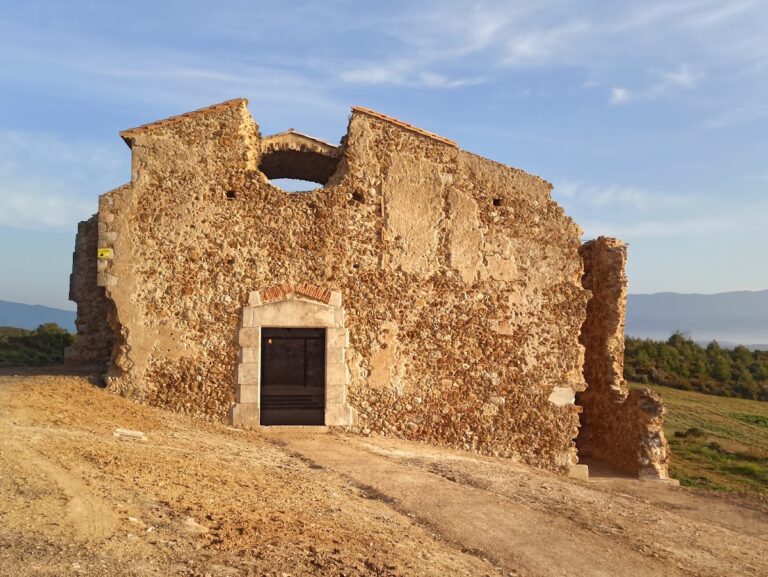
The former Cistercian complex at Cabanes retains only its church. It is attached to a rural dwelling and is now used as a storage building for an agricultural enterprise. The associated property continues to be known as Mas de Sant Feliu. The church has a Latin-cross plan, a six-bay nave, an eastern apse, and a transept measuring 21.5 meters. Its nave is 42.5 meters long and 10 meters wide.
Church of Sant Feliu
The nave has a pointed barrel vault, while the apse has a simple rib vault. Large, carefully squared and polished ashlar blocks form the walls. The nave belongs to the late Romanesque tradition, while the eastern end is Gothic. Their different forms indicate that the two parts were probably built by different builders, with a possible lengthy interruption between the construction of the nave and the apse. The nave is generally dated to the end of the 12th century, while the eastern end belongs to the second half of the 13th century or later.
Five transverse arches were intended to divide the nave into bays, supported externally by buttresses. The arches were never built, but the corbels prepared to receive them remain attached to the walls. In the north arm of the transept and in the apse, the vault ribs meet in small reliefs bearing circular representations of the Agnus Dei, the Lamb of God, a Christian symbol of Jesus Christ.
The church originally had two entrances. A round-headed doorway opens in the south wall of the nave, while a pointed-arch doorway was placed in the west wall of the north transept arm. The latter entrance has since been paved over. A stone memorial plaque for Abbess Francisca de Espasens, who died in 1403, remains embedded in the exterior wall of the apse.
Cloister
The cloister stood south of the church, in the angle formed by the nave and transept. Its relationship to the church reflects the arrangement of the former monastic complex, while the surviving building at Cabanes is now limited to the church itself.
Later monastic buildings
Girona monastery
In Girona, the monastery was attached to the north facade of Santa Susanna del Mercadal and had direct access to the parish church. The separate 18th-century church of Santa Maria de Cadins, completed in 1770 on an adjoining plot, has been destroyed. The former monastery entrance was reached through a small square opening onto the street. That square was later removed, and the site now contains the entrance to a healthcare building.
Casa Tarrés in Salt
At Salt, the nuns adapted Casa Tarrés for monastic use. The building was constructed in 1868 in the neoclassical style, and the community added the characteristic bell tower that forms part of its facade. Casa Tarrés now houses the Les Bernardes cultural center.
Sant Medir
At Sant Medir, the community first occupied existing buildings before building a new monastery. The present church stands on a site associated with the Benedictine community established there in 829 under the dedication of Saints Emeterius and Genesius.