Monastery of Sant Daniel: A Benedictine Nunnery in Girona


Site at a Glance
- Rating
- 4.4
- Popularity
- Low
- Country
- Spain
- Primary era
- Medieval
- External website
- Open
- Eras represented
- Medieval
- Civilizations
- Crown of Aragon
- Site type
- Religious
- Remains
- Monastery
On this page10 sections
History
The Monastery of Sant Daniel is a Catholic Benedictine nunnery in Girona, Spain, founded as a women’s monastery in 1018. It remains an active religious community and is described as the only Benedictine community in Catalonia still occupying the place where it was founded.
Traditions and foundation
According to tradition, St. Daniel was martyred at Arles during an Arab invasion in 888. His disciples carried his remains south and buried them in the valley later associated with Sant Daniel. A small church dedicated to St. Salvador and St. Daniel already stood there, and growing pilgrimage to the burial place led to the construction of a church dedicated to the saint’s veneration.
On 16 June 1015, Countess Ermesenda and Count Ramon Borrell bought the small church and adjoining lands from Pere Roger, bishop of Girona, to establish a women’s monastery. They paid 100 ounces of pure gold and four mujadas of land in Girona’s Mercadal. The transaction also assisted the bishopric in repairing Girona Cathedral, where serious water penetration had made worship impossible during storms.
On 15 March 1018, the widowed Ermesenda and her son Berenguer Ramon I donated the lands to the religious community. This act is regarded as the monastery’s official foundation. The institution was first recorded under the name Sant Daniel in 1028, when Bonafilla was mentioned as its first documented abbess.
Growth under Benedictine rule
The Benedictine order is a Western Christian monastic tradition governed by the Rule of St. Benedict, which emphasizes communal worship, disciplined daily life, and work. The community reportedly began with six nuns, grew to twelve in the thirteenth century, and numbered twenty in 1342. The nuns came from noble or wealthy families, and their family donations contributed to the monastery’s prosperity.
During the fifteenth and sixteenth centuries, the Holy See incorporated several declining Benedictine establishments into Sant Daniel. These included Santa Maria del Mar of Calonge, Santa Margarita of Prat de Roses, and the priory of Valldemira near Hostalric.
New regulations associated with the Council of Trent were introduced at Sant Daniel in 1578. The Council of Trent was a major sixteenth-century Roman Catholic council whose reforms strengthened religious discipline and regulated institutions, including enclosed communities of nuns. At the monastery, the new rules ended earlier arrangements that had allowed individual rooms and servants, making communal life more restrictive.
War, displacement, and rebuilding
Because Sant Daniel stood outside Girona’s defensive walls, warfare repeatedly forced the community to leave. In 1640, during the Reapers’ War, the nuns took refuge in houses belonging to the Archdeaconry of Empordà. The monastery was also repeatedly attacked and looted during the period of warfare between 1681 and 1819.
During the War of the Convention from 1793 to 1795, a conflict in which revolutionary France fought Spain and other European powers, French troops took Figueres and advanced toward Girona. The nuns spent almost a year at the Monastery of Sant Antoni and Santa Clara in Barcelona. At Sant Daniel, the buildings were used as a barracks and were severely damaged by fire before the community returned in 1795.
The Peninsular War of 1808 to 1814 brought another disruption. The nuns again took refuge within Girona, while the monastery served as a barracks and military hospital. A later and more destructive fire left only the church and cloister standing. The community lived together in a rented house while the minimum facilities were rebuilt, returning to the monastery in 1819.
Modern disruptions and continuity
The state confiscated the monastery in 1835, although the nuns continued to live there. During the Spanish Civil War of 1936 to 1939, they were expelled, and the complex was used as a school called “Pi y Maragall” and as housing for war refugees. It remained under military control after the war until 1940, when it was returned to the community.
The monastery’s historical documents preserve an almost complete succession of abbesses, with some gaps before 1548. The complex was officially declared a monument on 3 June 1931.
Remains
The medieval church
Little of the original complex survives. The oldest substantial remains belong to the central body of the church, which was renovated in the twelfth century. The building was based on the monastery church of Sant Pere de Galligants and was slightly larger, with a similar crossing tower and central apse. Unlike its model, Sant Daniel included a transept, the part of a church that crosses its main axis, giving the building a Greek-cross plan with arms of similar length.
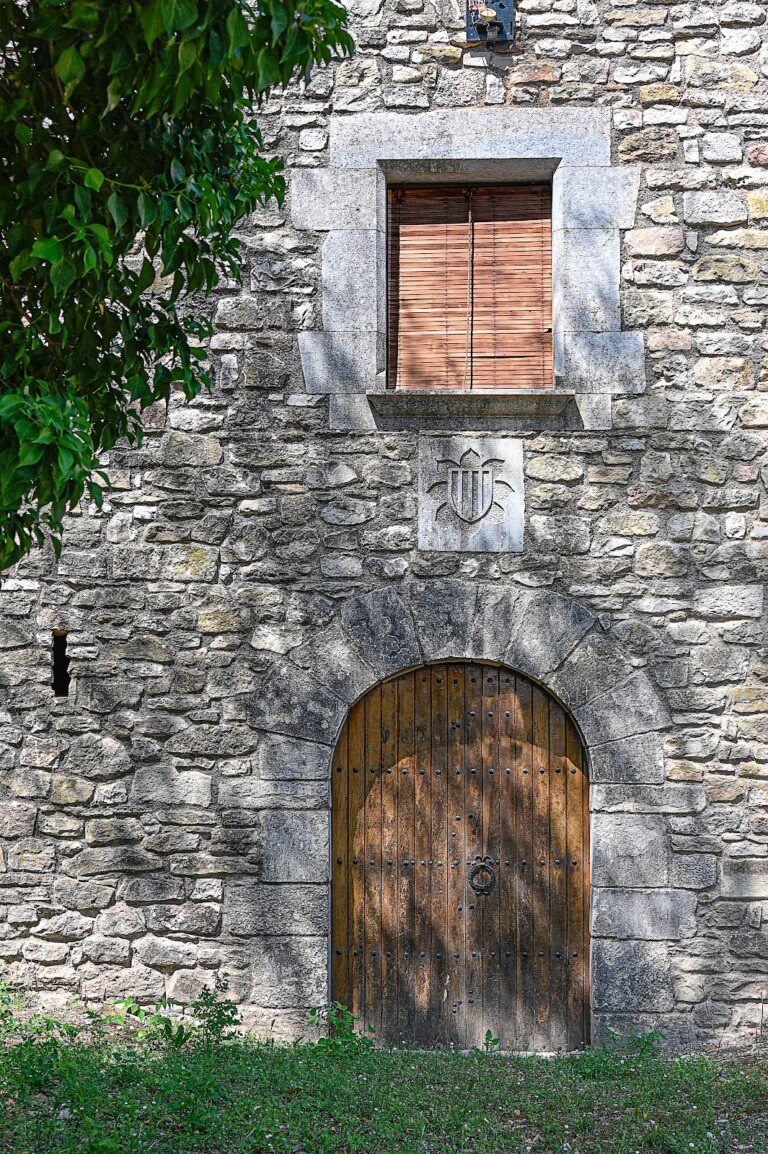
The primitive church vault has disappeared. The facade was enlarged, but the earlier facade remains visible at its centre. The original portal was replaced in the fifteenth century, providing a later alteration within the surviving medieval structure.
The crypt and Saint Daniel’s sarcophagus
A small crypt, a chamber beneath a church used for burials or the veneration of relics, preserves the devotional focus associated with St. Daniel. His remains are traditionally venerated there. They are enclosed in a Gothic sarcophagus of polychrome alabaster, a coffin carved from alabaster and finished in multiple colours, made in 1345 by Aloi de Montbrai on the orders of Bishop Arnau de Montrodon.
A carved figure of the saint occupies the top of the sarcophagus, while six scenes from his life decorate its sides. The remains were said to have been discovered in 1343, prompting the community to renew the cult of the relics and commission the tomb two years later.
The cloister
The rectangular cloister, a covered walkway enclosing an open courtyard, has two storeys. Its lower level dates from the thirteenth century and contains Romanesque decoration, paired columns, and Corinthian-style capitals, which are capitals enriched with elaborate foliage ornament. The upper storey dates from the fifteenth century and is considerably simpler, with Gothic forms.
Two of the cloister’s galleries are twice as long as the other two. The different dates and styles of the two levels preserve the monastery’s architectural development across the thirteenth and fifteenth centuries.
Alabaster sculpture
The monastery also contains an alabaster sculptural group of uncertain date and origin, stylistically placed between the Gothic and Renaissance periods. It consists of five human figures. The identifiable figures are the Virgin, the Three Marys, and St. John the Evangelist, while the missing central figure may have represented the recumbent Christ.