Church of St Mary the Virgin, Harlow: The Parish Church of Ancient Latton


Site at a Glance
- Rating
- 4.7
- Popularity
- Very Low
- Country
- United Kingdom
- Primary era
- Medieval
- External website
- Open
- Eras represented
- Medieval, Early Modern, Modern
- Civilizations
- English, Norman
- Site type
- Religious
- Remains
- Church
On this page17 sections
History
Church of St Mary the Virgin is a Norman Church of England parish church in Harlow, United Kingdom, built by the Normans in 1087. It served the ancient parish of Latton and remains associated with the northern portion of the parish created after Harlow New Town was established in 1947. The church has a Liberal Catholic tradition, emphasizing continuity with Catholic liturgical and sacramental traditions within the Anglican church, and belongs to the Diocese of Chelmsford in the Province of Canterbury.
Medieval parish church
The Norman building formed the centre of worship for Latton during the eleventh and twelfth centuries. Its west tower had been constructed by 1234. The medieval clergy included Roger and Anfred, priests of Latton around 1198, who may have served as joint rectors. Ernold, chaplain of Latton from about 1220 to 1234, died after falling from the church tower in 1234. Simon was recorded as rector around 1260, while Walter was mentioned in 1317 as a deceased rector.
Roger de Overe, recorded in 1358, was the first known vicar of Latton. William of Gaddesden was instituted as vicar in 1361 and was described as a canon of Latton. Fourteen successive vicars served between 1430 and 1503, at least seven of whom resigned. The change from rectors and other medieval clergy to a known succession of vicars reflects the continuing administration of the parish through the later Middle Ages.
The Arderne chapel and Tudor rebuilding
A north chapel for Sir Peter Arderne’s chantry was completed in 1466. A chantry was a chapel or endowed religious foundation established for the continuing celebration of prayers or masses for a particular person or family. Sir Peter Arderne, a fifteenth-century English landowner and member of the gentry, and his wife Bohun were commemorated by an altar tomb placed between the chapel and the chancel, the eastern part of the church around the principal altar.
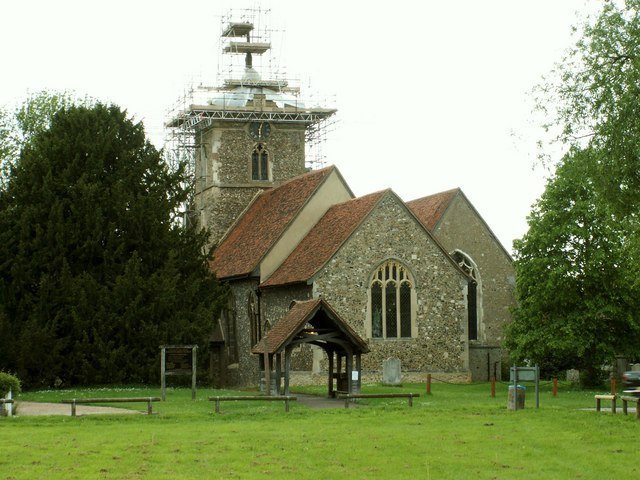
The Altham family, owners of the Mark Hall Estate, added the porch in 1562. During the late sixteenth century, the tower and the western end of the nave, the main central part of the church, were rebuilt. These works gave the medieval church important later elements while preserving evidence of its Norman origins and its subsequent development.
Later alterations and vicars
Around 1800, the exterior north wall of the nave was faced with brick. Its doorway and windows were closed and covered with plaster at the same time. The church underwent a series of nineteenth-century interventions, including interior restoration in 1848, extensive repairs to the tower in 1873, and extensive repairs to the chancel in 1888.
The later vicars included Thomas Denne, who served from 1600 to 1632, followed by Thomas Denne Jr. from 1632 to 1680. Michael Altham held the living from 1680 to 1705, Roger Altham from 1705 to 1730, and James Altham from 1730 to 1758. An unidentified vicar served between 1758 and 1801, followed by Charles Miller from 1801 until about 1820, Joseph Arkwright from 1820 to 1850, and Julius Arkwright from 1850 to 1864. William Pitt Wigram served from 1864 to 1870, William Oliver from 1871 to 1886, Spencer Nairne from 1886 to 1905, and Austin Oliver from 1905 to 1942.
War damage, fire, and the modern parish
A V-1, a German pilotless flying bomb used against Britain during the Second World War, damaged the church in 1945. The blast destroyed the stained-glass windows on the south side. Extensive repairs followed, and the church reopened in 1950.
In 1947, the creation of Harlow New Town and the resulting population growth led to the division of the ancient parish into three. The northern portion retained the name of Latton, preserving the church’s connection with the older parish. A fire in 1964 caused further damage and destroyed the rood screen, the partition traditionally separating the chancel from the nave. The fire was thought to have started when a workman’s cigarette rolled into the organ. A parishioner tending her son’s grave detected the fire at an early stage, but the church still required complete restoration in 1965.
A vestry, a room used by clergy and church officers for preparation and storage, was added on the north side of the nave in 1971. The tower was restored again in 1977. The church was designated a Grade I listed building on 9 July 1950. Grade I is the highest category of statutory protection for buildings of exceptional architectural or historic interest in England.
The postwar vicars were J. Oliver White, 1951 to 1954; Peter O’beirne, from 1954 until about 1960, with the spelling of his name uncertain; Ian Stuchbery, 1963 to 1969; Barry Rose, 1969 to 1979; John Pratt, 1979 to 1988; Peter Beech, serving before 1992 until his retirement in 1999; Shaun Conlon, 1999 to 2007; and Lynn Hurry, from 2008.
Remains
Medieval and early modern fabric
Norman church
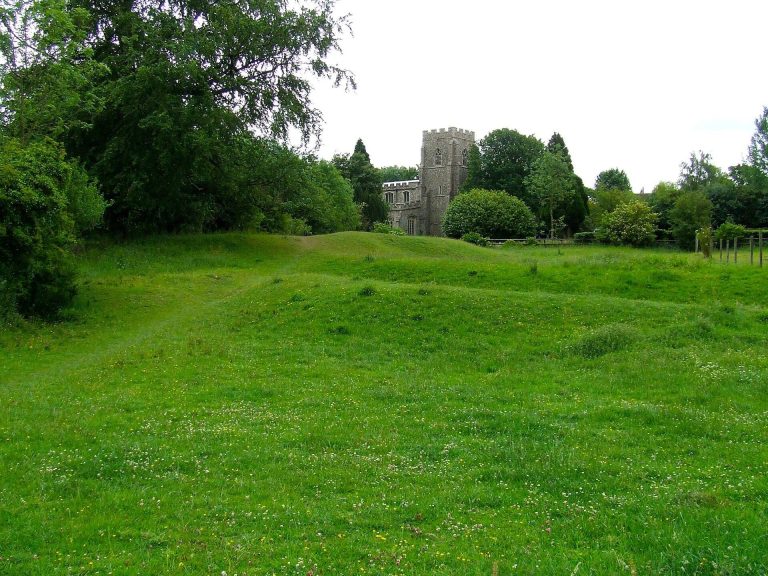
The surviving building retains its Norman character and includes a Norman window in the south wall. The arch of the Norman doorway remains visible above the now-disused south door, providing physical evidence of the early church. The building’s fabric also incorporates later alterations that reflect its continued use as the parish church of Latton.
West tower
The west tower dates from no later than 1234. It was rebuilt during the late sixteenth century, extensively repaired in 1873, and restored again in 1977. Its present fabric therefore brings together a medieval foundation, Tudor-period rebuilding, and later repair campaigns.
North chapel and altar tomb
The north chapel was completed in 1466 for Sir Peter Arderne’s chantry and retains fragments of wall decoration. It opens to the chancel. Between the chapel and chancel stands the altar tomb of Sir Peter Arderne and his wife Bohun, dated 1467 and bearing fine brass effigies, engraved metal representations of the deceased associated with the raised tomb.
Porch and north wall
The porch was added in 1562 by the Altham family. The tower and the western end of the nave were rebuilt during the late sixteenth century. Around 1800, the nave’s exterior north wall was faced with brick, while its doorway and windows were closed and covered with plaster. A vestry was added on the north side of the nave in 1971.
Monuments and memorials
Arderne brasses
The altar tomb of Sir Peter Arderne and Bohun is dated 1467. A separate brass dated 1492 probably represents Sir Peter Arderne’s daughter Elizabeth and her husband Richard Harper. Together, these memorials preserve the connection between the north chapel and the Arderne family.
Altham monument
An alabaster monument dated 1583 shows the kneeling figures of James Altham, his wife, and their eleven children. Sir Edward Altham’s marble monument, dated 1632, has pilasters, a pediment, urns, and angels. These monuments reflect the long association of the Altham family with the church and the Mark Hall Estate.
Franklin and Wolley brasses
Brasses commemorate Frances, the wife of Richard Franklin, in a memorial dated 1604. Another brass commemorates Emanuel Wolley, dated 1617, and his wife Margaret, dated 1635.
Wall tablets
A wall tablet commemorates the vicar Thomas Denne and dates from 1680. Other tablets commemorate Leventhorpe Altham, Roger Altham, Peyton Altham, Stephen Lushington, Frances Elisabeth Campbell, née Burgoyne, Robert Arkwright, and Loftus Arkwright. Peyton Altham’s tablet bears a large coat of arms.
Restored interior
The interior was restored in 1848, and the chancel received extensive repairs in 1888. The south-side stained-glass windows were lost in the 1945 V-1 damage. The 1964 fire destroyed the rood screen, after which the building was completely restored in 1965. These interventions form part of the surviving church, alongside the Norman window, medieval chapel, later tower, and its collection of memorials.