Church of Saint Margaret in Loukov: A Medieval Filial Church in Czechia


Site at a Glance
- Rating
- 4.8
- Popularity
- Very Low
- Country
- Czechia
- Primary era
- Medieval
- Eras represented
- Medieval, Early Modern, Modern
- Civilizations
- Habsburg, Holy Roman Empire, Kingdom of Bohemia
- Site type
- Religious
- Remains
- Church
On this page12 sections
History
The Church of Saint Margaret in Loukov, Czechia, was built in the fourteenth century and belongs to the group known as the churches below Lipnice Castle, together with the churches in Dolní Město and Řečice. It is first recorded in the papal tithe registers in 1352, when the now-vanished village of Loukov was also mentioned. At that time, the church was a parish church paying an annual tithe of six groschen.
The medieval estate and its patrons
Loukov was a small independent medieval estate, and its owners acted as patrons of the church. Their right of presentation allowed them to nominate a priest for appointment. Dobroslava, the widow of Naček of Lúké, exercised this right in 1355. She was probably the same woman later recorded as Vratna in 1356 and 1371, when she acted together with her sons Mikuláš, Naček, and Lev.
The patronage passed among members of the local ruling family. Mikuláš of Lúké presented a priest in 1380, while Naček of Lúkého did so in 1396. Between 1399 and 1407, Naček acted with his stepson Václav, Matěj of Lúkého, and Lev of Lúkého. Donations also supported the church. Naček and Václav gave money in 1397, and Lev, also known as Léva, made a donation in 1406, with part of it intended for repairs.
Changes in ecclesiastical and estate administration
After the Battle of White Mountain, the church ceased to serve as the seat of its own parish. Along with the churches in Dolní Město and Řečice, it became a filial church, meaning a church dependent on a parish church. It was first attached to the parish church in Světlá nad Sázavou. When the Lipnice parish was restored, probably in 1694, all three churches became filial churches of Lipnice, a status they have retained.
The three churches shared an ecclesiastical history but did not always have the same landed overlords. During the confiscation of the Trčka estates, Loukov and Řečice were attached to the Chotěboř estate, first belonging to the Rašín family of Rýzmburk and later to the Kinsky family. After 1714 they were separated from Chotěboř. In 1724 they were attached to the Lipnice estate, separated from it again in 1741, and incorporated into the newly established Loukov estate of the glassmaking Adler family. In 1763, the last Loukov owner from the Adler family sold the estate to Count Palma, who owned the Lipnice estate. The three churches then once again shared the same patron.
Repairs from the eighteenth to the early twentieth century
A new bell was acquired for the tower in 1739. Church accounts surviving from 1774 onward record shingle roofing in 1781, the repair and replacement of pews by the carpenter Myška in 1791, and organ repairs in 1796. Between 1848 and 1856, repairs were carried out at all three churches. At Loukov, a glass chandelier was installed in 1852, possibly at the nearby Loukov glassworks.
The builder Hradecký of Světlá nad Sázavou repaired the church in 1893, and a painter from Meziklas decorated the wooden gallery with festoons in 1912. In 1914, the builder and architect Emil Prückner of Světlá nad Sázavou repaired all three churches, mainly by undertaking roofing work. The Loukov project had been prepared by the heritage conservator and architect Boža Dvořák, although the completed work was much less extensive than his proposal. Extensive repairs were repeatedly requested during the 1920s. The church was reportedly repaired and given a new roof in 1928, but the work appears to have been limited. In 1925, patronage passed from the Trauttmansdorff family to the landowner Josef Kolář.
Twentieth-century conservation
Major repairs took place during the Second World War, from 1941 to 1944. Boža Dvořák initiated, coordinated, and designed the work in cooperation with the contemporary heritage conservator Hugo Doskočil, a prelate of Hradec Králové, while following the instructions of the Heritage Office. The medieval wall paintings were uncovered in 1941 by the Humpolec painter B. Šubrt.
The Church of Saint Margaret has been protected as a cultural monument of the Czech Republic since 1963. In 2009, the Association of Friends of the Churches below Lipnice carried out extensive reconstruction, including work on the shingle roof and plasterwork. The association continues to promote the repair and revitalization of all three churches in the group.
Remains
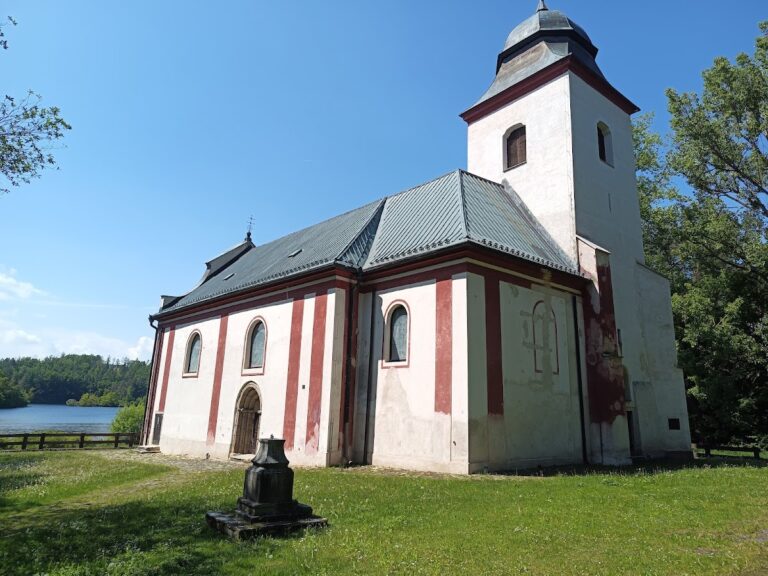
The church is a stone building laid in mortar, with a nave, presbytery, and sacristy. A square tower added during the second half of the seventeenth century forms part of the church. The building was covered with shingles, a roofing material also used in later repairs. In 1838, the church stood near an emphyteutic manorial farmyard below the Loukov glassworks. The same inventory listed five windows and three doors, including the entrance to the sacristy.
Interior arrangement and furnishings
The interior contained three altars. The main altar was dedicated to Saint Margaret, while the right-hand altar honored Saint Catherine and the left-hand altar Saint Barbara. The church also had a wooden pulpit, twelve pews, and a confessional in the sacristy. The organ stood on the choir gallery, which was reached by its own stairs from the cemetery. It was a small positive organ, a compact type of organ, with a small pedal and four mutation stops that produced pitches other than the fundamental tone. Two pews stood on the gallery, and the tower held two bells. An entrance to the gallery was located beside the tower.
Cemetery structures
In 1840 and 1841, Martin Fitz built a mortuary and a cemetery wall in the church grounds. These works formed part of the physical setting around the church and its cemetery.
Medieval wall paintings
Nave paintings
The nave contains medieval wall paintings of relatively high artistic quality, dated to the last decade of the fourteenth century. On the north wall are images of Saint Matthew and Saint Christopher, together with a fragment showing the Lamentation of Christ. Several bands of scenes cover the east wall, including the Crucifixion, the Last Supper, the Pieta, and the Sacrifice of Cain and Abel. The opposite nave wall depicts the Martyrdom of the Ten Thousand Knights and Saint George Fighting the Dragon.
Presbytery and sacristy paintings
The north wall of the presbytery shows the Sorrowful Christ with the instruments of the Passion, known as the Arma Christi. These objects include such symbols as the cross, scourges, crown of thorns, and nails. Other surviving paintings depict scenes from the life of Saint Margaret, the Christian martyr and saint traditionally associated with protection during childbirth and resistance to persecution.
Restored fabric and furnishings
During the repairs of 1941 to 1944, the carpenter Tvrdý made a new wooden coffered ceiling, formed from recessed decorative panels, following the pattern of the deteriorated earlier ceiling. The roof was again covered with shingles. Miroslav Baše, Karel Stehlík, and Eugen Weidlich restored the wall paintings uncovered during the work. Rudolf Šoula of Kejžlice supplied new paving.
Taťána Hošková, Věra Nováková, and Karel Stehlík created a new Stations of the Cross based on those in the church at Řečice. The woodcarver Drahozal of Humpolec repaired the main altar. The joiner František Michálek made a new altar table and pews and repaired the wooden gallery and pulpit, working on the gallery with the Lipnice painter J. Stojan. The 2009 reconstruction renewed the shingle roof, plasterwork, and other parts of the church fabric.