Hospitalkirche St. Jakob (Zittau): A Gothic Hospital Church in Germany


Site at a Glance
- Rating
- 4
- Popularity
- Very Low
- Country
- Germany
- Primary era
- Medieval
- External website
- Open
- Eras represented
- Medieval, Early Modern
- Civilizations
- Habsburg, Holy Roman Empire, Kingdom of Bohemia
- Site type
- Religious
- Remains
- Church
On this page7 sections
History
Hospital origins and medieval development
Hospitalkirche St. Jakob (Zittau) is a fourteenth-century Gothic hall church in Germany, dedicated to St. James the Elder and established in connection with the St. Jakob hospital outside Zittau’s historic gates. The hospital’s origins are traditionally placed around 1290, although no foundation charter survives. Its site was granted as a feudal holding without service obligations by the Lords of Donyn, the burgraves of Grafenstein, and the Johanniter Order is traditionally credited with founding the institution.
On 13 May 1303, King Wenceslas of Bohemia and Poland placed the hospital under the joint administration of the Zittau town council and the local Crusader commandery. The council handled secular affairs, while the commandery, a religious house, oversaw spiritual matters. A Corpus Christi chapel, also known as the Hospital Church, stood near the hospital before 1352. Its foundation was traditionally associated with Charles IV, the fourteenth-century Holy Roman Emperor and King of Bohemia. An altar was endowed in 1352, a bell tower followed in 1364, and further endowments were made in 1368 and 1396. A chapel probably dedicated to St. Martin was also recorded near the church in the late fourteenth century, likely to its southeast.
War, reform, and rebuilding
The Hussite Wars, fifteenth-century religious and political conflicts in Bohemia and surrounding regions, brought severe damage to the hospital. Its fields, properties, and buildings were devastated or burned, provisions for the poor were stolen, and many important documents were destroyed. Worship ceased for a time, but the hospital soon repaired the damage and recovered its economic position. The hospital and church were renovated in 1464.
The institution survived the Reformation and other sixteenth-century upheavals relatively well. In 1580 it cared for 25 poor people. The church’s galleries were installed in 1617, and its pulpit dates from 1680. During the Thirty Years’ War, which lasted from 1618 to 1648, the hospital buildings were burned in 1634 and used as fortifications in 1643.
The interior was renovated in 1721 to mark the 200th anniversary of Lorenz Heidenreich’s appointment as preacher at St. Jakob, an event associated with the introduction of the Reformation in Zittau. Mayor Johann Christian Nesen, Karl Philipp Stoll, Christoph Friedrich Kessler, and Pastor Gottfried Benjamin Martini supervised the work. During the Seven Years’ War, fought from 1756 to 1763, the church suffered major damage in the Zittau fire of 1757. Its copper roof turret, made in 1678, burned, and a replacement tower above the gable wall was completed in 1778.
Later institutional history
The original hospital no longer existed by the nineteenth century. An elongated building north of the church appeared in an 1845 depiction and survived at least until the beginning of the twentieth century, but it later disappeared. Beside St. Jakob Hospital stood the Holy Spirit infirmary, probably a care facility for lepers and seriously ill people who could not afford admission to St. Jakob Hospital. A nearby chapel was probably dedicated to St. Gertrude.
The adjacent hospital foundation was dissolved on 12 September 1952. The city then operated the hospital building and other facilities as the Rosa Luxemburg retirement home. After the facilities deteriorated following German reunification, they were transferred in 1994 to St. Jakob Zittau Residential and Nursing Home GmbH, and extensive renovation began in 1999. The former hospital chapel served the Evangelical Methodist congregation from 1990 to 2023.
Remains
Church layout and exterior
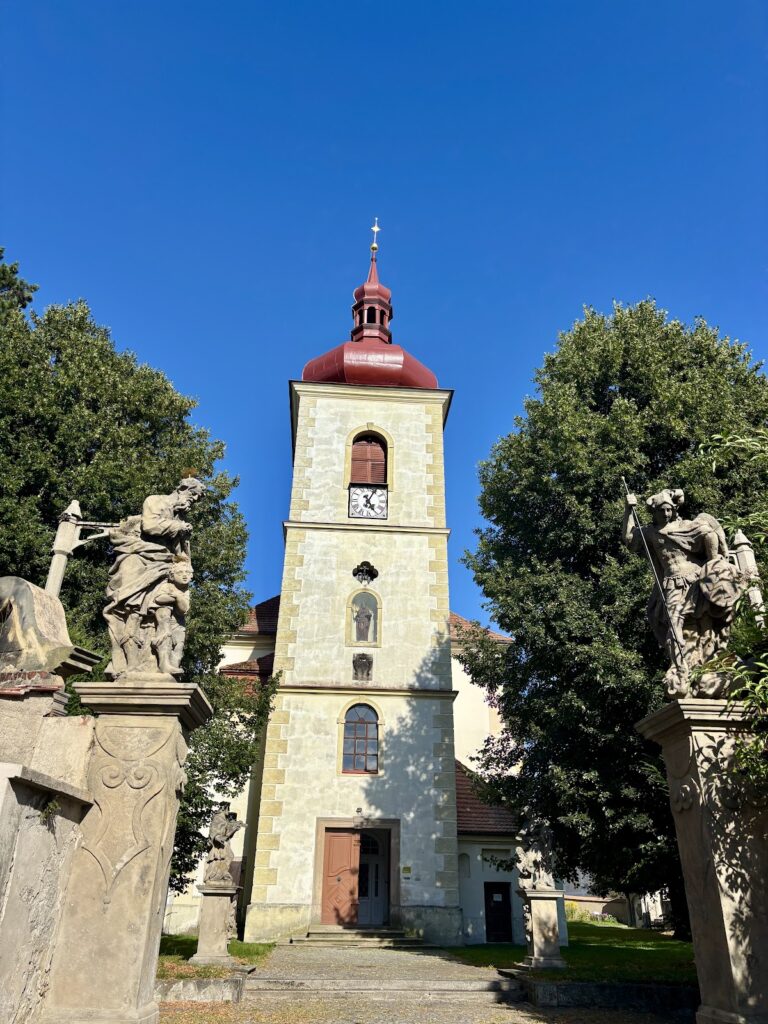
Hospitalkirche St. Jakob is a Gothic hall church, a design in which the nave and aisles form one unified interior of approximately equal height. The building stands at the junction of Friedenstrasse and Christian-Keimann-Strasse and remains associated with the former hospital complex outside the historic city gates. Its exterior includes a bell tower and a later tower rising above the gable wall. The later tower was completed in 1778 after the earlier copper roof turret was destroyed by fire in 1757.
Interior features
The interior retains galleries dating from 1617 and a pulpit from 1680. An inscription tablet preserves the memory of the 1721 renovation and links that work with the 200th anniversary of Lorenz Heidenreich’s appointment at St. Jakob. The church’s physical setting also preserves the relationship to the former hospital grounds, including the area where the St. Martin chapel probably stood southeast of the church.