Braunau in Rohr Abbey: An Augustinian Foundation and Benedictine Abbey in Germany


Site at a Glance
- Rating
- 4.6
- Popularity
- Low
- Country
- Germany
- Primary era
- Early Modern
- External website
- Open
- Eras represented
- Medieval, Early Modern
- Civilizations
- Holy Roman Empire
- Site type
- Religious
- Remains
- Monastery
On this page10 sections
History
Braunau in Rohr Abbey is a former Augustinian Canons’ monastery in Rohr, Germany, founded in 1133 and rebuilt in Baroque form during the late seventeenth and eighteenth centuries, with Rococo interiors. It later became a Benedictine abbey dedicated to Saint Wenceslas of Bohemia after monks expelled from Braunau Abbey in Czechoslovakia settled there after the Second World War.
Foundation and Medieval Development
Adalbert of Rohr established the monastery after the death of his wife in their childless marriage. He transferred his property to the Bishop of Regensburg on the condition that a monastery be founded at Rohr and that he be allowed to enter it. On 10 October 1133, Bishop Heinrich I of Regensburg appointed Bruno as the community’s first provost. The Augustinian Canons were clerics who lived in community under the Rule of Saint Augustine while undertaking religious and pastoral duties.
Pope Innocent II placed the monastery under apostolic protection in 1136 and confirmed its observance of the Augustinian Rule. Pope Eugene III renewed that confirmation in 1153. In 1158, Emperor Frederick Barbarossa granted the monastery imperial protection and confirmed its possessions. The Abensberg family held its bailiwick, the lay guardianship responsible for protecting the monastery and its interests, from 1138 until the family became extinct in 1485. The Wittelsbachs then assumed the role.
The community encountered serious internal and external difficulties during the middle of the thirteenth century. It became involved in conflicts with the Counts of Moosburg, a medieval noble family in Bavaria, while disagreements also divided the canons. Bishop Leo of Regensburg suspended Provost Konrad II from office for sixteen months after Konrad’s conflict with the convent.
Reform and Early Modern Challenges
A further crisis brought rapid decline at the beginning of the fifteenth century. The Bavarian duke and the Bishop of Regensburg appointed Petrus Fries, an Augustinian canon from the reform monastery of Indersdorf, as provost. Fries arrived with five canons and revitalized the institution, earning recognition as its “second founder.” In 1452, Nicholas of Cusa, a German cardinal, theologian, philosopher, and church reformer, appointed Fries visitor of the Bavarian Augustinian Canons’ monasteries. Rohr had by then become a center of reform within the order.
The market town and monastery suffered severe damage during the Landshut War of Succession. During the Protestant Reformation, the community was greatly reduced, but it retained the Augustinian Rule and its Catholic faith. Its numbers recovered during the Counter-Reformation, the period of Catholic renewal and institutional reform that followed the Reformation.
In 1595, Pope Clement VIII granted Provost Johann Holnsteiner the pontificals, episcopal insignia and related liturgical privileges that allowed a provost to use certain episcopal ceremonial forms. Holnsteiner led the monastery from 1589 to 1630, a period when economic stability permitted repairs to the church and conventual buildings.
War, Reconstruction, and Eighteenth-Century Life
Swedish forces under King Gustavus Adolphus destroyed Rohr in 1632 during the Thirty Years’ War, the seventeenth-century conflict that devastated much of Central Europe. The monastery burned, although the church and several service buildings initially survived. In 1648, imperial troops quartered at Rohr caused further destruction. A fire consumed the valuable library and part of the monastery archive, and the church was seriously damaged.
The monastery recovered after the Peace of Westphalia. Under Provost Patritius, Baron von Heydon, who led from 1682 until his death in 1730, the church and conventual buildings were rebuilt in Baroque form. The community joined the Lateran Congregation of Augustinian Canons in 1715. During the eighteenth century, it supported study at Ingolstadt, Dillingen, and Rome, cultivated instrumental music, established a boys’ choir school and a secondary school, and pursued scholarly work.
Secularization and the Benedictine Resettlement
Bavarian secularization ended the Augustinian monastery on 29 March 1803. Secularization transferred ecclesiastical institutions and property to secular control. The canons were expelled, the buildings passed into private ownership, and approximately half of the complex was demolished. The east wing accommodated the parish priest’s offices and a school, while part of the west wing became an inn. The abbey church continued as the parish church. The Holy Spirit Chapel, which had served as the burial place of the Abensberg family and Rohr’s provosts, was destroyed.
Two attempts to restore monastic life failed. Cistercian nuns from Seligenthal Abbey in Landshut came in 1880, followed by Premonstratensians from Wilten Abbey in 1890, but neither foundation endured.
After the Second World War, Benedictine monks expelled from Braunau Abbey in Czechoslovakia settled in the former monastery. In 1946 they re-established the community as a Benedictine abbey dedicated to Saint Wenceslas of Bohemia, a tenth-century Bohemian duke and Christian martyr who became Bohemia’s patron saint. The monks undertook pastoral work in Rohr and the surrounding area.
The Benedictines founded the Johannes Nepomuk Gymnasium with a boarding school, continuing the educational tradition of the former Braunau collegiate school, and gradually repaired the surviving monastery buildings. Twenty-nine priests and brothers lived at Rohr in 1947, and the community reached thirty-eight members in 1973 before entering a steady decline.
Czech Benedictine Connections and Recent History
Following the suppression of the Prague Spring in 1968, several expelled Czech monks from Břevnov Abbey joined the community at Rohr under Abbot Anastáz Opasek. From 1972 to 1989, Opasek organized religious, social, educational, and musical gatherings there, including events connected with Opus Bonum, a lay Catholic association he founded with Vladimír Neuwirth in 1972.
The abbey was also closely associated with the Ackermann-Gemeinde, formed by Catholic Sudeten Germans expelled from Czechoslovakia, and with its youth organization, Junge Aktion. Both groups held numerous events at the monastery. The abbots after the Benedictine resettlement were Dominik Prokop, 1946–1969; Virgil Kinzel, 1969–1988; Johannes Zeschick, 1988–2002; Gregor Zippel, 2002–2010; Markus Eller, abbot-administrator from 2010 to 2016 and again from 2021; and Barnabas Bögle, abbot-administrator from 2016 to 2021. All were expellees, and Rohr has had no resident independent abbot since 2010.
Since 1984, Rohr has belonged to the Bavarian Congregation of the Benedictine Confederation, a regional association of Benedictine monasteries. A 2015 decree of the Holy See made the serving president of that congregation Rohr’s superior. The legal reunification of Břevnov and Broumov abbeys took effect in 2018, restoring the title “Archabbot of Břevnov and Broumov,” a tradition with which Rohr’s abbots had been associated.
In 2026, the monastery began a scholarly investigation into alleged abuse cases dating from 1950 to 2010. Abuse by at least three members of the community has been confirmed.
Remains
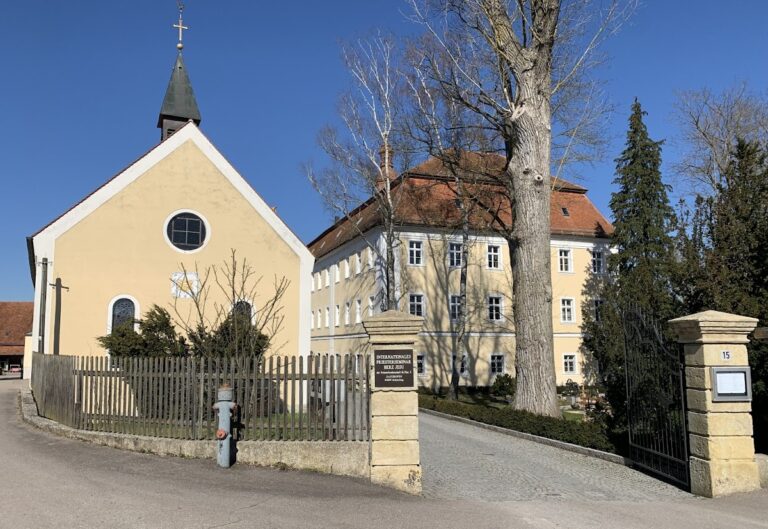
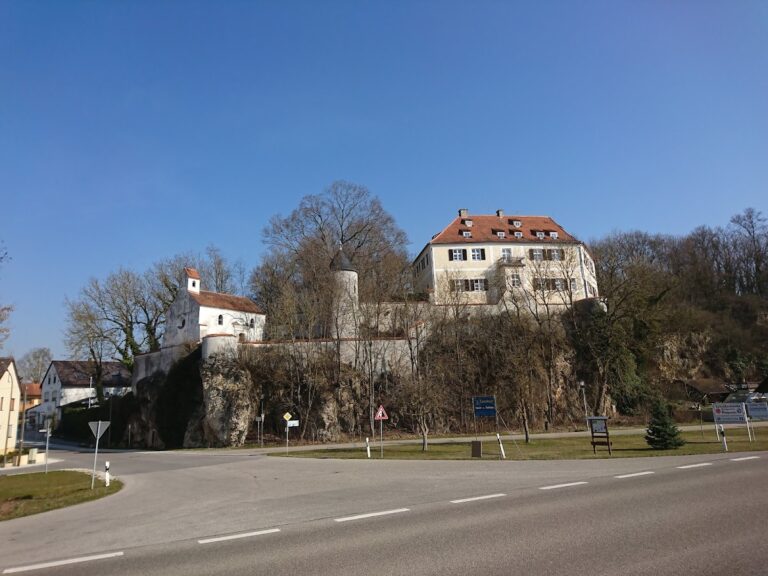
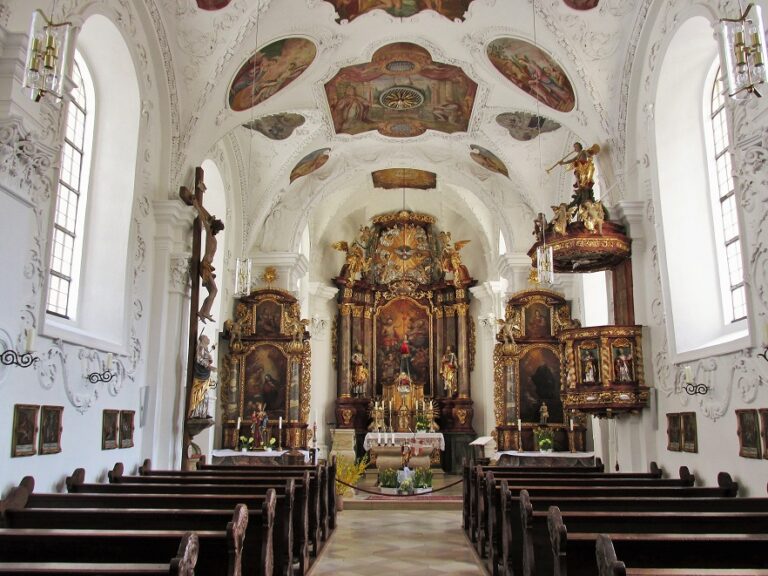
The surviving complex consists of the former Augustinian monastery and its abbey church, now incorporated into the Benedictine foundation. The principal buildings reflect the rebuilding campaign begun under Patritius von Heydon in 1682. Their exteriors were formed in the Baroque style, while the interiors received Rococo decoration. The eighteenth-century campaign concluded with the completion of the east wing in 1760–1761.
Abbey Church
The church is dedicated to the Assumption of the Blessed Virgin Mary, the same dedication held by the Augustinian monastery. Its high altar was created by Egid Quirin Asam between 1722 and 1723. The altar presents the Assumption as a fully three-dimensional sculptural scene, arranged as a Theatrum sacrum, a sacred theatrical composition that combines sculpture, architecture, and staging effects to make a religious event appear as a dramatic visual scene. Asam may also have helped design or build the church, although that attribution remains uncertain.
Johann Konrad Brandenstein built the church organ in 1725. In 2006, Metzler Orgelbau installed a new organ work with twenty-nine stops on two manuals and a pedal.
Monastery Buildings
The conventual buildings were rebuilt after the destruction of the Thirty Years’ War in the architectural language of the Baroque period. The east wing, completed in 1760–1761, was the final stage of the eighteenth-century building campaign. After the 1803 secularization, the surviving east wing was adapted for parish offices and school use, while part of the west wing was converted into an inn.
War Damage and Survival
The physical form of the complex also reflects the successive wartime disasters of the seventeenth century. The Swedish destruction of 1632 left the church and several service buildings standing at first, even as the monastery burned. The imperial fire of 1648 then seriously damaged the church and destroyed part of the library and archive. Later Baroque rebuilding created the form of the church and monastery that survives within the reduced post-secularization complex.
Nearby sites