Padise Abbey: A Fortified Cistercian Monastery in Estonia


Site at a Glance
- Rating
- 4.7
- Popularity
- Medium
- Country
- Estonia
- Primary era
- Medieval
- External website
- Open
- Eras represented
- Medieval, Early Modern
- Civilizations
- Crusader, Danish, Livonian Order, Russian, Swedish
- Site type
- Religious
- Remains
- Fortified Monastery
On this page12 sections
History
Padise Abbey in Padise, Estonia, is a former Catholic Cistercian monastery founded in the early fourteenth century by monks from Dünamünde Abbey near present-day Riga. An earlier two-nave chapel stood on the site around 1250, while the monks’ interest in the area is recorded by 1283. The monastery later became a fortified religious and military complex whose history reflects the struggles for control of the eastern Baltic.
Foundation and Fortification
Dünamünde Abbey was a Cistercian house, belonging to a Catholic monastic order shaped by communal observance, manual work, and an austere religious life. On 23 March 1305, during civil conflict in Livonia, the abbey was transferred to the Livonian Order and its master, Gottfried von Rogge, for 4,000 Cologne marks after the people of Riga had devastated it. About 200 displaced monks moved to the Harju-Madise parish and established a new monastery at Padise in 1310.
King Eric VI of Denmark authorized the monastery to be fortified. Stone construction began in 1317, and in 1319 the community became subordinate to Stolpe Abbey in Pomerania. Through Stolpe, Padise belonged to the Cistercian filiational network of Morimond Abbey, a major Cistercian mother abbey in France.
Destruction and Completion
The St. George’s Night Uprising, a major 1343 revolt by Estonian peasants against foreign Christian rulers and landholders in northern Estonia, reached Padise while the monastery was still partly built. The buildings were burned, and twenty-eight monks, lay brothers, and German vassals were killed. Reconstruction began after 1370.
By 1445, the principal works had been completed. They included the fortified gatehouse, residential and service buildings, and the church vaulting. The main building was consecrated in 1448. By about 1400, the monastery had acquired extensive estates in Estonia and southern Finland. During the fifteenth century, it became one of Estonia’s important spiritual centres and exercised influence across the Baltic region.
Decline and Military Transformation
From about 1500, Padise entered a period of decline and sold some of its lands, but it survived the upheavals of the Reformation in the 1520s. The Livonian War, a sixteenth-century struggle for control of Livonia involving the Livonian Order, Sweden, and Russia, transformed the monastery’s role.
In 1558, Gotthard Kettler, the last master of the Livonian Order, occupied the fortified monastery to prevent its seizure by the Swedes. He dissolved the community in 1559, expelled the monks, confiscated the buildings and estates, and converted the complex into a fortress. Swedish forces captured it in 1561. Russian forces took it in 1576 and strengthened its defences, but the Swedes recaptured it after a lengthy siege and damaging bombardment in 1580.
Estate, Fire, and Conservation
In 1622, King Gustavus Adolphus of Sweden granted the former monastery’s estates to Thomas Ramm, the burgomaster of Riga. The Ramm family retained the property until the Estonian land reform of 1919, when the estates were expropriated and nationalized. Part of the former monastery was converted into a country house, which remained in use as a residence until a fire in 1766. Masonry from the ruins was later reused in a nearby Neoclassical manor house.
Intermittent conservation and stabilization began in the 1930s, with further work taking place from 1936. A comprehensive restoration of the former complex was agreed upon in 2001. The restored portions now function as a museum, and the abbey reopened after renovation in May 2020. The ruins and surrounding defensive moat entered Estonia’s State Register of Cultural Monuments as an architectural monument on 15 April 1997. Their condition was assessed as satisfactory during an inspection on 2 May 2024.
The name Padise is thought to derive from the earlier village of Pae, recorded as Pathes in 1241 and Padis in 1257. The monastery was built about 8 kilometres east of that settlement. The present village of Padise developed on the former monastery manor lands in the 1920s and took the name Padise in 1977.
Remains
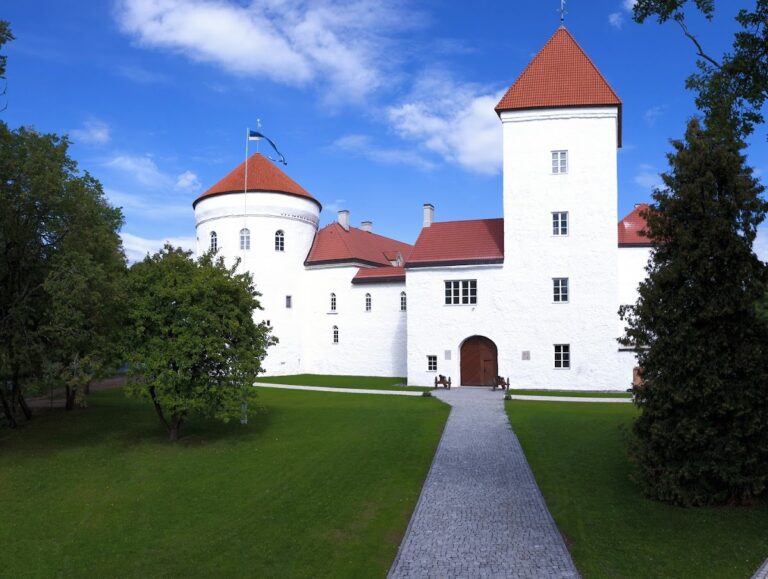
Padise survives as the ruins of a fortified stone monastery surrounded by a defensive moat, a ditch intended to hinder access and strengthen the site’s perimeter. The complex included a church, fortified gatehouse, residential and service buildings, an inner courtyard, vaulted spaces, and a basement. Its principal construction and rebuilding phases extended over about two centuries, and the surviving remains have been stabilized and partly restored.
Early Gothic Chapel
Before the monastery was established, Dünamünde monks built a two-nave Early Gothic chapel at Padise around 1250. It was constructed from limestone and covered by ribbed vaults, masonry vaults supported by intersecting structural ribs. The surviving remains include the lower part of the southern wall and four fragments of ribbed decoration.
Monastic and Fortified Buildings
Church and Vaulted Spaces
The later monastery included a church with vaulted interior spaces, and vaulting had been added by 1445. The main building was consecrated in 1448. The church remains among the surviving ruins, together with vaulted areas and the basement that formed part of the former complex.
Gatehouse and Defensive Moat
The fortified gatehouse formed the principal entrance to the monastery. It was among the major works completed by 1445, when the residential and service buildings were also in place. The surrounding defensive moat remains part of the site and marks the fortified perimeter.
Residential and Service Buildings
Residential and service buildings surrounded the monastery’s inner courtyard as part of the fortified stone complex. Their later military history is reflected in the adaptation of the monastery as a fortress, the strengthening of its defences by Russian occupiers in 1576, and the severe damage caused by the Swedish bombardment of 1580. Surviving sections have been stabilized and partially restored.
Bell and Later Reuse
The monastery formerly housed a fourteenth-century church bell described as Estonia’s oldest. The bell is now located at the Lutheran Church of the Holy Cross in Risti. After the monastic complex was converted into a country house, masonry from its ruins was reused in a nearby Neoclassical manor house following the 1766 fire. The restored remains of Padise Abbey are used as a museum.
Nearby sites