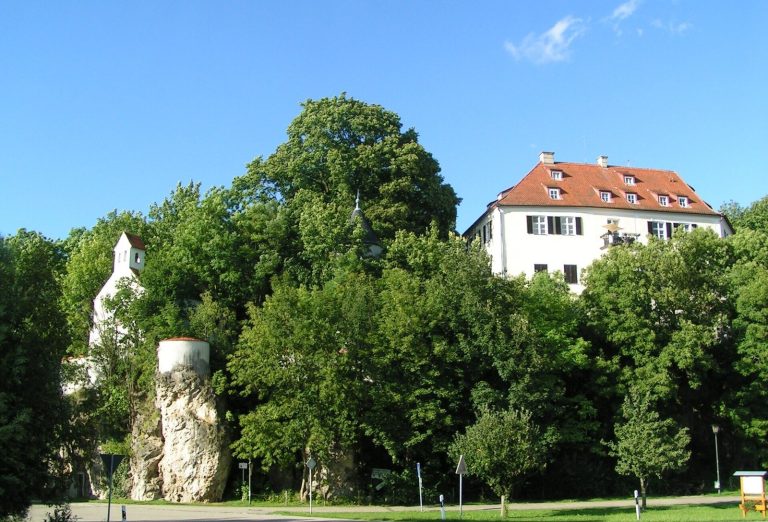
Castra Abusina: A Roman Fort on the Danube Frontier
Site at a Glance
- Popularity
- Medium
- Country
- Germany
- Primary era
- Classical
- Eras represented
- Classical, Modern
- Civilizations
- German, Roman
- Site type
- Military
- Remains
- Fort
On this page23 sections
History
Castra Abusina is a Roman military fort near Eining in Germany, founded around AD 80 in Raetia, a Roman province covering Alpine lands and nearby territories. Built by the Fourth Cohort of Gauls under Emperor Titus, it guarded the Danube frontier and later stood beside a civilian settlement. The name Abusina derives from the nearby Abens River.
Foundation and changing garrisons
A foundation inscription dates the fort to about AD 80. The Fourth Cohort of Gauls built it and formed its first garrison. Early in the second century, probably near the end of Emperor Trajan’s reign, a detachment of the Second Tungrian Cohort took over. This was an enlarged unit combining infantry and cavalry. A detachment of the Fourth Tungrian Cohort probably served at Abusina for several years between 138 and 147.
The Third Cohort of Britons, another mixed infantry and cavalry unit, is recorded at Eining from AD 153 and remained there until Roman rule in Raetia ended in the early fifth century. One of its first tasks was to rebuild the fort in stone, as part of a coordinated strengthening of this frontier under Emperor Antoninus Pius.
A civilian settlement grew beside the garrison. Soldiers’ families lived there alongside merchants, craftspeople, and innkeepers who supplied the fort. Discharged soldiers also settled in the community, as indicated by military diplomas, the certificates issued when soldiers left service.
Frontier wars and recovery
During the Marcomannic Wars under Emperor Marcus Aurelius, Roman control weakened and parts of Raetia temporarily fell outside the empire. The fort and civilian settlement were destroyed. Roman forces recovered the area around AD 175, probably with help from the Third Italic Legion, based at Castra Regina near modern Regensburg, and Abusina was rebuilt.
The rebuilt fort and settlement entered a period of stability that lasted into the early third century. In AD 213, Emperor Caracalla visited Eining to coordinate a preventive campaign against Alamanni gathering north of the Danube. The successful operations eased pressure on the province and the fort for about two decades.
An Alamannic incursion destroyed Abusina in AD 233. Further attacks followed, and the final major assault around AD 260 burned Eining as the Roman frontier defenses in Raetia nearly collapsed. The fort was reoccupied around AD 280. The Third Cohort of Britons and the Third Italic Legion were among the surviving forces that helped restore stability in the region.
Late Roman contraction and abandonment
Military reforms in the late third and early fourth centuries strengthened the mobile army in the hinterland while reducing the forces stationed directly on the frontier. Abusina’s garrison probably fell to about 140 men, and the defended area contracted to a much smaller, more heavily fortified post. The surrounding district continued to be used by soldiers and civilians. After the civilian settlement was abandoned following the attacks of 260, people took refuge within the fort’s walls.
Abusina’s final decline came around the middle of the fifth century, probably after an Alamannic advance from the west. Romanized inhabitants who sheltered in the fortifications may have been among those rescued in evacuations associated with Severinus of Noricum, a fifth-century Christian monk and missionary active in Noricum. In the sixth or seventh century, Bavarians established Oweninga about 500 metres north of Abusina. The settlement became modern Eining, with no continuous settlement between it and the Roman site.
Rediscovery and protection
Humanist scholars Johannes Aventinus and Peter Apian helped identify Abusina’s ancient remains; Apian also recovered stone monuments at Eining. The Reichs-Limeskommission, a German commission established to investigate the Roman frontier, did not examine the fort because its survey area ended at the frontier wall near Hienheim. Excavations began in 1879 through the efforts of local priest Wolfgang Schreiner. Work continued intermittently from 1911 to 1920, especially under state archaeologist Paul Reinecke, and resumed in 1968 at archaeologist Hans Schönberger’s initiative.
Since 2005, Abusina has formed part of the UNESCO World Heritage property of the Upper Germanic-Rhaetian Limes, a Roman frontier system of military installations and routes. It is also protected as a registered archaeological monument under Bavarian law. A redesign concept selected in 2010 was completed in 2011, when the site received the name Römerpark Abusina Eining.
Remains
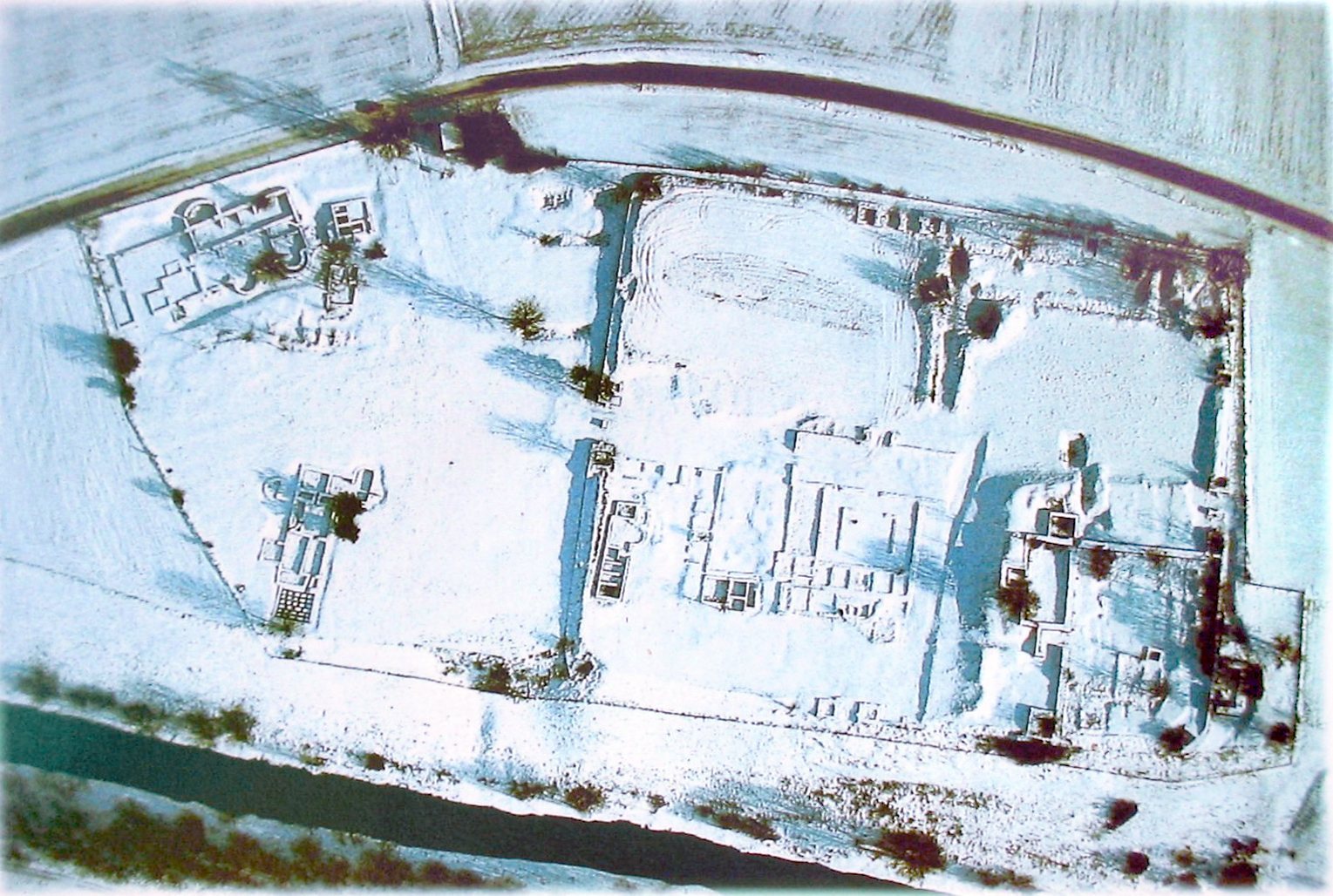
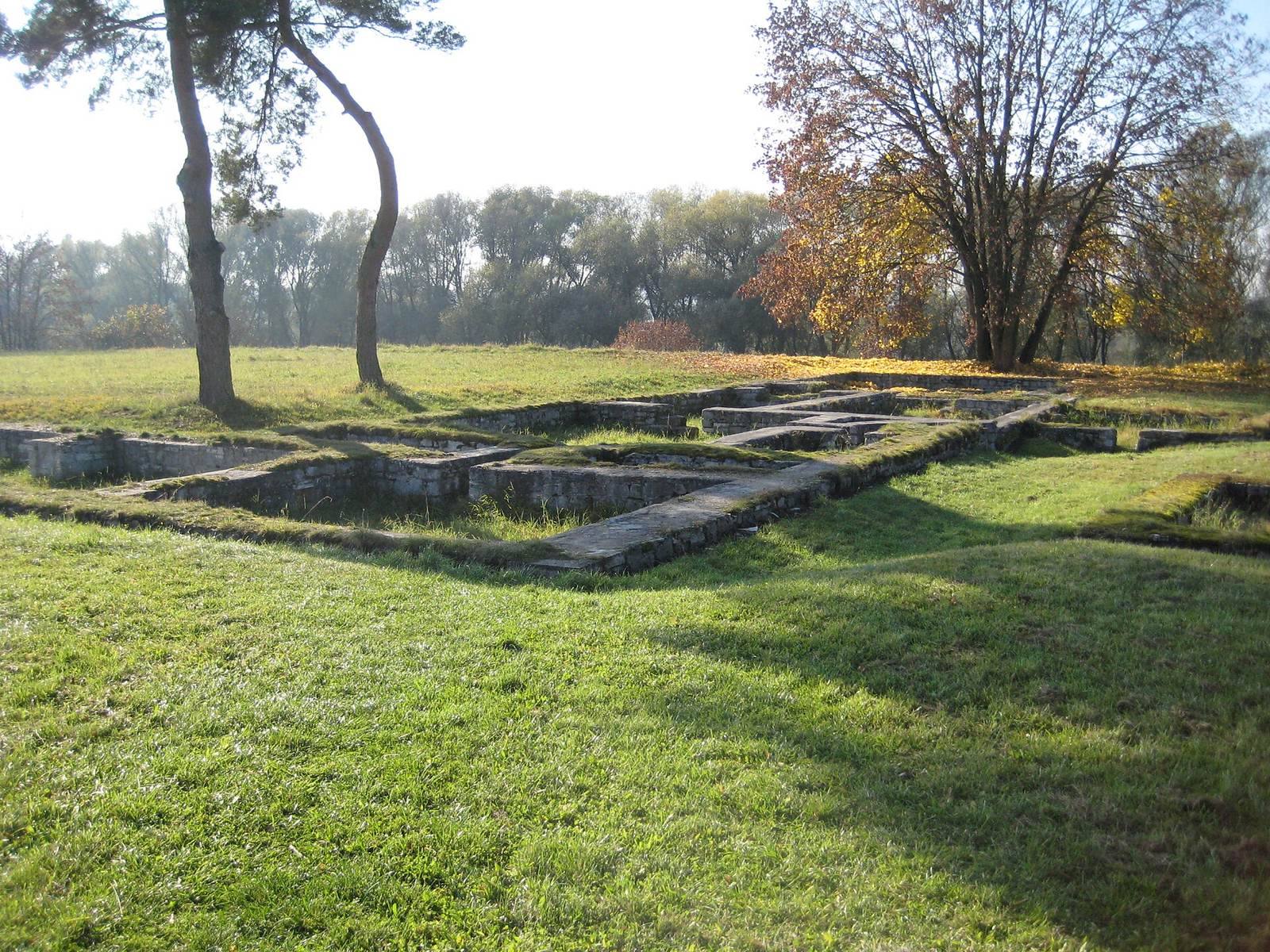
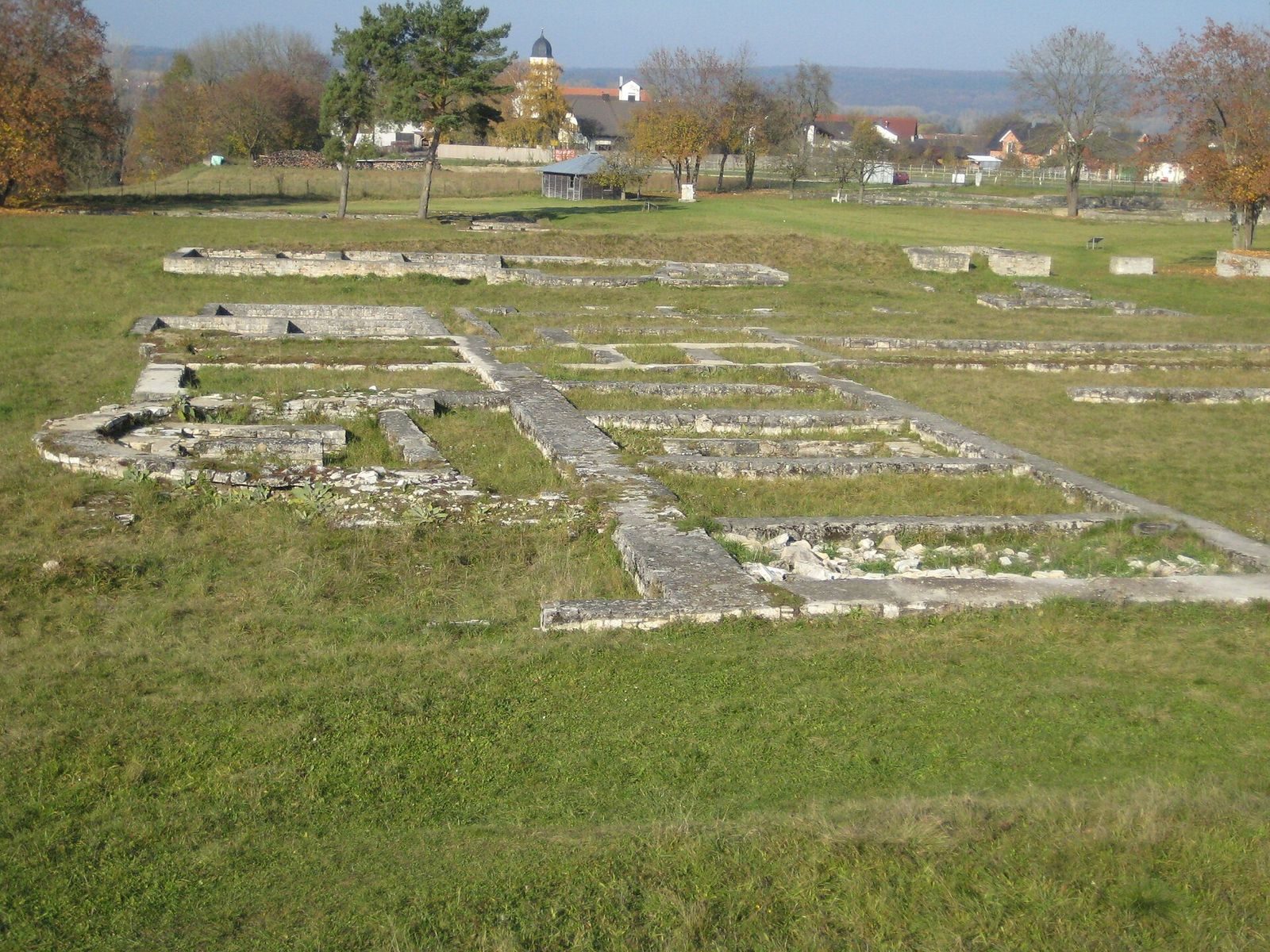
The site occupies the high bank of the Danube, about 500 metres south of Eining’s present centre, between the road to Sittling and the Abens, which meets the Danube just north of the fort. The layout combines the military enclosure with a fan-shaped civilian settlement and separate installations nearby. The fort developed from a timber-and-earth plan into a stone-walled enclosure; its excavated remains have been exposed, conserved, and reconstructed at foundation level.
Imperial-period fort
Enclosure and gates
The original timber-and-earth fort measured about 147 by 125 metres and covered roughly 1.8 hectares. Its plan shaped later versions of the fort. The main gate first faced north; during the second-century stone rebuilding, the principal exit was turned east, giving the layout an asymmetrical form.
The stone fort had rounded corners, four gates, and a defensive wall about 1.4 metres thick and probably 5 metres high. An earthen rampart ran along the inside, with towers at the corners, beside the gates, and between them. Two V-shaped ditches, each about 8 metres wide and 4 metres deep, protected three sides. On the Danube side, the steep bank and river probably provided a sufficient barrier.
Command and service buildings
The headquarters stood at the centre of the fort, and its wall lines remain visible. It contained offices, an armoury, and a shrine for the unit’s standards, with the troop treasury beneath it. A heated building stood at its northern edge. The commander’s residence lay just north of the headquarters.
Barracks, stables, workshops, a hospital, and a prison served the garrison. Fragments of an armoured imperial statue, dating to the first half of the third century, were found within the fort. The statue probably once stood in the standards shrine.
Late Roman defenses
Small fortified post
In late antiquity, the defended area was reduced to about 0.18 hectares. A small, strongly fortified post occupied the southwest corner, using parts of the earlier outer wall. A defensive ditch separated it from the rest of the fort. Including the ditch, the post covered less than a quarter of the original garrison area.
Northern grain store
A grain store, probably added during the period of Emperor Valentinian, stood outside the northern wall. It measured about 9.5 by 19.5 metres and used the fort wall as its rear wall. A tower occupied the centre of its north wall. Corner supports, a stone floor, and grain finds point to storage use. The building may have obstructed the view and firing range of nearby towers, prompting the addition of another tower in front.
Walls and entrance
Herringbone masonry, stonework laid in alternating diagonal courses, appears on the inner face of the northern wall and the west side of the northeast tower. The tower’s foundations reuse semi-cylindrical stones from the earlier fort’s battlements. A gate in the late Roman defenses had an angled entrance passage that made direct access more difficult.
Civilian settlement and services
Settlement and roads
The civilian settlement spread in a fan around the fort. The Danube South Road curved around the enclosure, while another road branched east just before the main gate. Buildings extended about 500 metres in each direction from the gate, across an area roughly one kilometre from north to south and almost half a kilometre from east to west.
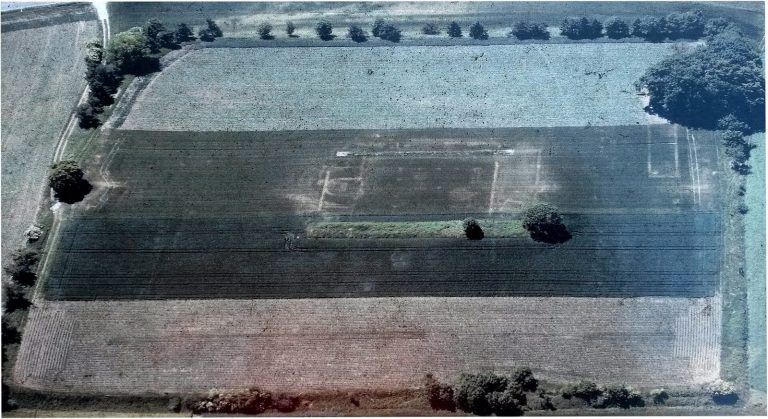
Most houses used timber frames. Some were built of stone, occasionally with underfloor heating, and reached lengths of up to 50 metres. Archaeological fieldwork and aerial surveys have helped trace their locations.
Bath complexes
Two bath complexes stood successively outside the fort. The first was a small bathhouse on the steep Danube bank, where persistent flood risk led to its abandonment. A small bath building had an underfloor heating system. The replacement complex north of the fort was larger and more elaborate; a substantial bathing building there is probably its hot room. A separate bath is associated with the later, smaller fortified post.
Official roadside station
A large heated roadside station stood in front of the fort’s northern side and included a small bathing area. It provided lodging and changing horses for state officials travelling on official business. It also served soldiers assigned road-security and toll-collection duties.
Outlying military installations
Weinberg watchtower
A Roman watchtower stood on the Weinberg northeast of Eining, where it could help cover a gap in sight lines to the fort at Pförring and the fortified frontier near Hienheim. Two stone buildings beside its foundations served as barracks for the tower garrison and a small temple dedicated to Mars and Victoria. The tower probably remained in use until the third century and was likely destroyed during an Alamannic incursion. Debris points to later Christian worship in the area; Bavarians who settled nearby in the sixth or seventh century may have adapted the barracks foundations for a simple church.
Unterfeld camp
The military camp at Unterfeld, north of Eining, covers about 10.6 hectares and measures approximately 328 by 320 metres. The modern road from Eining to Staubing crosses the site, following roughly the course of the camp’s principal road. The camp may have housed a detachment of the Third Italic Legion, perhaps supported by mounted auxiliary troops, but its precise function remains uncertain.
Finds and modern conservation
Archaeological finds
The Eining hoard, discovered accidentally in 1975, contains parts of Roman parade armour. Hans-Jörg Kellner documented the find, which is now held by the Archaeological State Collection in Munich. Finds from the wider area are held chiefly by museums in Kelheim, Landshut, Munich, and Abensberg.
Modern site installations
Modern park installations use rust-coloured steel panels in front of ancient gates and building entrances. At the riverside rear gate, a steel-and-concrete structure crosses the sloping ground. These additions sit among the conserved remains of the excavated fort.