Weltenburg Abbey: A Baroque Benedictine Monastery on the Danube


Site at a Glance
- Rating
- 4.6
- Popularity
- High
- Country
- Germany
- Primary era
- Early Modern
- External website
- Open
- Eras represented
- Early Modern
- Civilizations
- Electorate of Bavaria, Holy Roman Empire
- Site type
- Religious
- Remains
- Monastery
On this page12 sections
History
Weltenburg Abbey is a Benedictine abbey in Germany, whose present complex took shape mainly during the Baroque period in Weltenburg, a district of Kelheim in Lower Bavaria. Dedicated to Saint George, it stands beside the Danube Gorge and today combines pastoral care for two parishes with hospitality, education, agriculture, conferences, lectures, and concerts.
Roman and Early Christian Weltenburg
By around AD 45, the southern bank of the Danube at Weltenburg marked the beginning of the Via iuxta Danuvium, a Roman military and frontier road that followed the river upstream to the fort at Hüfingen. The route was one of the principal east-west connections north of the Alps and linked with traffic from the Via Claudia Augusta near Mertingen. Archaeological finds and excavated areas on the Frauenberg, above the later abbey, indicate that a Roman military station stood there.
The Frauenberg had already been settled repeatedly in prehistoric times. Evidence from the Weltenburg area indicates that it had a Christian character by around AD 600, providing an early religious setting for the monastery that later developed beside the river.
Uncertain Foundation and Early Medieval Rule
A local tradition places the foundation of the monastery around AD 617 and attributes it to Eustace and Agilus of Luxeuil, Hiberno-Scottish monks associated with the rule of Saint Columbanus. The Hiberno-Scottish mission was a medieval movement through which Irish and Scottish monks spread Christian teaching and monastic practices across parts of continental Europe. Research has rejected this foundation account, leaving Weltenburg’s claim to be Bavaria’s oldest monastery unresolved.
Another tradition says that Saint Rupert dedicated the abbey church to Saint George around AD 700. Saint Rupert, remembered as the Apostle of Bavaria, was an early medieval missionary and bishop associated with the Christianization of the region. The tradition depends on the Weltenburg Martyrology, a liturgical register of saints and martyrs written in Regensburg around 1047 to 1049 and brought to Weltenburg about fifty years later. Its passage may instead refer to the installation of the first abbot of Prüll.
During the eighth century, the monks probably adopted the Rule of Saint Benedict, perhaps in connection with the church reform associated with Boniface. Tassilo III, Duke of Bavaria from 748 to 788, supported the monastery. He was the last Agilolfing duke, and his deposition by Charlemagne brought Bavaria more firmly under Frankish royal control. After Tassilo’s deposition, Weltenburg became directly subject to imperial authority, and later tradition long treated him as the monastery’s founder.
A list of Frankish imperial monasteries from 817 names a monastery called Altemburc. If that name refers to Weltenburg, it is the earliest documented mention of the abbey. Monks later abandoned the site during the Hungarian invasions of the early tenth century. In 932, the monastery was resettled from Saint Emmeram’s Abbey and became a proprietary monastery of the Diocese of Regensburg.
Medieval Administration and Reform
From 1123 to 1328, Augustinian Canons administered Weltenburg. These were religious clergy who followed the Rule of Saint Augustine and commonly served within a communal chapter. A new church was consecrated in 1191. The fourteenth and fifteenth centuries then brought frequent changes of abbots and administrators.
Under Abbot Konrad V, who held office from 1441 to 1450, the Kastl reforms reached Weltenburg. These reforms promoted stricter observance and renewal in Bavarian Benedictine monasticism. The church and abbey buildings were renovated, and monastic life was reorganized.
War, Recovery, and the Baroque Rebuilding
Weltenburg was plundered during the Schmalkaldic War, the 1546 to 1547 conflict between Emperor Charles V and the Protestant Schmalkaldic League. Financial hardship followed, and Abbot Michael II Häusler, who served from 1553 to 1556, sold valuable holdings from the monastic library.
The abbey was also plundered during the Thirty Years’ War, the major European conflict of 1618 to 1648 that combined religious and dynastic struggles across the Holy Roman Empire and neighboring territories. Abbot Matthias Abelin, in office from 1626 to 1659, nevertheless left the monastery in orderly condition. In 1686, Weltenburg joined other houses in founding the Bavarian Benedictine Congregation, a federation of Benedictine monasteries in Bavaria.
A major rebuilding campaign began under Abbot Maurus I Bächl, who led the abbey from 1713 to 1743. The work created the monastery courtyard, the convent buildings, the Frauenberg Church, churches in incorporated parishes, and several agricultural and service buildings. The foundation stone of the new abbey church was laid on 29 June 1716 by Johann Franz Eckher von Kapfing und Liechteneck, Prince-Bishop of Freising. The church was consecrated on 9 October 1718, while its decoration continued until 1735. Elector Max Emanuel of Bavaria visited in 1721 and expressed admiration for its architecture.
Dissolution and Benedictine Revival
Bavaria’s secularization dissolved the abbey in March 1803. Secularization involved the state suppression or transfer of ecclesiastical institutions and property during the political reorganization of the German territories. The silver church treasure was confiscated, and the acceptance of novices was prohibited. The brewery and other manufacturing buildings were sold. Because the church and convent could not be sold, they were converted in 1812 into the village parish church, parish house, school, and teacher’s residence.
At the initiative of King Ludwig I, Weltenburg was re-established in 1842 as a priory of Metten Abbey. The convent was renovated, and properties including the brewery were repurchased. The community joined the Bavarian Congregation of the Benedictine Confederation in 1858 and became an independent abbey in 1913. An agricultural school operated at Weltenburg from 1904 to 1973.
Modern Conservation and Continuing Use
In March 1995, the abbey hosted a week-long Rosary congress that promoted and prayed for a new Marian dogma. The complex’s position directly beside the Danube has also made it highly vulnerable to flooding. Flood protection was installed between January and October 2006 and formally inaugurated on 12 October that year. Extensive restoration of the chapel took place from 1999 to 2008, alongside renovation of the convent and the flood-protection work.
Monks at Weltenburg are associated with brewing beer from 1050. The abbey brewery is promoted as the world’s oldest monastic brewery, although that distinction is disputed by Weihenstephan Abbey. It now produces approximately 30,000 hectolitres annually. Weltenburg belongs to the Bavarian Benedictine Congregation, provides pastoral care for two parishes, and continues its religious, educational, agricultural, and cultural activities.
Remains
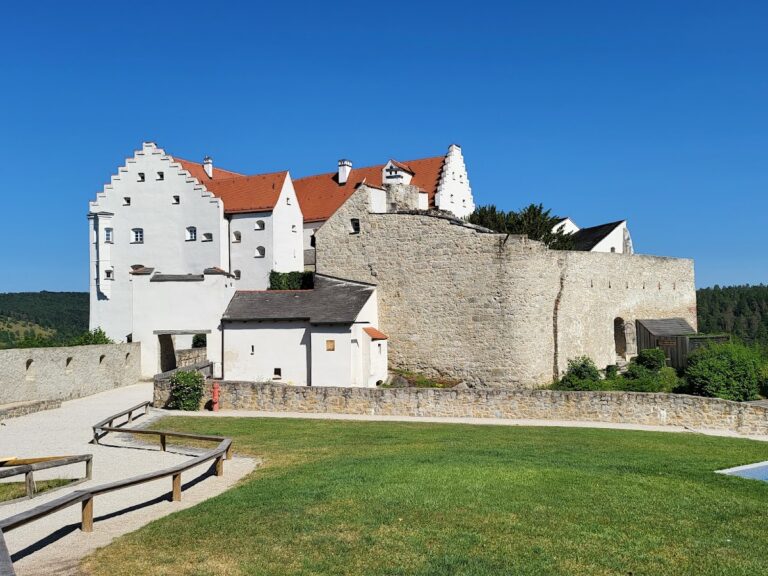
Weltenburg Abbey occupies a peninsula or bend of the Danube directly above the Danube Gorge, also known as the Weltenburg Narrows. The buildings stand above the gravel bank on the inner curve of the river, where gravel accumulated, while high Jurassic cliffs, especially on the opposite outer bend, provide protection. The Frauenberg rises above the present abbey and contains prehistoric settlement remains, excavated areas, archaeological finds, and evidence interpreted as a Roman military station.
The Baroque Monastery
The surviving complex is predominantly Baroque and is organized around a monastery courtyard. Its principal building campaign produced the convent, the abbey church, the Frauenberg Church, churches connected with incorporated parishes, and several agricultural and service buildings around the courtyard.
Convent Building
The Baroque convent building was constructed from 1714 to 1716 under the master builder Philipp Plank. It forms part of the rebuilding campaign associated with Abbot Maurus I Bächl and remains one of the principal elements of the monastic complex.
Abbey Church of Saint George
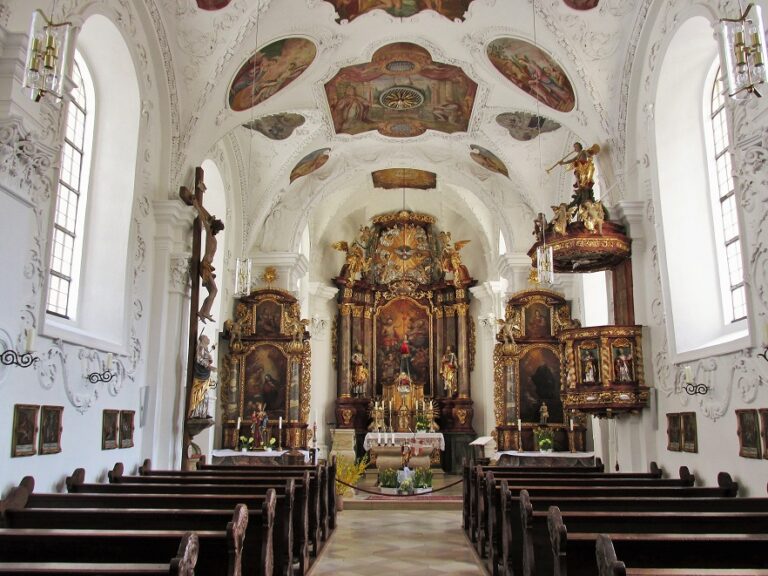
The present abbey church is dedicated to Saint George. Its structure was erected as a largely completed shell between 1716 and 1718, while Cosmas Damian Asam and Egid Quirin Asam, known together as the Gebrüder Asam, carried out its major artistic decoration through 1735. The broader construction and furnishing campaign is dated to 1716 to 1739.
The church contains a portal, vault frescoes, and an organ by Johann Konrad Brandenstein. A representation in the vault above the altar area presents the tradition that associates Tassilo III with the monastery’s foundation. The earlier church, consecrated in 1191 and replaced by the present building, was a single-nave structure with a crypt, a chamber often placed beneath a church for burials or relics.
Courtyard and Brewery Buildings
The monastery courtyard includes a beer garden, and the wing facing the Danube contains a large restaurant on its ground floor. Brewery products have been served in the courtyard and beer garden. The Weltenburger Kloster Barock Dunkel received the World Beer Cup award for the world’s best dark beer in 2004, 2008, and 2012.
Nearby sites