Monastery of Santa Giulia: A Lombard Royal Monastery in Brescia


Site at a Glance
- Rating
- 4.7
- Popularity
- Medium
- Country
- Italy
- Primary era
- Medieval
- External website
- Open
- Eras represented
- Medieval, Early Modern
- Civilizations
- Carolingian, Holy Roman Empire, Venetian
- Site type
- Religious
- Remains
- Monastery
On this page12 sections
History
The Monastery of Santa Giulia is a convent complex in Brescia, Italy, founded by the Lombards in 753 and shaped by major rebuilding during the fifteenth and sixteenth centuries. It incorporates the earlier Monastery of San Salvatore, a royal foundation that became an important religious, dynastic, and economic center in northern Italy.
Lombard foundation and royal monastery
San Salvatore was established in 753 at the initiative of Desiderius, then a Lombard duke, and his wife Ansa. The Lombards were a Germanic people who had created a kingdom in Italy in 568. San Salvatore was a women’s monastery, and its first abbess was Anselperga, the couple’s daughter. The foundation possessed extensive lands and wealth beyond the Brescia area, and its resources supported active commercial exchange. Its position as a royal monastery connected it closely with the ruling dynasty.
The Basilica of San Salvatore was consecrated in 763 in the presence of Pope Paul I, who held the papacy from 757 to 767. Relics of Saint Julia, brought from the island of Gorgona, were placed in the basilica’s crypt, a vaulted chamber used for relics and burials. The crypt also received relics associated with Saints Sophia, Pistis, Elpis, Agape, Hippolytus, and Pimenio, which came from Rome.
After Desiderius became king, he and Ansa further supported San Salvatore with the aim of establishing a dynastic burial place. Queen Ansa and other members of her family, probably including her father and two brothers, were buried there. Tradition also identifies the monastery as the place where Ermengarda, the daughter of Desiderius and repudiated wife of Charlemagne, lived in exile after their marriage was annulled in 771. The tradition links the separation with the political struggle between the Lombards and the Papal State, which was allied with the Franks.
Carolingian expansion
Desiderius was the last Lombard king. His defeat in 774 brought the Lombard kingdom under Frankish rule, and the Carolingians, the dynasty that replaced Lombard authority in northern Italy, confirmed San Salvatore’s earlier privileges. The monastery continued to increase its economic power and acquired possessions in many parts of Italy.
Among its Carolingian-period holdings was the port of Sclavaria on the Ticino, outside the walls of Pavia, which was then the capital of the Kingdom of Italy. In 916, Emperor Berengar I authorized his daughter Berta, who was abbess of the monastery, to construct a castle at the port. This holding illustrates the monastery’s extensive territorial interests and the administrative responsibilities attached to its wealth.
Romanesque rebuilding and early modern transformation
A major Romanesque rebuilding campaign took place in the middle of the twelfth century. The cloisters were reconstructed, the crypt beneath San Salvatore was enlarged, and the Oratory of Santa Maria in Solario was added to the complex. These works changed the monastery’s buildings while retaining its older religious focus.
Further completion works began in the late fifteenth century. They included the completion of the nuns’ choir, the rebuilding of the cloisters, and the construction of the northern dormitory. The choir was built in 1466 and was later incorporated into the transformed presbytery of San Salvatore. The Church of Santa Giulia, begun in the sixteenth century, was completed in 1599.
Abbess Angelica Baitelli, who governed the monastery in 1646 and 1647, reorganized and preserved its historical documentation. Her manuscript, the Historical Annals of the Building, Establishment, and Endowment of the Monastery of San Salvatore and Santa Giulia, traced the institution’s history from 740 to her own time. The nuns used it while defending the monastery’s historical autonomy against an attempt by the diocesan bishop to place it under his authority.
Suppression, museum use, and heritage recognition
Revolutionary Jacobin laws suppressed the monastery in 1798. Its possessions were confiscated, and the complex was converted into a cavalry barracks. A long period of deterioration followed. In 1882, the buildings were adapted for use as a Museum of the Christian Age, although parts of the complex remained abandoned for a considerable time.
The Municipality of Brescia acquired the entire property in 1966 and began architectural recovery work together with the creation of the new Santa Giulia Museum. The former Church of Santa Giulia later served as a museum and conference center. In 2011, the monastery became part of the UNESCO World Heritage serial property The Longobards in Italy: Places of the Power (568–774), a group of seven places recognized for architectural, pictorial, and sculptural evidence of Lombard culture.
Remains
The surviving complex brings together churches, a chapel, cloisters, the nuns’ choir, a northern dormitory, and a bell tower. Its buildings preserve evidence of several construction phases, from a Roman-period structure beneath San Salvatore to Lombard, Romanesque, late medieval, and sixteenth-century additions. The Santa Giulia Museum also incorporates archaeological objects and architectural fragments connected with Brescia’s wider history.
Churches and chapel
Basilica of San Salvatore
The present Basilica of San Salvatore is generally dated to around the ninth century and represents a rebuilding of the church associated with the Lombard foundation. It has a single nave and two apses, semicircular or polygonal ends of a church. The building stands over an earlier one-nave church with three apses, which itself occupied a Roman-period structure dating to the first century BC. That earlier building was destroyed in the fifth century.
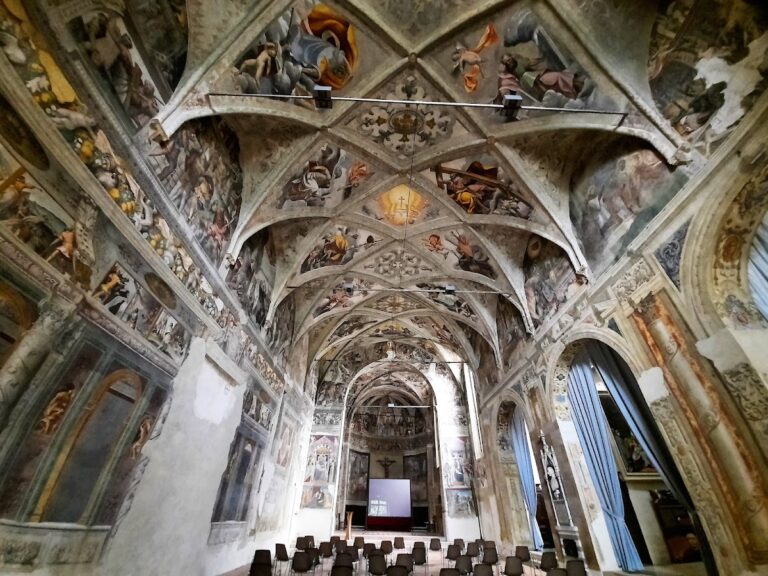
The basilica preserves paintings from the Carolingian period and frescoes by Paolo da Cailina the Younger. Its presbytery, the area around the main altar reserved for the clergy, was reshaped in the sixteenth century within the former nuns’ choir, constructed in 1466. The crypt was enlarged during the twelfth-century rebuilding and preserves the religious setting associated with the monastery’s relics.
Bell tower
The bell tower was built in the thirteenth or fourteenth century. Its decoration includes frescoes by Romanino, a painter associated with northern Italian art. The tower forms part of the later medieval fabric that developed around the older basilica and monastic buildings.
Oratory of Santa Maria in Solario
Added in the middle of the twelfth century, the Oratory of Santa Maria in Solario has a square plan arranged on two levels. An octagonal tiburium, a raised polygonal structure over the central part of a chapel, crowns the building and carries a small arched loggia. A staircase connects the two floors.
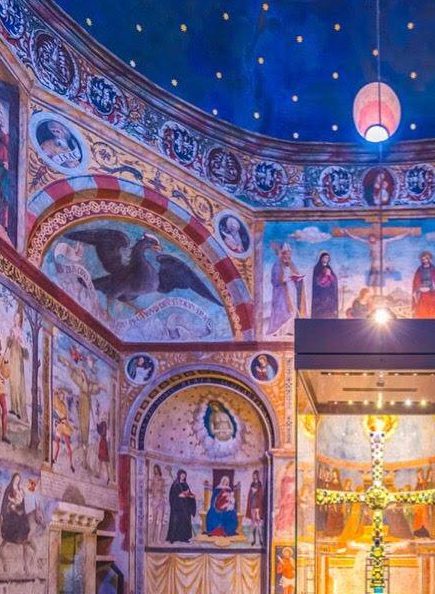
The lower level has restrained decoration and was probably used to protect the monastery’s treasury of liturgical and other precious objects. The central pillar supporting its vault incorporates a Roman altar dedicated to the Sun as its base. The upper level is covered largely by frescoes depicting scenes from the life of Jesus, attributed to Floriano Ferramola.
Church of Santa Giulia
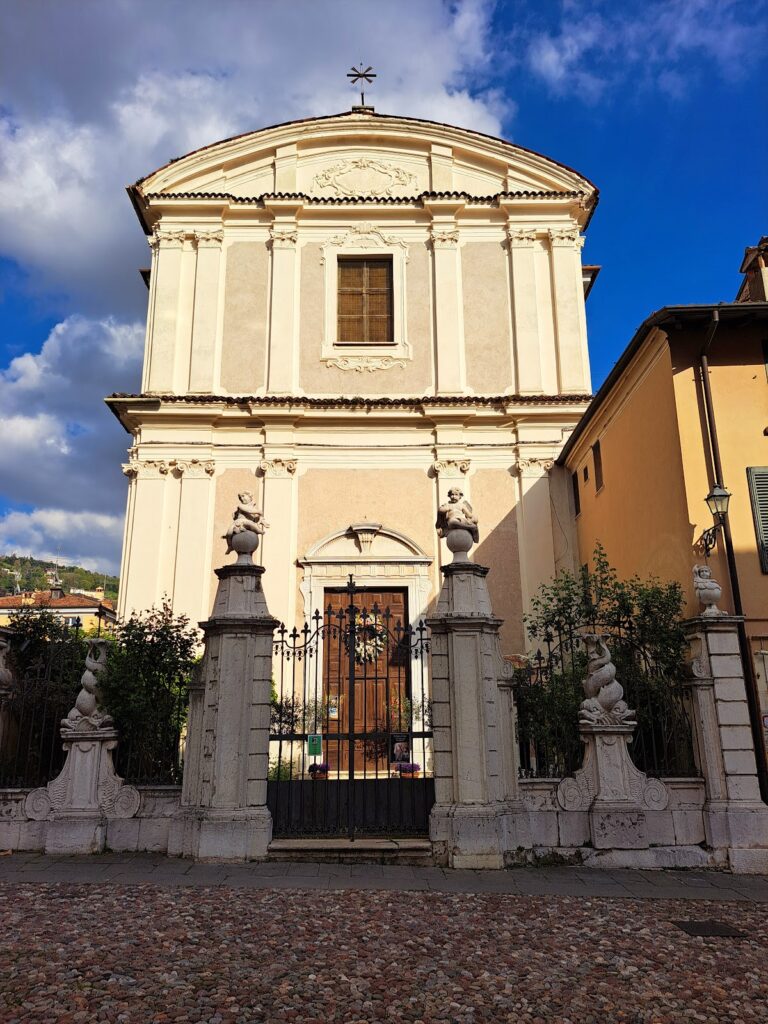
The Church of Santa Giulia belongs to the sixteenth-century rebuilding of the complex and was completed in 1599. Its later use as a museum and conference center reflects the transformation of the former monastery after suppression and its incorporation into the civic museum complex.
Monastic buildings and museum collections
The cloisters, nuns’ choir, and northern dormitory preserve the organization created or renewed during the late medieval and early modern building campaigns. The wider complex also contains a bell tower and architectural material recovered from local buildings that were later demolished. These preserved elements include frescoes from Brescia’s Broletto, a statue of Saint Faustina, and a fresco cycle by Moretto da Brescia.
The Santa Giulia Museum holds ancient objects ranging from the Bronze Age to the Roman period, including Iron Age material, the fourth-century Brescia ivory casket, and the Boethius diptych, a pair of hinged panels used in late antique and medieval commemorative or religious art. Its collections also include a plan that probably shows the appearance of the Roman city center during the reign of Emperor Vespasian. The medieval section contains a processional cross traditionally attributed to Desiderius, although its date is probably somewhat later.