San Salvatore, Brescia: A Lombard Monastic Basilica

Site at a Glance
- Rating
- 4.9
- Popularity
- Very Low
- Country
- Italy
- Primary era
- Medieval
- External website
- Open
- Eras represented
- Classical, Medieval, Early Modern
- Civilizations
- Carolingian, Holy Roman Empire, Lombard, Roman, Venetian
- Site type
- Religious
- Remains
- Monastery
On this page9 sections
History
San Salvatore, Brescia, is a Lombard-period basilica in Italy, founded in 753 as the church of a female monastery by Desiderius, duke of Brescia and future king of the Lombards, and his wife Ansa. Their daughter Anselperga became the monastery’s first abbess. The foundation belonged to the Lombards, a Germanic people who ruled much of Italy from the sixth century until the Frankish conquest in 774.
Foundation and royal monastery
The monastery quickly acquired an important religious role. Its crypt was built in 759 and 760, and relics associated with Saints Julia, Sophia, Pistis, Elpis, Agape, Hippolytus, and Pimenio were placed there. In 763, Pope Paul I, the eighth-century bishop of Rome, solemnly consecrated the basilica and monastery.
After Charlemagne defeated the Lombards, San Salvatore retained its privileges as a royal institution and enlarged its possessions. Charlemagne was the Frankish ruler whose conquest reshaped northern Italian politics. The monastery is traditionally identified as the place where Desiderata, Charlemagne’s Lombard wife and Desiderius’s daughter, spent her exile after their marriage was annulled in 771.
Medieval development
Alfred the Great, the ninth-century king of Wessex in southern England and a major patron of monasteries, is recorded as having visited San Salvatore while travelling to Rome in the 850s. His later foundation of Shaftesbury Abbey, a nunnery placed under his daughter’s direction, may have been inspired by San Salvatore, although the connection remains uncertain.
The basilica was substantially remodeled during the ninth century. In the twelfth century, most of the monastic buildings were rebuilt or restored in the Romanesque style, and the Oratory of Santa Maria in Solario was erected. The complex was restored again in the fifteenth century, when a dormitory was added. The church of Santa Giulia, dedicated to Saint Julia, was completed in 1599.
Suppression and museum use
The monastery was suppressed in 1798 after the French invasion of Lombardy and was converted into barracks. The complex remained in poor condition until 1882, when it became a Museum of the Christian Age. A general restoration in 1966 accompanied the creation of the Santa Giulia Museum, and San Salvatore is now incorporated into that museum complex.
In 2011, the monumental area containing the San Salvatore and Santa Giulia monastic complex was inscribed on the UNESCO World Heritage List as part of Longobards in Italy: Places of Power (568–774 A.D.). This serial heritage designation comprises seven properties and recognizes their cultural and historical value under criteria (ii), (iii), and (vi).
Remains
The basilica and crypt
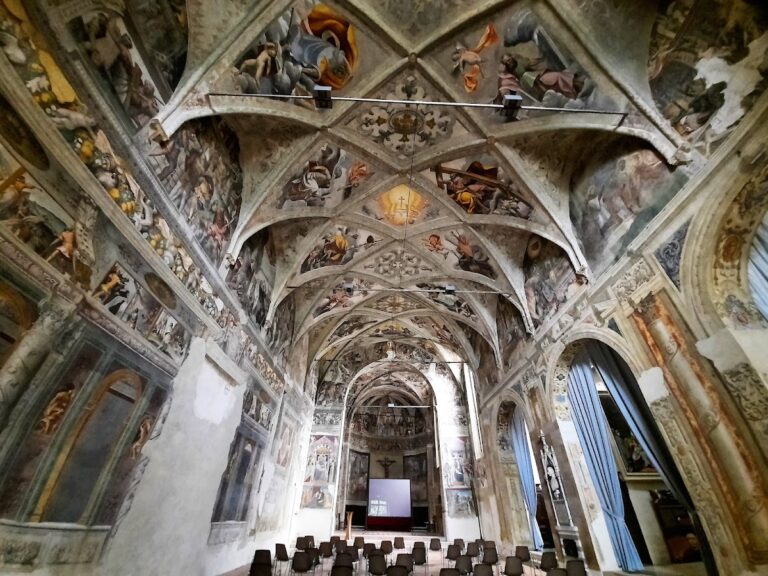
The basilica is organized as a three-aisled Lombard church, with the aisles divided by columns and capitals. The capitals combine reused classical pieces, Byzantine examples, and locally made work. Its current arrangement is associated with the ninth-century rebuilding of an earlier church that had a single nave and three apses. The building has a transept, the crosswise section of a church, ending in three apses, or rounded terminations. Its original façade does not survive in its present form.
The church was once richly covered with stucco and frescoes. Together with the Tempietto of Cividale, it formed one of the richest and best-preserved early medieval decorative ensembles. Much of the crypt’s decoration has been lost, while part of its marble liturgical furnishing survives. The interior retains frescoes by Paolo da Caylina the Younger and Floriano Ferramola, as well as paintings from the Carolingian period, the era and artistic culture associated with Charlemagne’s dynasty.
The former nuns’ choir was built in 1466 and converted into the presbytery, the area reserved for the altar and clergy, during the sixteenth century. Fragmentary Lombard marble elements from the church’s original liturgical furnishing are displayed at several points within the building. The last chapel of the left aisle contains architectural terracottas from San Salvatore, originally parts of a monumental decorative ensemble.
Chapels and painted decoration
At the base of the bell tower, to the right of the entrance, is a chapel covered inside and outside by Romanino’s fresco cycle of the Stories of Saint Obizius. The bell tower dates from the thirteenth or fourteenth century, while the frescoes were painted in 1526 and 1527.
The Chapel of the Virgin opens on the opposite side of the church. After 1527, Paolo da Caylina the Younger painted its cycle of the Stories of the Virgin and the Infancy of Christ, which remains completely preserved. On the east side of the church, the Chapel of Saint John the Baptist retains part of a fourteenth-century fresco cycle depicting the Stories of Saint John the Baptist, executed by a Lombard master.
To the right of the main entrance, on the church’s former façade, is Ferramola’s fresco of Saint Michael the Archangel. These paintings, together with the other chapel cycles, preserve successive phases of the building’s artistic history within the medieval and early modern complex.
Oratory and later church
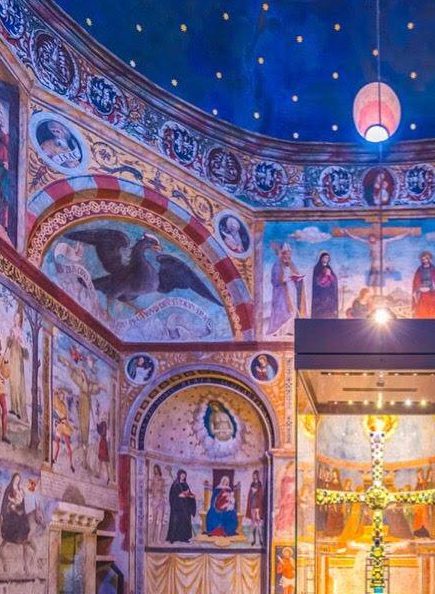
The Oratory of Santa Maria in Solario was erected in the twelfth century. It has a square plan, an octagonal lantern, and a small arched loggia. A Roman altar dedicated to the Sun was reused as the base of the central pillar supporting the vault on the ground floor. The upper floor is decorated with scenes from the life of Jesus.
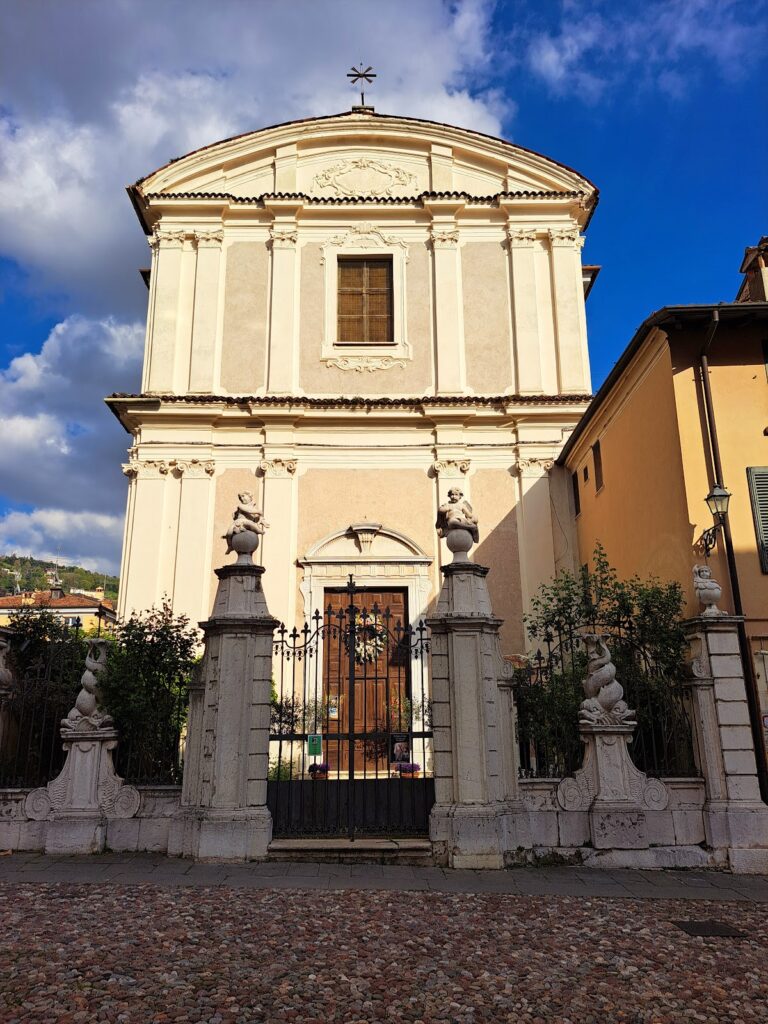
The sixteenth-century church of Santa Giulia, completed in 1599, forms part of the same complex and now serves as the museum’s conference center. Together, the oratory and later church reflect the continued expansion and changing functions of the former monastery.
Earlier remains and museum collections
San Salvatore stands above earlier remains, including a Roman-period domus, or urban house. Its date is given as either the first century BC or the first century AD, and it was destroyed in the fifth century AD. Foundations attributed to an older church and monastic complex associated with Saints Michael and Peter also lie beneath the basilica.
Roman houses are visible beneath the former vegetable garden of the nuns. The museum complex also preserves ancient finds ranging from the Bronze Age to the Roman period, including Iron Age material, the fourth-century ivory Brescia Casket, and the Diptych of Boethius. Other holdings include a plan probably showing the appearance of the Roman center of Brixia under Emperor Vespasian, a processional cross traditionally attributed to Desiderius but probably somewhat later, and architectural remains from demolished local buildings.
Nearby sites