Marienkirche: A Historic Lutheran Church in Hann. Münden, Germany


Site at a Glance
- Rating
- 4.8
- Popularity
- Very Low
- Country
- Germany
- Primary era
- Early Modern
- External website
- Open
- Eras represented
- Medieval, Early Modern, Modern
- Civilizations
- Holy Roman Empire
- Site type
- Religious
- Remains
- Church
On this page17 sections
History
Marienkirche is a historic church in Germany, located in Hann. Münden, whose origins may reach back to around 1006. If that early date is correct, the church would rank among the oldest in the region. Its history is closely linked to Hilwartshausen Convent, a women’s religious institution on the opposite bank of the Weser. The first surviving reference to the church dates from 1315, when it was described as a chapel of Saint Mary at Gimte.
Medieval chapel and Hilwartshausen
In 1315, Mainz Archbishop Peter von Aspelt granted an indulgence to people who contributed to the chapel’s construction costs. In medieval Catholic practice, an indulgence was a formal remission of penalties associated with sin, often connected with prayer, pilgrimage, or donations. A cemetery beside the chapel is mentioned from 1335.
The chapel was a subsidiary church of Hilwartshausen Convent and belonged to the Archdeaconry of Nörten, an administrative division of a medieval diocese overseen by an archdeacon. The oldest part of the present building, the choir, probably dates from around 1300. An altar slab referring to Hermann von Neste points to 1270, although its relationship to the surviving choir is uncertain. The church records do not explain whether an earlier Romanesque building was replaced by an Early Gothic one.
Reformation and seventeenth-century enlargement
With the Reformation in the Principality of Calenberg-Göttingen in 1542, the congregation became Protestant. The Reformation was the sixteenth-century religious movement that led to the establishment of Protestant churches in parts of Europe. That same year, Duchess Elisabeth of Calenberg-Göttingen appointed the first Protestant clergyman for the Hilwartshausen parish.
A major enlargement followed in 1610-1612 under Dorothea Stoffregen, the abbess, or head, of Hilwartshausen Convent. The present nave was added to the smaller chapel. During the associated transfer of church use at Hilwartshausen, the enlarged Marienkirche passed to the local population. The Peterskirche at Hilwartshausen, which had previously served the surrounding villages, became the church of the remaining nuns.
Alterations, restoration, and the parish ensemble
The interior changed repeatedly after the enlargement. Galleries were installed, the altar was modified, and a new pulpit was added in 1774. Renovations in 1838-1839 enlarged the windows, removed their tracery, added an exterior staircase and an organ gallery, replaced the seating, and introduced a Neo-Gothic pulpit altar. In 1956, the wooden altar-and-pulpit wall, upper gallery, and external staircase were removed. A new floor and a western vestibule were added as part of an attempt to restore a simpler interior.
The Baroque altarpiece, whose paintings by the local artist Johann Daniel Sarrazin date from 1680, was reconstructed in the 1980s. About fifteen years after the Second World War, the damaged altar was stored in a coal shed on the parish grounds. Restoration returned it to the church in 1982. The present tower was built in 1774, and its bronze bell was cast two years later.
Marienkirche belongs to the Gimte-Hilwartshausen parish, which includes Gimte and Volkmarshausen. The parish forms part of the Göttingen-Münden church district within the Hildesheim-Göttingen ecclesiastical district of the Evangelical Lutheran Church of Hanover. The associated church ensemble includes a cemetery laid out southeast of the church in 1873, a vicarage from 1772, and a sexton’s house dating from around 1880.
The organ and bells
The first organ was installed in 1770 as a gift from Johann Friedrich Hagemann, owner of the Graumühle in Minden. It was probably built by Stephan Heeren of Gottsbüren. The instrument was rebuilt in 1845-1846, probably by Balthasar Conrad Euler. Its first known specification, written down in 1859, listed 15 stops on two manuals and pedal, with mechanical action and slider chests.
The organ’s tin façade pipes were surrendered for wartime use during the First World War. Conrad Friedrich Carl Euler repaired it in 1932 and installed zinc façade pipes. Paul Ott repaired and modified the instrument in 1957-1958, when it was moved to its present position. Werner Bosch carried out further work in 1975 and restored it in 1994-1995, returning it to the 1845-1846 specification. The organ is protected as a heritage object.
Johann Justus Schreiber cast the church’s bronze bell at Allendorf in 1776. Its inscription names Gimte, Volkmarshausen, and Hilwartshausen, together with ecclesiastical and secular officeholders. A second bell, made of iron and used for striking, was decommissioned in 1945 and later removed.
Remains
Building and structural form
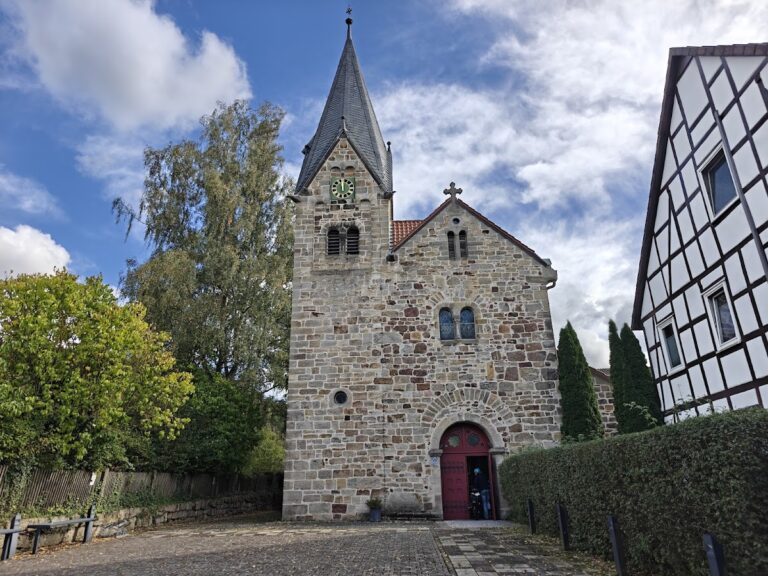
Marienkirche is a rectangular building with two bays and a lower, recessed rectangular choir. The nave and choir are covered by gabled roofs, with a cross on the eastern gable. Rubble stone forms the walls. Each long side of the nave and choir has two pointed-arch windows, while another pointed-arch window is set in the eastern end. A western vestibule with a round-arched entrance projects from the building.
Inside, a cross-ribbed vault, formed by intersecting ribs, spans the church. A gallery follows a U-shaped plan. Above the western gable is a square roof turret, a small tower rising from the roof rather than the ground. It is clad in slate and topped by a sphere, a patriarchal cross with two horizontal bars, and a weather vane. The turret has two small flat-arched sound openings on each of its eastern and western sides, and one on each of its northern and southern sides.
Altar and painted decoration
Baroque altarpiece
The altar, made around 1680, stands on a rustic stone table. Its painted sequence presents the Last Supper, the Passion, the Resurrection, and the Ascension. Christ appears smiling, including in the Crucifixion scene, rather than as the suffering figure or exalted ruler more usual in many contemporary representations. Mary, the apostle John, and Mary Magdalene appear at the Crucifixion, with Mary Magdalene symbolically holding Christ’s foot.
Red-spotted stone known as “peasant marble,” classical Greek columns, and floral and fruit ornament frame the altarpiece. Tulips, lilies, roses, and autumn fruits carry associations with redemption, love, harvest, and renewal. The predella, the lower part of an altarpiece, contains another Last Supper scene with texts and biblical quotations about communion, bread, and wine. The upper panels show Christ’s Ascension among angels.
Eastern stained-glass window
The figurative eastern window was made in 1961 by Hans Matschinski of Braunschweig. Nine New Testament scenes are arranged in chronological sequence. They show the announcement of Christ’s birth, the Nativity, the Presentation in the Temple, the Flight into Egypt, Jesus at the age of twelve in the Temple, the Wedding at Cana, Mary during the Passion, and the risen Christ surrounded by Mary and the disciples.
Furnishings and memorials
Pulpit
The wooden pulpit dates from 1961 and was made from the remains of a memorial plaque dated 1612. Its four-sided pulpit basket has two panels on each side, containing paintings or inscriptions.
Font
A round sandstone font from 1617 stands among the church’s historic furnishings. Angels’ heads decorate its basin, while lions’ heads ornament the stem.
Painted epitaph
The surviving painted epitaph dates from 1612. Civic mayor Matthias Schieffen donated it in memory of his wife, Cattrina Hollemens, and their three sons. Schieffen and his sons stand to the left of the cross, while his wife kneels on the right. Its inscription, written in Gothic minuscule, contains biblical quotations on righteous living and premature death. The monument is among the oldest surviving furnishings in the church.
Organ and bell
Organ
The organ has 15 stops on two manuals and pedal, with mechanical action and slider chests. Some pipes from the 1770 instrument survive. Its present arrangement follows the restored 1845-1846 specification, while the façade pipes are zinc.
Bronze bell
The tower contains the bronze bell cast in 1776 by Johann Justus Schreiber. It has a D-sharp pitch and bears the names of Gimte, Volkmarshausen, and Hilwartshausen, along with the names of ecclesiastical and secular officeholders. The former iron striking bell had a higher D-sharp pitch and was later removed.