San Pietro Apostolo: A Minor Basilica and Collegiate Church in Trapani

Site at a Glance
- Rating
- 4.6
- Popularity
- Very Low
- Country
- Italy
- Primary era
- Early Modern
- External website
- Open
- Eras represented
- Medieval, Early Modern
- Civilizations
- Norman
- Site type
- Religious
- Remains
- Basilica
On this page21 sections
History
San Pietro Apostolo is a Roman Catholic church in Trapani, Italy, traditionally regarded as the city’s first Christian place of worship. Dedicated to the Apostle Peter, it stands in the historic San Pietro district and is a parish church of the Diocese of Trapani, an important collegiate church with an archpriest, and a minor basilica. Tradition places its foundation after Saint Peter’s passage through Trapani, on the site of an earlier pagan temple whose dedication was associated either with Saturn or Neptune. The date of the first Christian foundation is unknown.
Norman Foundation and Medieval Privileges
The original sacred enclosure was repeatedly converted, rebuilt, and enlarged as Christian worship developed. In 1076, Count Roger I of Sicily, the Norman ruler who became the island’s first count, ordered a rebuilding and enlargement. At this time the church received the dignity of an important collegiate church and was placed under an archpriest. A collegiate church is served by a college of clergy, whose canons later occupied the choir stalls.
San Pietro also acquired a place in Trapani’s political history during the period of the Sicilian Vespers, the revolt and conflict that reshaped the island’s rule in the late thirteenth century. Peter III of Aragon swore in the church that he would preserve Trapani’s privileges, after the population had demonstrated its loyalty. In 1535, following his victorious campaign in Tunis, Emperor Charles V presented the church with a finely made banner captured from Ottoman Turkish forces.
Rebuilding in the Seventeenth and Eighteenth Centuries
A wooden chapel associated with the architect Giovanni Biagio Amico was added around 1695. The church was solemnly consecrated on 29 October 1726 by Giuseppe Barlotta Ferro, abbot of Santa Maria de Parco di Altofonte and titular bishop of Telepte. A titular bishop holds the title of a historic diocese without necessarily governing it.
The building was rebuilt and expanded during the eighteenth century. The architect Luciano Gambina carried out a comprehensive redesign around 1775, with the work completed in that year. After San Pietro was elevated as a collegiate church in 1736, a choir gallery, the Chapel of the Blessed Sacrament, and the baptistery were added around 1753. During the 1780s, the original wooden ceilings were replaced with masonry vaults.
The church was also connected with the rulers who stayed in Sicily. King Victor Amadeus II of Savoy visited and intervened at San Pietro during his residence on the island from 23 October 1713 to 7 September 1714, shortly before his coronation in Palermo. In 1801, Ferdinand III, later Ferdinand I of the Two Sicilies, received the blessing of the Blessed Sacrament there. Francesco I and Ferdinand II were later received in the church during the Bourbon court’s residence in Palermo.
The Diocese of Trapani and Modern Damage
From the seventeenth century until 1844, repeated petitions sought to restore Trapani as an independent bishopric. Earlier appeals had been made in 1496, but the Diocese of Mazara del Vallo opposed surrendering territory, and the proposed bishopric did not possess sufficient financial resources. Ferdinand II removed these obstacles in 1844, and Pope Gregory XVI established the Diocese of Trapani through the papal bull Ut animarum Pastores. San Lorenzo became the cathedral, ending the long dispute involving San Pietro and the protobasilica of San Niccolò. A minor basilica is an honorific title, distinct from the separate function of a cathedral.
Bombing during the Second World War damaged the church, and the 1968 Belice earthquake caused further structural harm. The building remained closed for several years before reopening for worship during the 1990s. Restoration was completed in 2003. A bronze bell weighing 4,000 kilograms was returned to its position in 2014, while work in 2021 upgraded the dome lighting and restored the paving of the forecourt.
Remains
Plan, Facade, and Dome
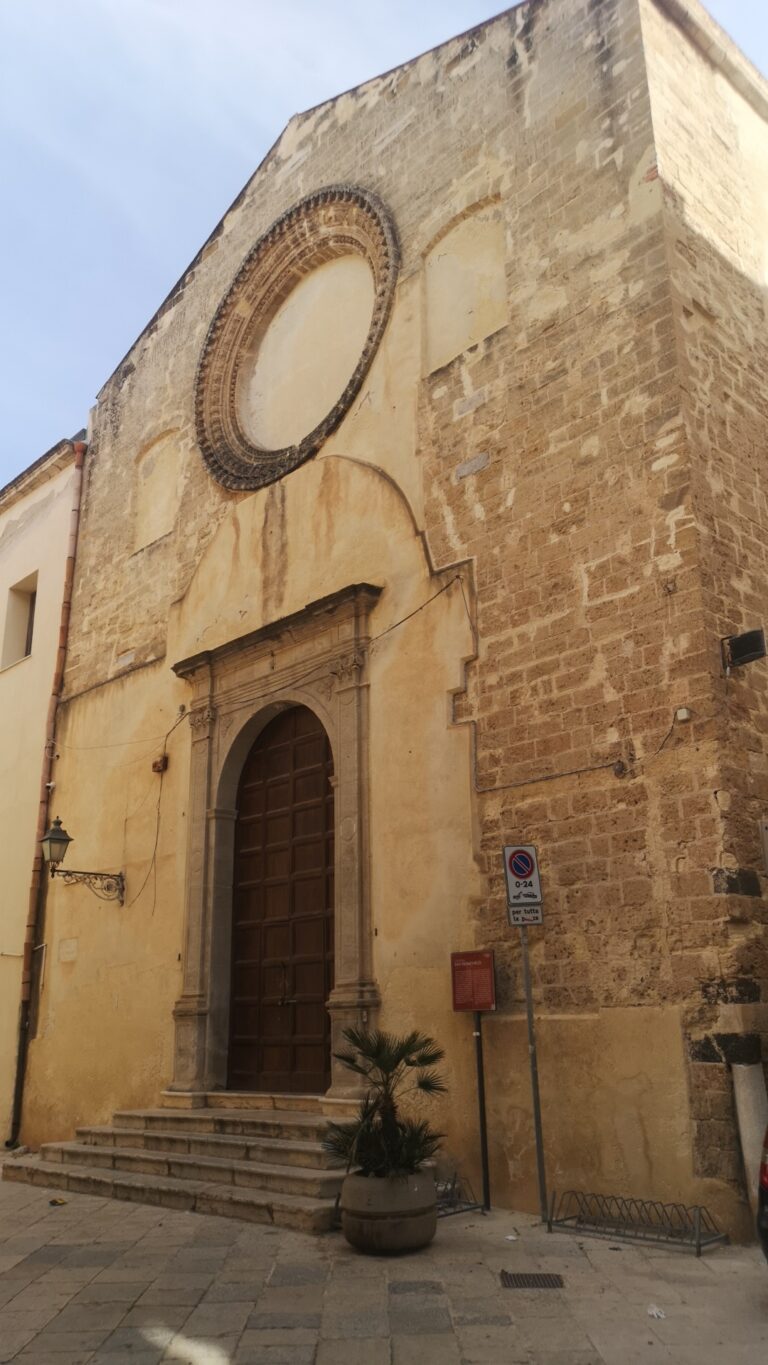
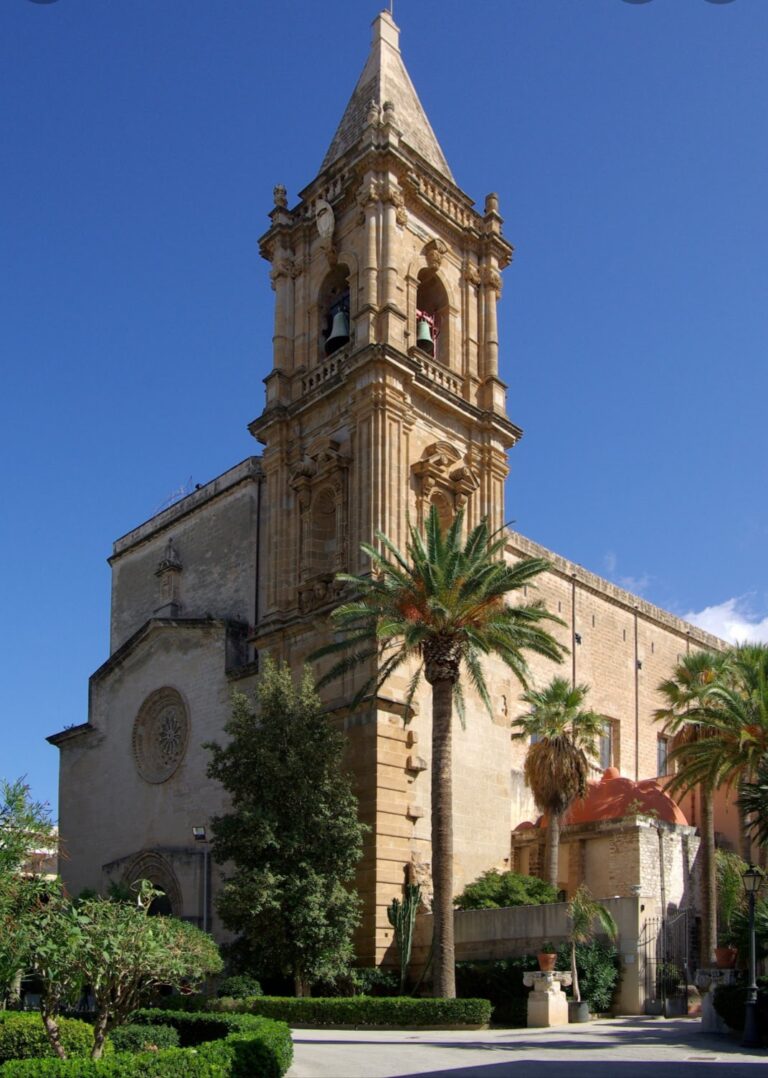
San Pietro has a five-nave basilica plan. Its west-facing facade is preceded by a portico supported by piers, a form associated with Byzantine basilicas. The facade has three main portals, together with a smaller southern portal and a fifth entrance on the north side. A bell tower stands to the left, while the eastern apses are concealed externally by the rectory.
Central Portal
The central portal is framed by Ionic columns with Corinthian capitals. Above its architrave, a broken pediment contains an aedicule, a small shrine-like architectural frame, and an intermediate niche with a statue of the Madonna and Child, known as the Madonna del Cardello. Reliefs of the Annunciation occupy the upper decorative zone, and the sculpture is associated with the Gagini school, the Renaissance tradition linked to the Gagini family’s Sicilian workshops. Beneath the pedestal is a coat of arms bearing the papal tiara and the Keys of Saint Peter. Statues of Saint Peter and Saint Paul stand in niches beside the portal.
Interior Structure
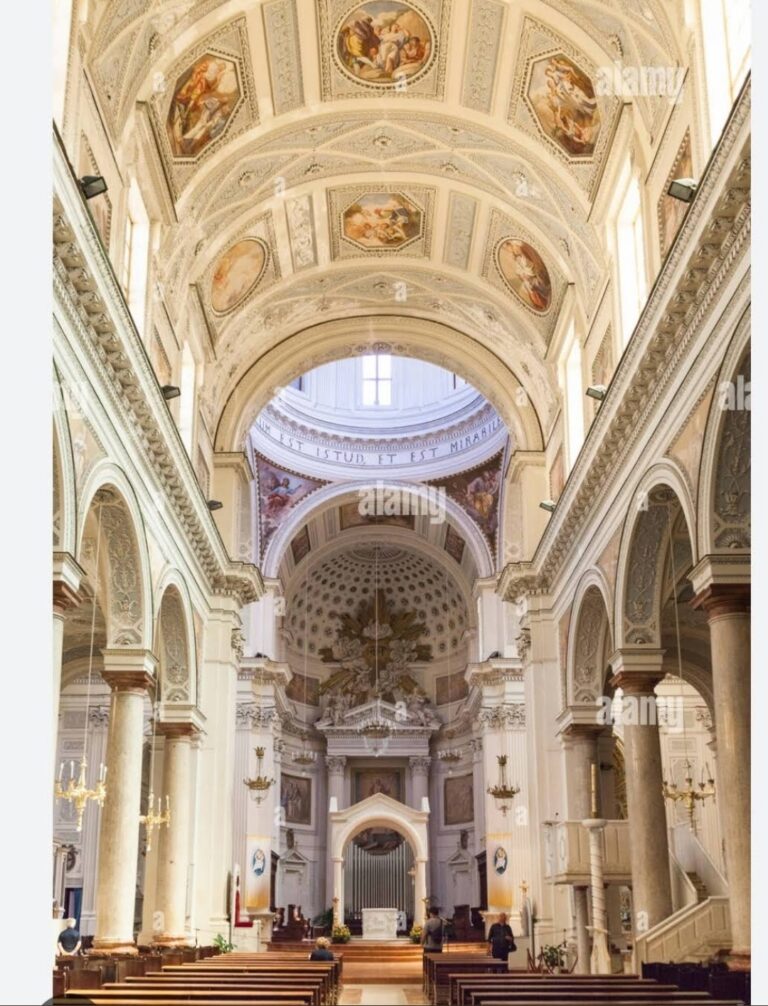
Fourteen columns and an equal number of external pilasters divide the interior into five naves. Six columns on each side separate the main nave from the side aisles, while the first two columns on either side lean against the piers of the crossing. The crossing dome rises on pendentives, curved triangular supports that carry a dome over a square or polygonal space, above an octagonal drum. Its ribs are made of tuff. Some small domes over the outer aisles retain parts of their eighteenth-century yellow-green ceramic-scale covering. Barrel vaults with lunettes cover the main nave and transept, and the masonry vaults carry painted panels and frescoed compartments.
Choir and Baptistery
Organ and Choir Gallery
A choir gallery attached to the counterfacade is supported by two columns. It is entirely occupied by the monumental organ built in Palermo by Francesco La Grassa between 1836 and 1847. The instrument consists of three organs and seven keyboards, with several thousand pipes of different heights arranged in an unconventional manner. Its effects can reproduce the sounds of brass instruments, cymbals, trumpets, horns, oboes, saxophones, bassoons, violins, cellos, clarinets, drums, the fife, bagpipes, and, according to its description, the human voice.
Baptistery Chapel
The first bay of the right-hand nave contains the baptistery chapel, with a baptismal font and a wooden high-relief depicting the Baptism of Jesus. The third bay contains the southern exit. On the opposite side, the first bay of the left-hand nave contains archive rooms, the third bay contains the northern exit, and the fourth bay holds a wooden pulpit.
Transept and Apses
Chapel of Saint Peter
The right arm of the transept contains the Chapel of Saint Peter. Its principal image is a wooden statue by Mario Ciotta showing Peter seated on a cathedra in papal vestments beneath a large wooden baldachin, a canopy over a sacred image or altar.
Chapel of Saint Paul
The left arm of the transept contains the Chapel of Saint Paul, with a statue of the saint and Andrea Carrera’s painting of Saint Paul, dated 1617. The chapel also contains a painting signed by Marcello Provenzano and dated 1616.
Chapel of the Blessed Sacrament
The right apsidiole, a small apse, contains the Chapel of the Blessed Sacrament. It includes a crucifix, a valuable frontal, and busts set into the oculi of the altarpiece.
Chapel of the Madonna of Trapani
The left apsidiole contains the Chapel of the Madonna of Trapani. The statue stands beneath a baldachin supported by eight columns arranged in a semicircle, following the style of the corresponding baldachin in the Basilica and Sanctuary of Maria Santissima Annunziata. The premises were historically granted to the millers’ guild and contain large paintings on the side walls.
Presbytery and Apse
The raised presbytery contains a monumental altar facing the apse and choir stalls with twenty-six seats for the collegiate canons. The altarpiece has pairs of columns with Corinthian capitals, with the inner pair projecting forward to support an architrave and broken pediment. Its aedicule contains Andrea Carrera’s Transfiguration, which entered the church in 1679. A large stucco sunburst fills the apse vault, while the side walls carry oil paintings on canvas of the Adoration of the Magi and the Adoration of the Shepherds.
Side Chapels and Religious Art
Chapels of Guilds and Saints
The Chapel of Saint Donatus the Bishop contains Francesco Matera’s Miracle of Bishop Donatus and was historically granted to the bakers’ guild. The Chapel of Saint Andrew contains Andrea Carrera’s Jesus Calling Saint Andrew to the Apostolate. The Chapel of Saint Catherine of Alexandria holds Francesco Matera’s Martyrdom of Saint Catherine and was historically patronized by rope-makers.
The Chapel of the Archangel Raphael contains a large painting of the archangel by Matteo Mauro. The Chapel of Saint Eligius the Bishop contains Matteo Mauro’s painting of Eligius of Noyon and was historically granted to the blacksmiths’ guild. The Chapel of Saint Albert has a niche with a statue of Albert degli Abati, a Carmelite confessor.
Crucifix and Immaculate Conception Chapels
The fifth bay of the left-hand nave contains the Chapel of the Most Holy Crucifix. A crucifix attributed to Giuseppe Milanti stands on a reliquary between statues of the Virgin Mary and Saint John the Evangelist. The chapel was historically under the patronage of the Palmeggiano family.
The Chapel of the Immaculate Conception contains Calcedonio Errante’s painting of the Immaculate Conception and Giacomo Lo Verde’s Jesus, Mary, and Joseph. The Adragna family held its patronage. The Chapel of Saint Nicasio Burgio preserves its primitive chapel and altar.
Other Works
Other surviving works include a niche framed by panels depicting twenty religious episodes, a statue of Saint Joseph with the Child, Francesco Nolfo’s Pietà, a bust of Francis of Paola, Giuseppe Errante’s painting of Saint John Nepomuk, and a fourteen-panel Via Crucis.