Kring: An Earthwork Enclosure Interpreted as a Roman Outpost
Site at a Glance
- Popularity
- Very Low
- Country
- Germany
- Primary era
- Classical
- Eras represented
- Classical
- Civilizations
- Roman
- Site type
- Military
- Remains
- Fort
On this page10 sections
History
The Kring is an oval earthwork enclosure on Ravensberg near Hann. Münden in Lower Saxony, Germany. Archaeological evidence suggests that it served as a small Roman camp and an outpost of the camp at Hedemünden, about 3 km away across the Werra. Its origins are placed around the beginning of the Common Era.
Bronze Age setting and early interpretations
A Bronze Age trade route passed near the enclosure, linking a ford across the Fulda at Spiekershausen with a crossing of the Werra at Hedemünden. For many years, the Kring was considered a prehistoric or early medieval refuge fort. Its Roman character came to light through research on the nearby camp at Hedemünden.
Recognition of the Roman enclosure
German archaeologist Carl Schuchhardt carried out the first investigation in 1892, digging a trial trench inside the enclosure without producing significant results. In 1983, University of Hanover students surveyed the site’s form and elevation at the initiative of Hanover’s Institute for Monument Preservation. The Göttingen district archaeological service conducted metal-detector surveys in 1988, 1991, and 2000. The iron objects they recovered could not initially be dated, but were later identified as Roman.
A tree blown down in 1991 exposed charcoal at the site. Dating analysis completed in 2005 placed the charcoal in the early Roman Imperial period, the first era of rule by Roman emperors, renewing archaeological interest in the Kring from 2006. Metal-detector surveys followed that year, and excavations from 2007 to 2009 included about ten trenches inside the earth bank. The Roman finds strengthened the interpretation of the Kring as a small camp and an outpost of Hedemünden.
Recorded names
From the 16th century, the enclosure was known by names resembling Hünenburg, and it was sometimes called Ravensburg after its position on Ravensberg. The origin of “Kring” is uncertain. It probably refers to the circular earthwork; in Germanic usage, the word could describe a legally bounded area. Other possibilities connect it with a gathering circle where judgments were announced or carried out, or with an activity mentioned in a Middle High German legal text.
Remains
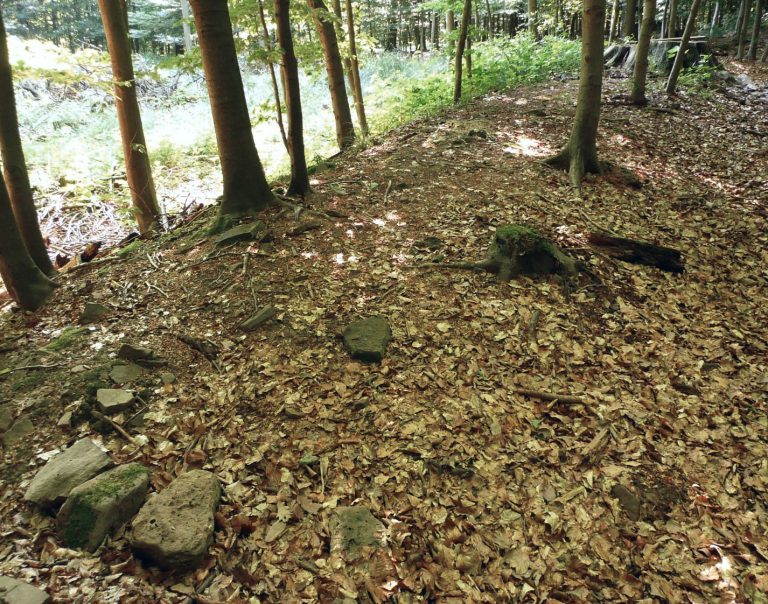
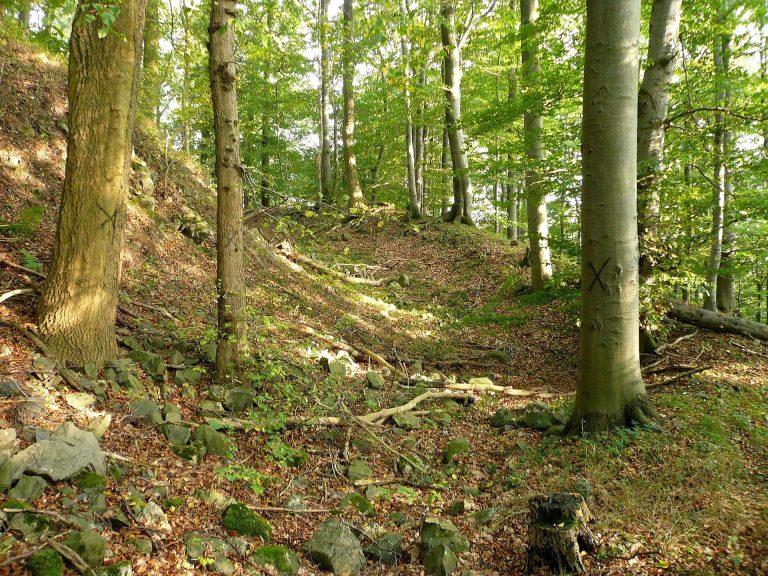
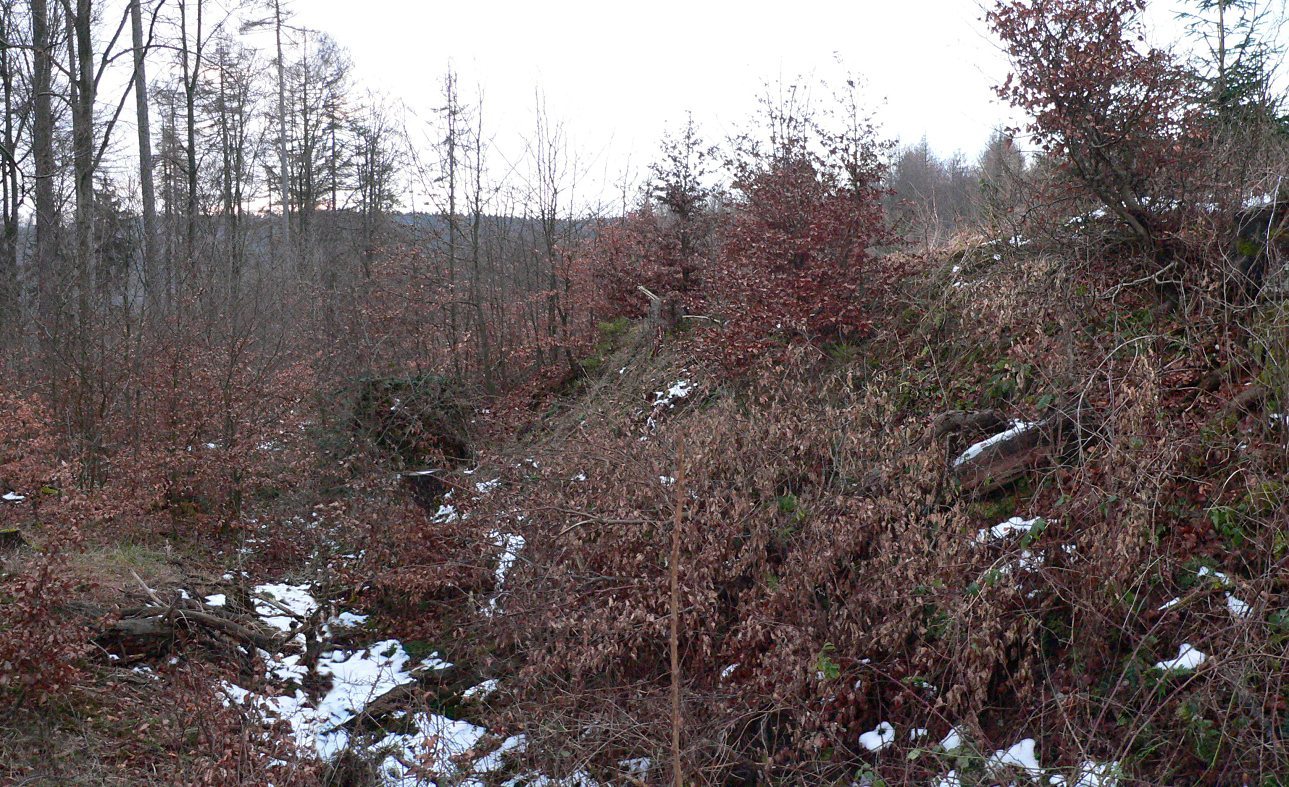
At an elevation of 395 m, the oval enclosure measures 82 by 110 m and covers about 4,000 m2. A raised bank built from timber and earth surrounds the interior, with a ditch outside it.
Earth bank and eastern entrance
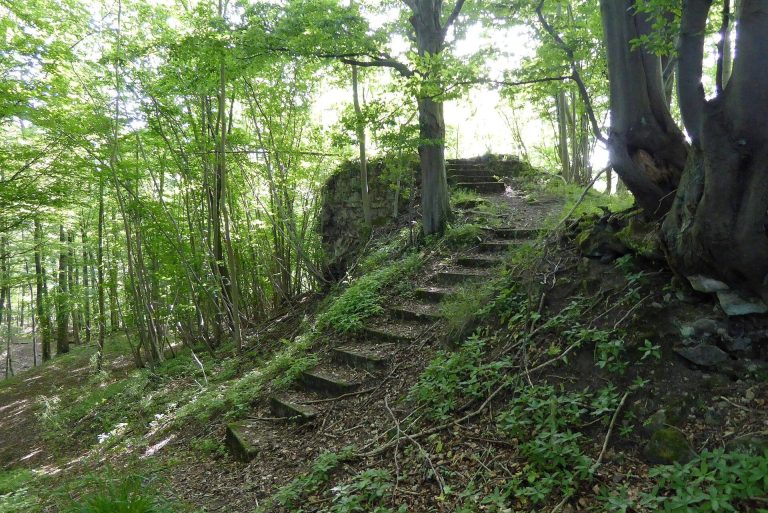
The bank extends for 225 m around the enclosure and survives along its full length, with minor damage. It is about 6 m wide and 1.5 m high; on sloping ground, its outer face reaches 2.5 m. The crest stands about 2.5 m above the outer ditch, which is up to 4 m wide and about 1 m deep. The construction may have included upright wooden outer faces. On the east side, at the enclosure’s lowest point, a 5 m opening faced an earthen bridge across the ditch.
Archaeological finds
Bronze Age hoard
Opening several burial mounds in the northern foreland in 1881 produced a hoard of 20 bronze objects from the Urnfield period, a prehistoric period associated with cemeteries where cremated remains were buried in urns. The objects were made available to museums in Hanover and the local history museum in Münden.
Roman military objects
Roman finds from the investigations include equipment parts, tent pegs, construction iron, tools, catapult bolts, military footwear, and coins. Some objects date to the reign of Augustus, Rome’s first emperor, from 27 BC to AD 14. One notable item is an iron restraint resembling a neck fiddle, with metal loops for fastening a person’s hands beside the head. A fully preserved iron Roman dagger came from a deposit on the route leading from the Kring toward the Werra ford.
Charred timber
The tree blown down in 1991 exposed charred beech roundwood in a hole left by its uprooted roots. The remains point to an earlier construction of timber and earth and suggest that fire destroyed it.