Monastery of Carboeiro: A Benedictine Monastic Complex in Spain


Site at a Glance
- Rating
- 4.4
- Popularity
- Medium
- Country
- Spain
- Primary era
- Medieval
- External website
- Open
- Eras represented
- Medieval
- Civilizations
- Kingdom of León
- Site type
- Religious
- Remains
- Monastery
On this page12 sections
History
The Monastery of Carboeiro is a Benedictine monastery in Spain, in the parish of Santa María de Carboeiro, Silleda, Galicia. Founded in the tenth century, it was dedicated to Saint Lawrence and became one of Galicia’s most influential religious institutions during the eleventh to thirteenth centuries. Its surviving church is a late Romanesque building transitional toward Gothic architecture, constructed during the monastery’s major rebuilding and enlargement in the twelfth century.
Foundation and early protection
The precise foundation date is uncertain, although it is associated with 926, 936, or 939. Tradition attributes the foundation to Count Gonzalo Betótez and his wife, Teresa Eiriz, who acquired an earlier hermitage dedicated to Saint Lawrence from its owner, Egica. A small religious community may already have been present when the foundation document was issued. Félix became the first abbot, and the monastery church was consecrated in the presence of Ero, Bishop of Lugo, and Rosendo of Celanova, a Galician bishop, monastic leader, and saint.
Gonzalo Betótez died in 927 and was buried at the Monastery of Camanzo, which he and Teresa had also founded across the Deza River. Teresa later sought the protection of King Ramiro I, placing Carboeiro under royal jurisdiction and securing special privileges from the Crown. These arrangements helped establish the monastery’s institutional position during its early development.
Destruction and restoration
Carboeiro suffered serious destruction during the late tenth century. A Norman raid led by Gunderedo in 968 may have contributed to the damage, while the military campaigns of Almanzor, the Córdoba-based Umayyad ruler whose forces attacked many Christian territories in Iberia, destroyed the monastery in 997. King Bermudo II ordered its restoration in 999.
The community had been dispersed, so the priests Estrarico and Trasuario were brought to the site to follow the monastic tradition of Saint Benedict, whose rule emphasized communal prayer, disciplined work, and obedience. Trasuario was charged with rebuilding the establishment and later became its abbot. His work began a renewed phase in Carboeiro’s religious and economic history.
Expansion and influence
After its restoration, Carboeiro expanded its lands and political influence through royal grants, private donations, purchases, and territorial privileges. The monastery’s abbots included Trasuario, Tanitus, Munio, Ranemiro, Afonso, Xoán, Martín, Froila, Fernando, Pedro Froilaz, Osorio, and Xoán de Deus. Its greatest prosperity extended from the eleventh through the thirteenth centuries.
In 1096, Abbot Afonso acquired the neighboring Couto de Pastoriza through an exchange with Count Raymond of Burgundy and Urraca. A couto was a medieval territorial estate or jurisdiction often associated with ecclesiastical lordship. In 1144, during the abbacy of Froila, the community bought the Couto de Merza from Alfonso VII. Its wider holdings included plantations in Ribeiro.
Royal protection strengthened the monastery’s authority, and by the late twelfth century Carboeiro was probably connected with the Cluniac reform, a movement to reinforce monastic discipline through more centralized reforming influence associated with Cluny. Aragonta, daughter of the founders and wife of King Ordoño II of León, defended the monastery’s rights over lands in Salnés. Further privileges came from Alfonso VII in 1144, Ferdinand II in 1159, Alfonso IX, and Ferdinand III.
Twelfth-century building campaign
Abbot Froila enlarged and improved the monastic residence, completing that work by the summer of 1148. His successor, Fernando, who held office from 1162 to 1192, continued the enlargement of the church. Abbot Pedro Froilaz subsequently completed the building works. This campaign produced the church that survives in late Romanesque form with emerging Gothic elements.
Decline and secular transformation
From the late thirteenth and fourteenth centuries, Carboeiro gradually lost influence, especially as the nearby Monastery of Santa María de Aciveiro became more prominent. Its landholdings continued to grow, but disputes with tenants and pressure from Galician nobles reduced its autonomy. As royal authority in Galicia weakened, local magnates, including the fifteenth-century group known as the “Mad Counts,” imposed greater power over the region.
Reforms promoted by the Catholic Monarchs, Ferdinand II of Aragon and Isabella I of Castile, and authorized by Pope Innocent VIII and Pope Alexander VI changed Carboeiro’s status around 1500. It became a priory dependent on the Monastery of San Martiño Pinario in Santiago de Compostela. A priory was a monastic house governed below the status of an independent abbey.
Carboeiro later functioned as a monastic farm administered by two monks. They collected rents, managed the estate, and provided spiritual services for the surrounding population. By the late eighteenth century, the complex was being used as a prison for nuns.
Abandonment and conservation
The confiscation laws associated with Juan Álvarez Mendizábal, nineteenth-century Spanish measures that dissolved or transferred many ecclesiastical properties, led to the monastery’s abandonment in 1835 or 1836. Its properties passed into private ownership or were offered for public sale. During the nineteenth century, the buildings also served as a refuge for groups fighting the French and later for bandits and outlaws.
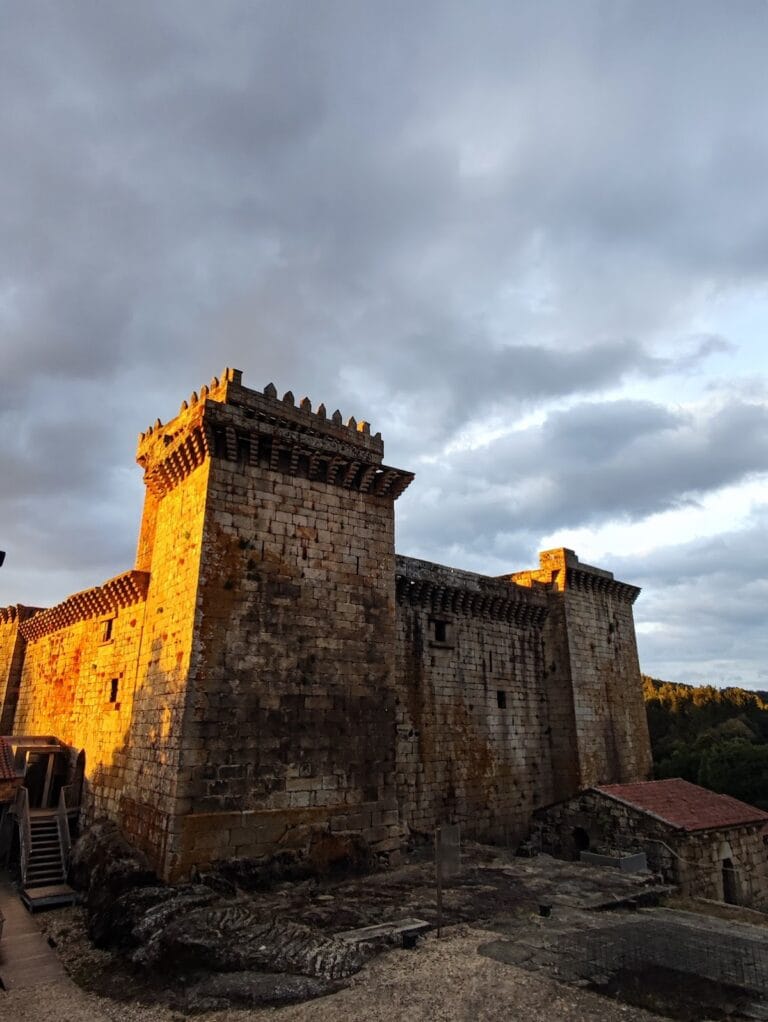
After abandonment, the complex deteriorated, lost its roof, and was repeatedly looted. It was declared a Historic-Artistic Monument and a Property of Cultural Interest in 1931. The municipality acquired it in 1989, and conservation and restoration campaigns from the 1970s, particularly between 1990 and 2009, preserved the church and some monastic buildings.
Carboeiro also entered modern cultural memory. Antonio López Ferreiro used the monastery as the setting for his historical novel O niño das pombas, published in 1905. The 1965 film Cotolay was filmed at the complex, with local residents participating in a production that recorded its abandoned condition at that time.
Remains
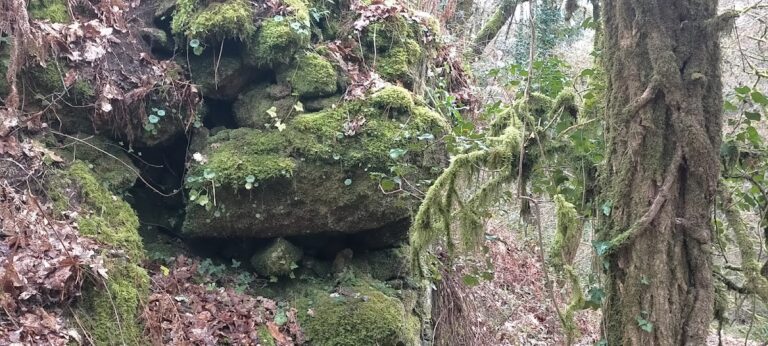
The surviving complex stands beside the Deza River, using a bend near the river’s confluence with the Ulla. It lies beneath Couto Costoia, formerly called Mount Custodia, from which stone used in construction may possibly have been obtained. The nearby Toxa River descends steeply into the Deza, forming the Toxa waterfall. The surrounding woodland also shaped the site’s name, which is associated with charcoal production. Historical forms include Carbonário, Karuonario, Carbonero, Carbonieyra, Carguero, Garguero, Cargueiro, and Gargueiro. The 999 restoration document calls the place Algalí, while documents from 1095 and the twelfth century use Retorta or place the locality beneath Mount Custodia.
Church
Plan and construction
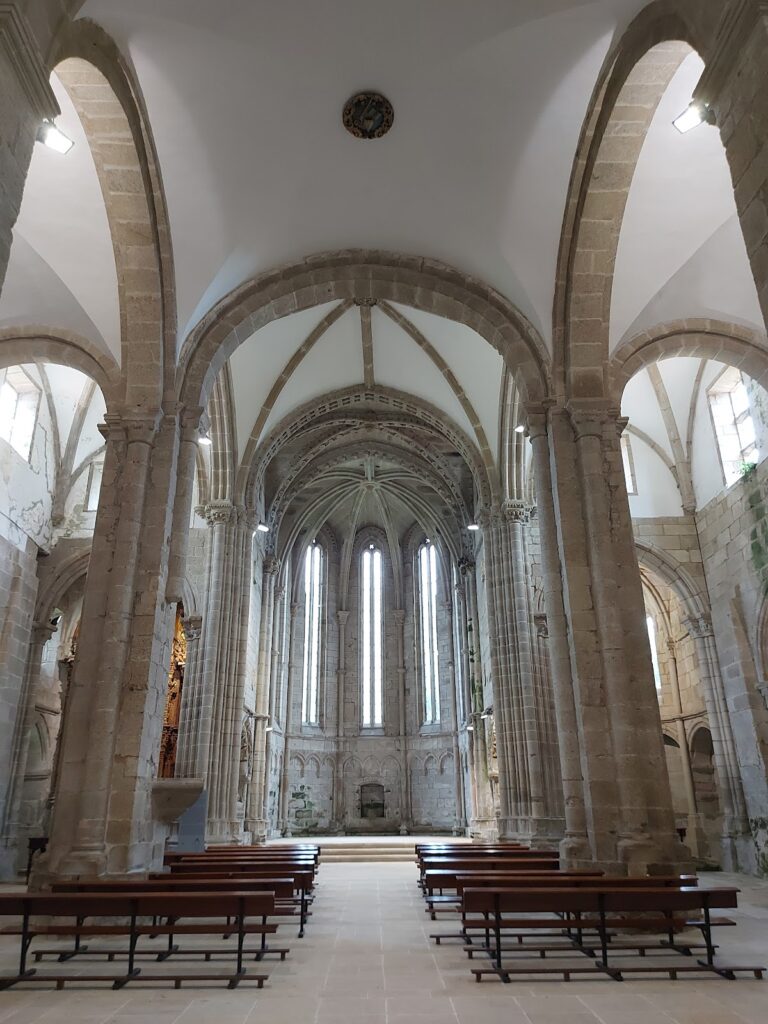
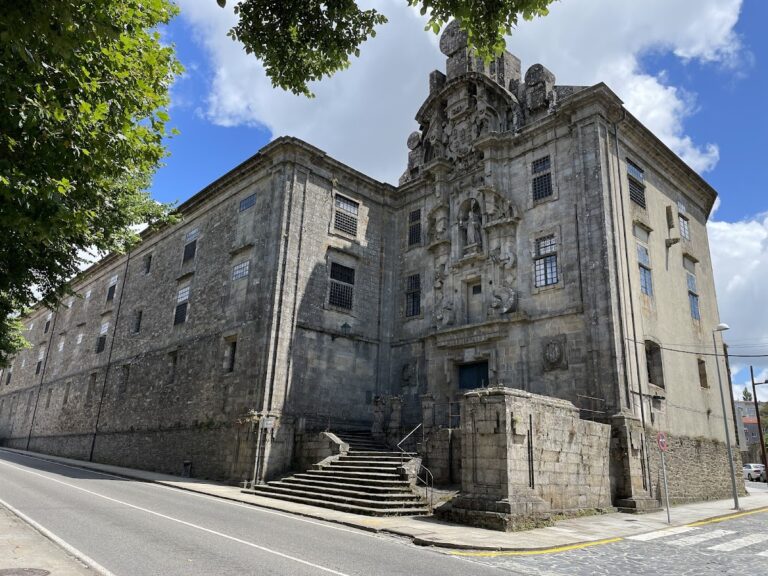
The church follows a Latin-cross plan with three longitudinal naves, a transept, and three apses. The central nave is twice the width of the lateral naves. Built in the twelfth century during the rebuilding associated with Abbot Fernando, it combines late Romanesque architecture with forms transitional toward Gothic. The church and some monastic buildings remain in good condition after modern restoration and recovery work, while other parts of the complex had previously deteriorated after the roof was lost and the monastery was abandoned.
Façade and sculpture
The principal façade has archivolts, bands of molding around an arch, decorated with the twenty-four elders of the Apocalypse. In the Christian Book of Revelation, the Apocalypse is the final book of the New Testament, and its twenty-four elders appear as heavenly figures in a vision of divine worship. The decoration has been compared with the sculpture of the Portico of Glory at the Cathedral of Santiago de Compostela.
The church’s tympanum, the field above a doorway, once included three central sculptures from the twelfth century. Two were removed in the late 1950s and are now held by the Frederic Marès Museum in Barcelona. They are attributed to followers of Master Mateo, the medieval sculptor associated especially with the Portico of Glory at Santiago Cathedral.
Inscriptions and interior decoration
Three inscriptions survive in the church. An exterior inscription gives the era date “MCCVIIII.” Inside, another inscription states that Abbot Fernando founded the temple with his monks on 1 July 1209. A funerary inscription identifies Fernando as buried in the church, praises his conduct, and records his death in 1192.
Mural paintings survive, or remain perceptible, on the ceiling and walls of the chapel to the left of the high altar. They may have been executed during the abbacy of Pedro Froilaz. The church was also supplied from its foundation with relics associated with Saint Lawrence, Saint Hippolytus, Saint Pelagius, Saint Vincent, Saint John the Baptist, Saint John the Evangelist, Saint Thomas, and Saint Peter, together with a thorn from Christ’s crown.
Nearby sites