Barreira Tower: A Medieval Fortress in Galicia


Site at a Glance
- Rating
- 5
- Popularity
- Very Low
- Country
- Spain
- Primary era
- Medieval
- Eras represented
- Medieval
- Civilizations
- Crown of Castile
- Site type
- Military
- Remains
- Castle
On this page8 sections
History
Barreira Tower is a medieval tower-fortress in Spain, standing in Riobó parish in the municipality of La Estrada, Pontevedra, Galicia. It was associated with the historic territory of Tabeirós and occupied a route toward Ourense and Santiago de Compostela. After Tabeirós passed to the archbishops of Santiago during the reign of Alfonso VII of León, Barreira became an administrative and revenue-collecting center within their lordship.
Lordship of Santiago
Tabeirós came under the authority of the archbishops of Santiago in exchange for their renunciation of Faro Castle in A Coruña. Barreira was thereafter regarded as one of the most important fortresses controlled by the see of Santiago. Archbishops sometimes stayed there briefly, while a merino, a medieval official with administrative and judicial authority, governed the fortress. The office could be held by a person appointed by the archbishop or by the fortress’s holder, and it changed hands frequently. Some parts of the complex, possibly including a tower or the entrance bastion, may have served as residences for these administrators.
The conflict of 1342
In 1342 Barreira belonged to the nobleman Vasco Pérez. On 5 April, Alfonso XI of Castile ordered him to render homage to Archbishop Martín Fernández de Gres, because the fortress lay within the lordship of the Church of Santiago and was reportedly being used as a base for attacks on local inhabitants and pilgrims.
Vasco Pérez refused. Although he joined Alfonso XI at the siege of Algeciras, he left Barreira in the hands of men who carried out robberies and other abuses. The fortress consequently became a stronghold for banditry. Before departing for Algeciras, Martín Fernández de Gres began a siege in the summer of 1342 with several canons and the cantor Suero Gómez. A bastida, a temporary structure used to help capture a fortified position, was being built during the operation.
On 24 September, Alfonso XI sent a letter from Algeciras asking the archbishop to end the siege and stop construction of the bastida, after placing Vasco Pérez and his property under royal protection. Two days later, the archbishop replied that Vasco Pérez had disobeyed the royal order, abandoned Barreira to criminals, and refused to surrender it to Lope Díaz de Rojas, the chief merino of Galicia. The siege’s final outcome is not known. Vasco Pérez was probably dispossessed, and Barreira subsequently came into the possession of the archbishops of Santiago.
Pedro Enríquez and the ownership dispute
In 1379 Pedro Enríquez, count of Trastámara, Lemos, and Sarria and chief pertiguero of Santiago, granted the parishes of San Martín de Riobó and Corcoesto to his vassal Ruy Soneira de Rioboo. A pertiguero was an official involved in the territorial and military administration of the Church of Santiago. Pedro Enríquez then seized Barreira and completely rebuilt it, despite a restriction that prevented the chief pertiguero from holding castles or fortified houses in the territory of the see.
In 1384 Archbishop Juan García Manrique and Pedro Enríquez disputed Barreira, the fortress and territory of Castro de Montes, and other properties. A judgment issued at Torrijos on 17 March ordered Pedro Enríquez to return them to the archbishop within thirty days and to pay 1,359 maravedís in legal costs. At the beginning of 1385, the royal alcalde Fernán Sánchez de León required Barreira’s castellan to render homage during the continuing dispute, but on 3 February King Juan I of Castile prohibited the homage from taking place.
Pedro Enríquez delayed compliance with the judgment. He claimed that he had inherited Barreira through the 1371 will of Pedro Yáñez Saraza and had rebuilt it at his own expense. On 24 November 1388, Juan García Manrique and Pedro Enríquez agreed at Medina del Campo to submit the matter to a commission consisting of Lope Gómez de Lira, Fernán Pérez de Andrade, and Juan Rodríguez de Biedma. Rejecting its decision would incur a penalty of 10,000 Castilian gold doblas.
On 10 December 1388, the commission ruled that Pedro Enríquez had never possessed a right to Tabeirós or Barreira. He had to return the properties and obtain his wife Isabel de Castro’s acceptance of the ruling. The archbishop was required to compensate him with 300 marks of silver for his investment in the properties, as well as 30,000 old-coin maravedís for expenses on the houses of Mazarelas in Santiago.
Final transfer and destruction
The dispute resumed during Pedro Enríquez’s final years. On 24 October 1398, powers were granted to three canons, Alfonso Arias, Domingo Fernández de Cándamos, and Juan Vázquez de Collora, to continue the case before the Castilian court. In his will of 29 April 1400, two days before his death, Pedro Enríquez ceded Barreira and its territory, free of legal claims, to Archbishop Lope de Mendoza. The transfer remained subject to repayment of an unspecified debt owed to Pedro Enríquez or his heirs.
In 1420, Lope de Mendoza granted Barreira in encomienda to Fadrique Enríquez, Duke of Castile and son and heir of Pedro Enríquez. An encomienda placed a property or territory under another person’s custody, protection, or administration. Barreira was later destroyed during the Irmandiño Revolt, a major fifteenth-century uprising in Galicia during which many noble fortresses were demolished. It was rebuilt after the revolt, but eventually fell into the ruined condition seen today.
Remains
The fortress and its setting
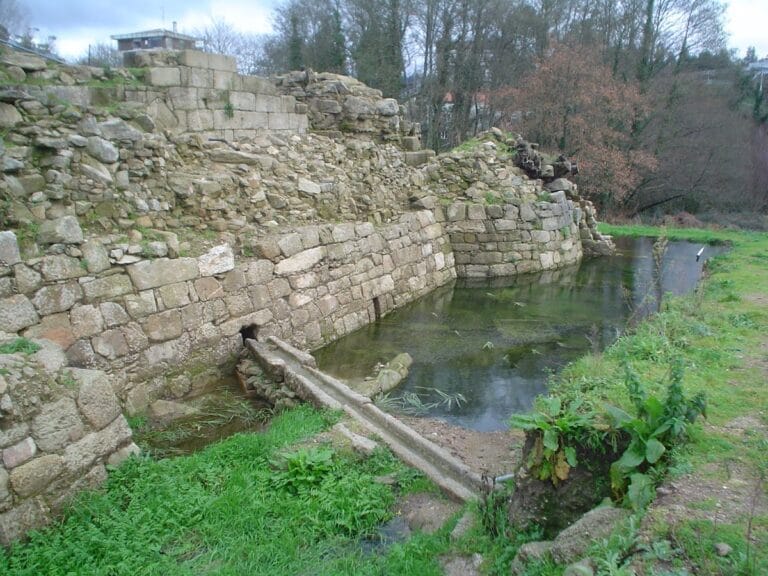
Barreira is a tower-fortress situated on Barreira Hill in Riobó parish. Its position formed part of the medieval route toward Ourense and Santiago de Compostela. The wider complex may have included several towers and an entrance bastion, with one of these elements possibly providing accommodation for the administrators who managed the fortress. The surviving site is now in ruins, preserving the remains of a stronghold that served both administrative and military purposes within Tabeirós.
Siege works and rebuilding
The fortress’s physical history includes the complete rebuilding carried out by Pedro Enríquez after his seizure of Barreira in the late fourteenth century. During the siege of 1342, a bastida was constructed to support an attack on the fortified position, adding a temporary military work to the site’s defenses. Barreira was later destroyed in the Irmandiño Revolt and rebuilt once more. Its present fabric therefore reflects successive phases of construction, destruction, and repair rather than a single medieval building campaign.
Nearby sites