Koserow Church: A Medieval Parish Church on Usedom’s Baltic Coast


Site at a Glance
- Rating
- 4.4
- Popularity
- Very Low
- Country
- Germany
- Primary era
- Medieval
- Eras represented
- Medieval
- Civilizations
- Duchy of Pomerania, Holy Roman Empire
- Site type
- Religious
- Remains
- Church
On this page15 sections
History
Koserow church is a medieval parish church in Germany, built during the second half of the thirteenth century on Usedom’s outer Baltic coast. It is described as the oldest church on the island’s Baltic coast and Usedom’s only medieval church on the outer coast. Together with the churches at Liepe, Benz, and Netzelkow, it belongs to the island’s oldest village churches.
Medieval Foundation and Expansion
Koserow church was not founded or built by a monastery. It remained under state patronage and was regarded as the poorest of Usedom’s churches. A small fieldstone chapel may have stood here shortly before or after 1300, and the surviving squared fieldstone walls of its choir reach to the level of the window springing. The present building was probably extended westward in the early fifteenth century, when the nave and the set-back west tower were added.
The church’s difficult finances shaped its later history. During the reigns of Frederick William I and Frederick the Great, eighteenth-century Prussian kings associated with a centralized and financially disciplined state, Koserow church was the only church on Usedom exempted from certain levies because of its chronic poverty. Its poor condition continued to attract criticism in the nineteenth century.
Pastoral and Religious History
Wilhelm Meinhold served as pastor at Koserow from 1821 to 1827. During this pastorate he wrote his first book in 1826. He later drew on names and events connected with the local pastoral history around 1630 for his novel The Amber Witch, published in 1841.
The church’s traditions also preserve memories of the sea. A votive ship, a model vessel given to a church as an expression of thanks after survival at sea, was reportedly donated in 1823 by one or more fishermen from Ückeritz after they had been rescued from danger. Fishermen from Zempin donated the tower chandelier on 6 January 1900 in gratitude for an exceptionally large catch in the Achterwasser.
A larger earlier bell was reportedly taken as war booty during the Thirty Years’ War, the European conflict of 1618 to 1648, by Croatian troops serving the emperor. Dredging in the Swine recovered the bell in 1895. It was raised and transferred to a museum in Stettin, where it was still reportedly held.
Repairs and Parish Changes
Major repairs between 1875 and 1897 partly renewed the nave’s south wall and completely rebuilt the upper part of the tower. The interior was comprehensively renovated in 1897. The windows were renewed in 2007, and the church underwent another extensive renovation in 2009. Further external work later included cosmetic repairs to the west side of the tower and the south side of the nave in May 2015.
The medieval crucifix was restored in 2007 after deterioration, the partial loss of its right foot, and damage from wood-boring beetles. The votive ship was repaired in 1936 and 1977, then comprehensively conserved after later insect damage and returned to the church on 14 June 2009. In 2011, a second bell was dedicated after an interval of almost 400 years. The bell frame was renewed and a bell-ringing mechanism installed beforehand.
Since 2012, the Evangelical parish has belonged to the Pasewalk provostship, a regional administrative subdivision, within the Pomeranian Evangelical Church District of the Evangelical Lutheran Church in Northern Germany. Previously, it belonged to the Greifswald church district of the Pomeranian Evangelical Church. The parish includes Koserow, Kölpinsee, Loddin, Ückeritz, Zempin, Neu Pudagla, and Stubbenfelde, with the churches at Koserow and Zempin specifically associated with it.
Remains
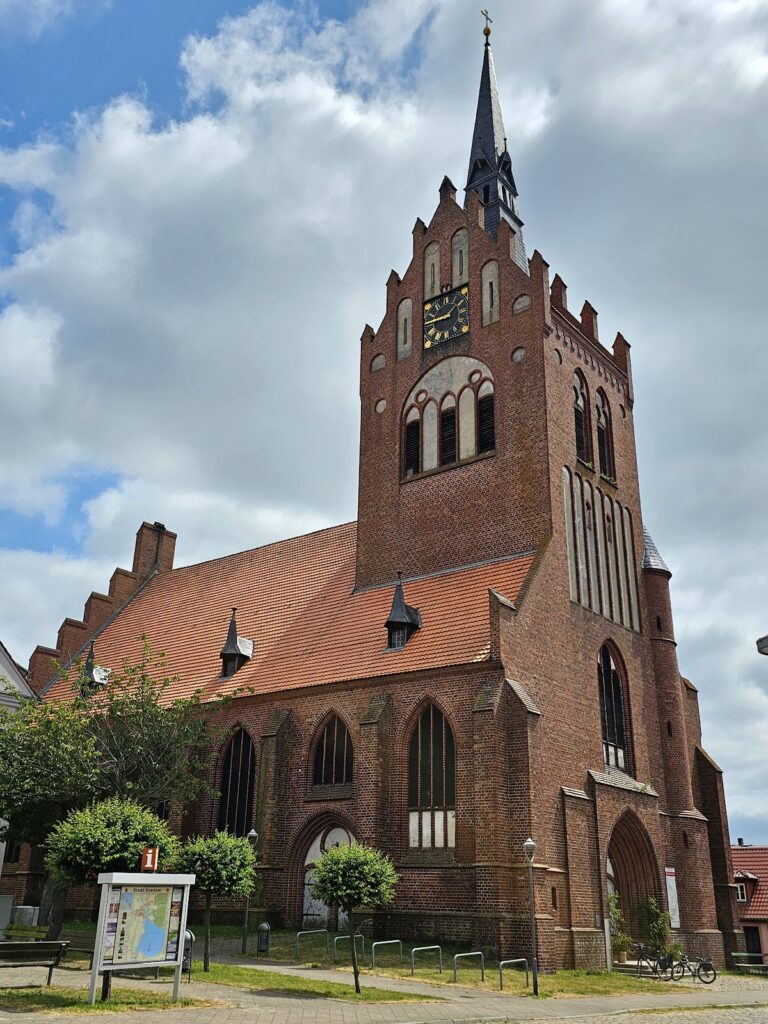
Koserow church is a fieldstone-and-brick building composed of a nave, choir, and west tower set back from the nave. Fieldstone forms the lower masonry, while brick makes up the upper sections and all portal and window surrounds. A projection in the eastern part indicates that the earlier roof was higher. The nave and raised tower have gabled roofs covered with modern hollow roofing tiles, and a carefully maintained fieldstone wall completely encloses the church.
Exterior Structure and Decoration
Walls, Portals, and Tower
Regularly squared fieldstone rises almost halfway to the eaves in the choir, reaches less than one-third of the eaves height in the nave, and forms a high plinth in the tower. The portal and window surrounds are made entirely of brick, much of it shaped brick. The north-side pointed-arch portals of the nave have been bricked up. The south portal has a profiled, stepped surround that was renewed in May 2015.
Two lean-to dormers with sound openings stand on each side of the tower roof. On the west face of the upper tower storey, a rose window set inside a pointed blind arch is placed above a stepped pointed-arch portal. The rose window has a three-stepped surround. Brick blind-arcade decoration, consisting of recessed arch-like forms without openings, appears on the west gable of the nave and the east gable of the choir.
Choir and Gable Ornament
The east gable has two narrow horizontal rows of plaster panels. A toothed frieze separates them and forms a German band, a brick decorative pattern made with a sawtooth design. The surviving lower choir masonry preserves the carefully squared fieldstone associated with the earlier chapel, while the upper portions of the church express the later combination of fieldstone and brick construction.
Interior Architecture
Ceiling and Chancel
Until the end of the nineteenth century, the interior had a plain timber-beam ceiling supported by exposed horizontal beams. The last beam remains visible behind the organ at the west gable. The 1897 renovation replaced the earlier ceiling with a four-sided, faceted timber vault whose form resembles an inverted ship’s hull.
The same redesign altered the chancel. It removed the southern timber gallery in the choir, raised the inner east gable as a smooth wall, and inserted a new central window. The carved altar, crucifix, baptismal font, and pulpit were given new positions during this reorganization.
Late Gothic Altar
A carved altar made before 1500 stands against the east wall of the choir. It was restored and reassembled in 1955. Its carved figures and the paintings on the reverse sides of the wings are of high artistic quality. The altar is considered likely to have come from a Lübeck workshop, although more recent interpretations suggest a possible connection with the workshop responsible for the high altar of St. Nicholas Church in Stralsund.
The central shrine presents the Crucifixion, with Mary and John beneath Jesus on the cross. Four pairs of saints occupy the two box wings. On the left, Peter and Paul stand above Catherine and Barbara. On the right, a female martyr and a bishop appear above Anne with the Virgin and Child, and Christopher with the Christ Child. Peter’s key and Catherine’s sword are missing. At Catherine’s feet, the emperor whom she defeated through faith pulls his beard.
The two outer wings carry paintings of female saints in contemporary dress beneath foliage. Ursula and Mary Magdalene, holding an ointment vessel, appear on the left wing. Margaret and Agnes, accompanied by a lamb, appear on the right.
Crucifix and Baptismal Objects
A particularly large Late Gothic wooden crucifix hangs above the baptismal font on the north choir wall. Carved from oak, it is approximately 2.33 metres high and was probably made around 1400. Its origin is unknown, and a Swedish origin cannot be established with certainty. Eleven circular holes with remains of wooden nails are arranged across the upper part of its head, suggesting that it may originally have been a real-hair crucifix.
An earlier, relatively plain color finish concealed almost complete Baroque polychromy. During the 2007 restoration, the damaged wood was secured and supplemented, and the older finish was uncovered. It includes strongly rendered wounds and traces of blood that intensify the depiction of martyrdom. Local tradition holds that the crucifix came from a Swedish ship stranded near Koserow more than 500 years ago and was recovered from the Baltic Sea by local fishermen. It is popularly called the Vineta Cross after Vineta, the legendary sunken city associated with the southern Baltic coast.
The baptismal bowl and altar candlestick are repoussé-brass works from around 1650. Repoussé metal is shaped by hammering it from the reverse side. The bowl depicts Eve handing Adam the apple; their arms and the Tree of Life form a cross interpreted as a sign of reconciliation.
Organ and Votive Ship
The organ on the west gallery was built in 1897 by the Stettin organ builder Barnim Grüneberg. It has one manual and a pedal and originally contained ten stops, the sets of pipes controlled by the organist. Its Neo-Gothic case has three pointed-arch pipe fields. The raised central field has a gable with a trefoil and finial cross, while the side fields are crowned with battlements and pinnacles.
The organ was restored in 1977, when it was expanded to four pedal stops and seven manual stops. A further restoration in 1994 was followed by work in 2012 that restored the original disposition, meaning the original arrangement of its stops and tonal resources.
The votive ship is a frigate measuring 107 centimetres long, 16.5 centimetres wide, and 101 centimetres high. It bears the inscription “Anno 1823” and was built by J. Labahn of Ückeritz. A white flag flies from the mainmast, while a black-and-white Prussian flag bearing an eagle is mounted at the gaff.
Bell Ensemble
The present bell ensemble includes a bronze bell recast in Stettin in 1886 by the bell founder Voß. A second bell was added in 2011, restoring a two-bell ensemble after the long interval described in the church’s history.
Later Artwork
South of the altar lies Stream of Life, a sculpture by Otto Flath. Carved from elm in 1936, it has stood in its present position since 1994.