Angel’s Fort in Świnoujście: A Prussian Coastal Fortress


Site at a Glance
- Rating
- 4.4
- Popularity
- Medium
- Country
- Poland
- Primary era
- Modern
- External website
- Open
- Eras represented
- Modern
- Civilizations
- German, Kingdom of Prussia
- Site type
- Military
- Remains
- Fort
On this page6 sections
History
Angel’s Fort, also known as Fort III, is a nineteenth-century Prussian fortification in Świnoujście, Poland. Built by the Prussian Army from 1854 to 1858, it formed part of the Świnoujście Fortress, a coordinated group of defensive installations, and protected the fortress’s western complex from attack from the landward side.
Construction and nineteenth-century development
By 1863, earth ramparts and a double moat filled with water surrounded the fort. Between 1870 and 1880, the inner rampart was strengthened with three protected shelters for field guns, a small ammunition magazine, and a shelter for gunners. Telegraphic communication and an electrical network were connected to the fort toward the end of the nineteenth century. During the second half of that century, its garrison comprised infantry and artillery troops numbering approximately one company, or about 100 men.
Changing military functions
During the First World War, Angel’s Fort began to lose importance as a combat installation. In the interwar period, control passed to the German Navy, which adapted the fort for chemical warfare, the use of toxic chemical agents as weapons. Gas-tight doors and armored window covers were installed to limit the entry of such agents and protect those inside. During the 1930s, an observation-and-reporting company for air defense was established at the fort, and an anti-aircraft radio-station position was built on its observation turret.
During the Second World War, a narrow-gauge railway connected the fort with other parts of the fortress, while machine-gun positions were established around it. In May 1945, the garrison evacuated westward by ship without fighting. After the war, the Soviet Navy occupied Angel’s Fort and used it as an observation facility. The fort was entered in the heritage register under number 562 on 2 August 1968.
Remains
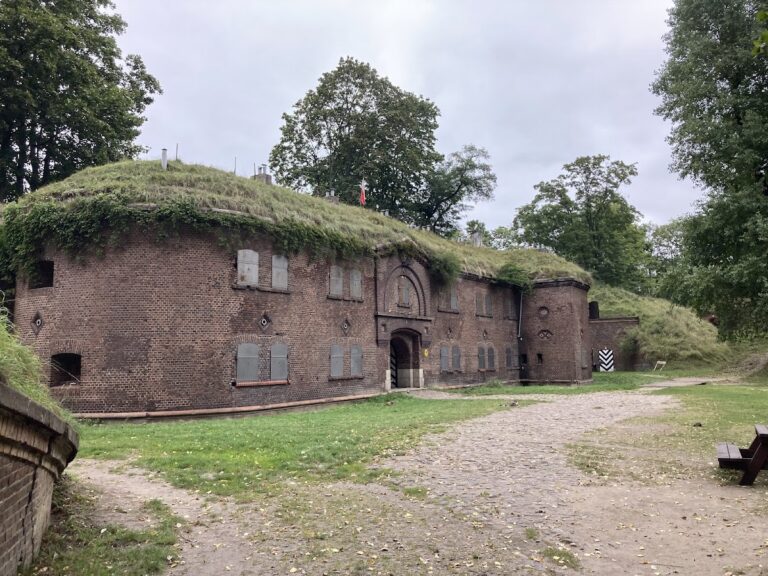
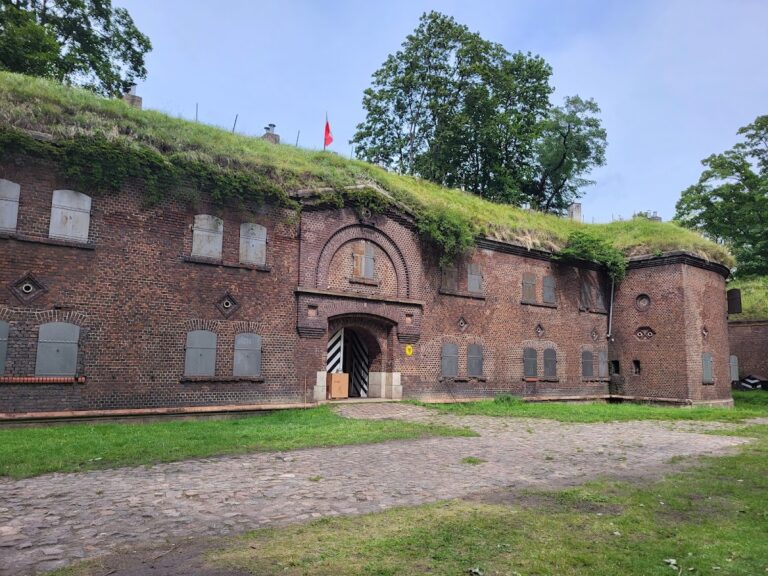
Angel’s Fort is centered on a three-story circular rotunda, a round building or building section, topped by a terrace and an observation turret. Loopholes in its external walls accommodated light guns and small arms. A pentagonal system of earth ramparts surrounds the rotunda. These defensive embankments protected the fort and provided firing positions, while also incorporating a fortified gate with further gun and artillery positions.
Ramparts and entrance defenses
The defensive gate retains loopholes for guns and rifles. Steel wheels survive in its outer pillars; they were used to raise the drawbridge across the moat. Two small rooms beside the gate passage formerly served as stores for weapons and ammunition. Around the fort’s redoubt, an enclosed defensive work, stand well-preserved artillery remises, protected structures associated with artillery, together with the small ammunition magazine and the shelter for gunners.
Rotunda and internal circulation
The entrance contains two pairs of double-leaf armored doors installed during the interwar chemical-warfare adaptation. Oval openings at the base of the stairwell and on successive floors mark the shaft of a former lift. This lift transported ammunition to the upper floors, terrace, and redoubt. The stairwell itself contains stone spiral steps that lead from the ground floor to the terrace, linking the fort’s internal levels with its upper defensive areas.
Nearby sites