Usedom Abbey: A Medieval Premonstratensian Monastery in Germany


Site at a Glance
- Rating
- 4.4
- Popularity
- Very Low
- Country
- Germany
- Primary era
- Medieval
- External website
- Open
- Eras represented
- Medieval
- Civilizations
- Duchy of Pomerania
- Site type
- Religious
- Remains
- Monastery
On this page10 sections
History
Foundation at Grobe
Usedom Abbey was a medieval Premonstratensian monastery in Germany, founded at Grobe near the town of Usedom before or around 1155 during the Christianization of Pomerania. The Premonstratensians were a Roman Catholic order whose ordained canons combined communal religious life with pastoral work. The abbey became the first and most important Premonstratensian establishment in northeastern Germany.
Pomeranian Duke Ratibor I and his wife, Pribislawa, provided the land, organized the construction of the monastery and church, and endowed the new community. At the initiative of Anselm, Bishop of Havelberg, regular canons from the Magdeburg monastery of Unser Lieben Frauen arrived under Provost Sibrandus. Canons from Havelberg and several from Pardwin near Brandenburg later joined them.
Grobe appears in records from 1159 under the forms “Grobe,” “Groben,” and “villa Groben.” The settlement name has been interpreted as referring to a place protected by a surrounding ditch or rampart. Bishop Adalbert of Pomerania confirmed the monastery on 8 June 1159. The abbey was dedicated to the Virgin Mary and Godehard of Hildesheim, an eleventh-century bishop venerated as a saint. Bishop Konrad I confirmed its possessions in 1168.
Episcopal importance and Danish attacks
For a time, the Pomeranian bishopric had its seat at Grobe, increasing the monastery’s influence during the twelfth century. This period ended when the episcopal seat moved to Cammin in 1175. Danish incursions between 1162 and 1177 severely damaged the monastery, and Grobe was described as deserted in 1177.
The Pomeranian dukes continued to support the foundation. In 1175, Duke Casimir I gave the monastery the village of Slatkoviz and exchanged four surrounding villages for Pustkow near Cammin. Duke Bogislaw I re-established the damaged community in 1178 with Premonstratensians from Havelberg. After his death in 1187, he was buried at Grobe.
A further Danish attack on Usedom in 1184 led to the monastery’s relocation from the settlement near Usedom to nearby Watchow hill. The hill was also called Marienberg or Mons Mariae, meaning Mount of Mary, and later became known as Klosterberg. Ratibor I, Bogislaw I, and Wartislaw V, members of the Pomeranian ducal dynasty, were buried at the monastery. Ratibor I was interred in the monastery church in 1155 or 1156.
Territorial growth in the thirteenth century
Usedom Abbey developed an extensive sphere of influence across Usedom Island and areas south of the Szczecin Lagoon. Its possessions and dependencies included Zwilipp in 1159, the church at Pasewalk and the village of Munichow, now Mönchow, in 1177, and Neuwarp together with fishing rights in the Warper Lake in 1184.
Under Duke Barnim I, the monastery expanded during the thirteenth century. The church at Ueckermünde came under its authority in 1243. In the following year, the community received rights to obtain firewood and construction timber in the Ueckermünde Heath and to fish in the Szczecin Lagoon. The monks probably established the lagoon village of Mönkebude, first recorded in 1244.
A ducal exchange in 1270 further consolidated the abbey’s position on Usedom Island. Six communities held by the Bishopric of Cammin, Krienke, Suckow, Mellenthin, Balm on Lake Balmer, Ückeritz, and Loddin, were transferred to Grobe in exchange for Damerow in Pomerania near Naugard. The Bishopric of Cammin was the medieval diocese centered on Cammin, now Kamień Pomorski in northwestern Poland.
Transfer to Pudagla and dissolution
After 1307, under Abbot Disibodus, the Premonstratensian community moved from Marienberg to Pudagla on Lake Schmollensee. Bishop Heinrich of Cammin authorized the transfer on 10 February 1308, and the relocation is also dated to the period from 1307 to 1309 or to 1309 itself. At Pudagla, the monastery retained its older name, Uznam or Usedom.
The monastery was dissolved in 1535 during the Reformation, the sixteenth-century movement that established Protestant churches and led to the secularization of many Catholic religious houses in northern Europe. Pudagla was converted into a ducal domain, territory administered directly by a duke rather than by a monastery. From the late sixteenth century, the former monastery also served as a refuge for ducal widows.
Archaeological investigation
Between 1991 and 1998, the University of Greifswald conducted architectural and archaeological excavations south of Usedom near Wilhelmshof, on the former monastery grounds, for the Historical Commission for Pomerania. Aerial photography, geoelectrical surveying, and geomagnetic measurements were combined with excavation to identify foundations, graves, and other buried remains.
Remains
The Grobe and Marienberg locations
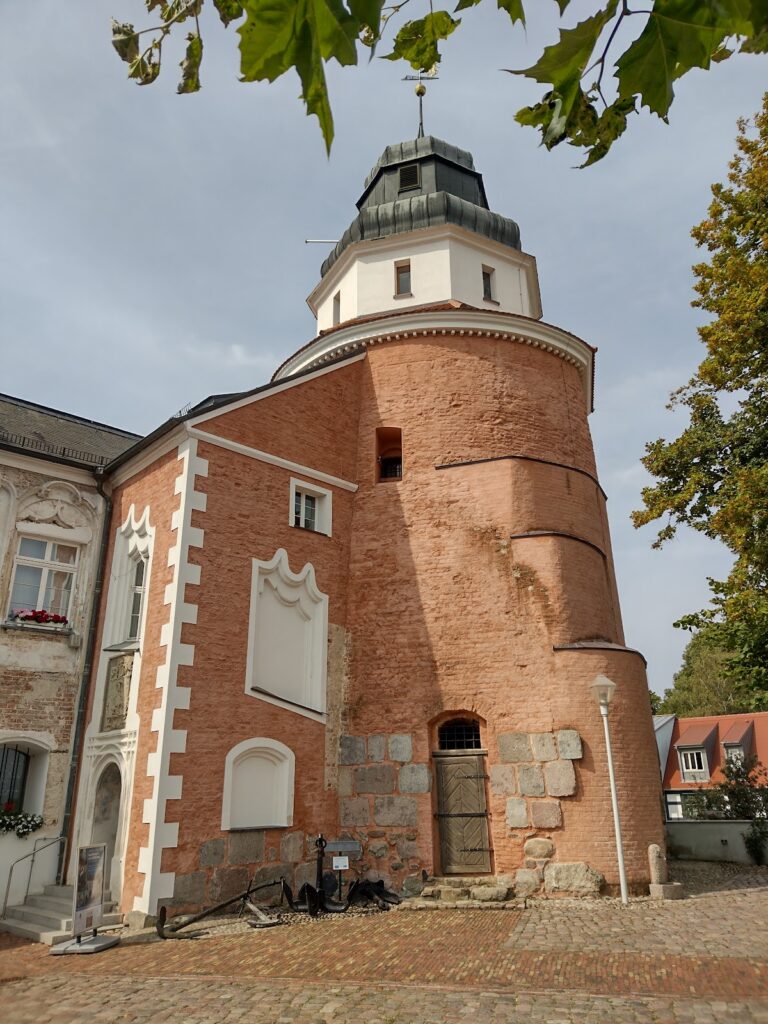
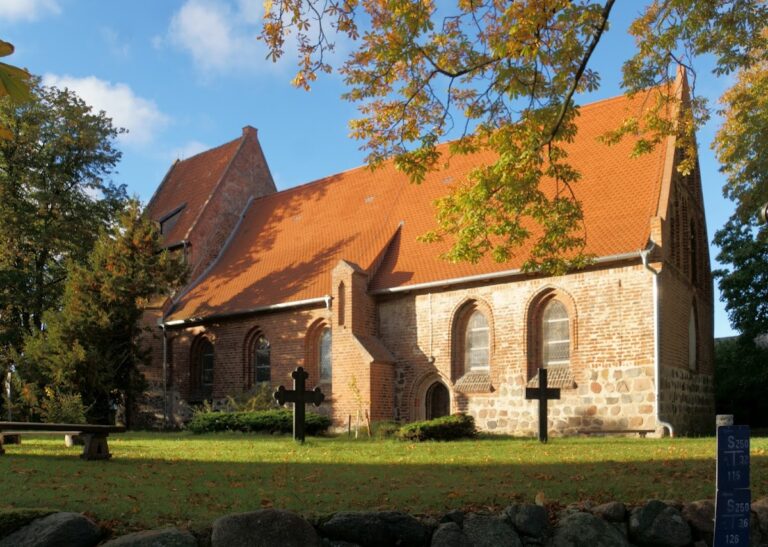
The original monastery and church stood beside the settlement of Grobe, approximately 1.2 kilometers south of the town of Usedom. The archaeological location of Grobe Abbey has been identified with Priesterkamp hill in Usedom. After the Danish attack of 1184, the community occupied Watchow hill, also known as Marienberg, Mons Mariae, and later Klosterberg.
The Pudagla complex
The later monastery at Pudagla stood high above Lake Schmollensee. Its complex included a cloister, the covered walkway and enclosed courtyard that organized the monastic buildings, an economic courtyard, and a church. Only fragments of the monastery walls survive at Pudagla, while the monastery church was demolished by blasting in 1984.
Foundations and burial area
Excavations and non-invasive geophysical surveys exposed foundation remains belonging to the monastery complex and its church, together with graves and other ground finds. These remains connect the buried structures with the successive locations occupied by the abbey and provide archaeological evidence for the organization of the former monastery grounds.
Excavations in 2010 recovered 70 skeletons from a burial area used from approximately the twelfth century until the beginning of the sixteenth century. Most graves could not be assigned to particular settlement phases. The cemetery included an unusually high proportion of older men, while the estimated average life expectancy was nearly 33 years. About 26 percent of the population died during childhood, and few deaths occurred during adolescence.
Bone analysis indicates a relatively low overall disease burden and comparatively few nonspecific stress markers or inflammatory lesions of the skull. Healed bone injuries were frequent and were probably mostly accidental. Dental evidence points to a comparatively protein-rich diet. Together, the osteological study of bones and the paleopathological examination of disease and injury suggest comparatively favorable living conditions at Grobe. The burial population was considered representative of a medieval community rather than a cemetery used solely by the monastery’s religious members.
Nearby sites