St. Mary’s Church Torgau: A Late Gothic Lutheran Hall Church in Germany


Site at a Glance
- Rating
- 4.4
- Popularity
- Very Low
- Country
- Germany
- Primary era
- Medieval
- External website
- Open
- Eras represented
- Medieval, Early Modern
- Civilizations
- Electorate of Saxony, Holy Roman Empire, Margraviate of Meissen
- Site type
- Religious
- Remains
- Church
On this page18 sections
History
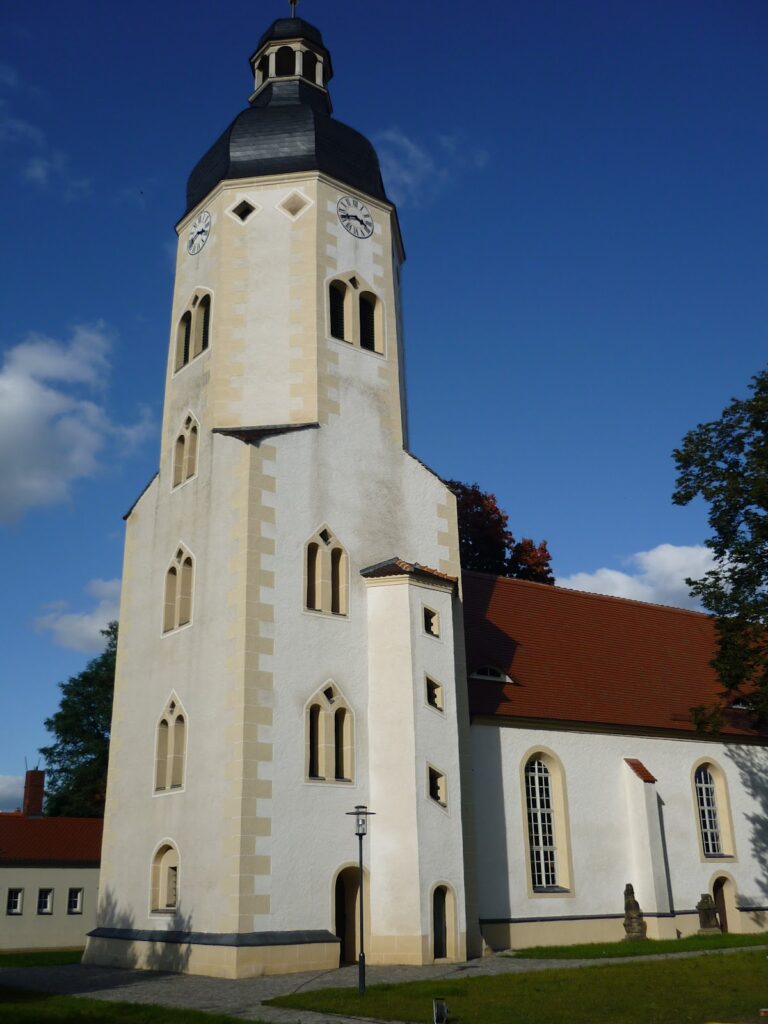
St. Mary’s Church Torgau in Torgau, Germany, is a late Gothic Lutheran hall church with Romanesque origins. It belongs to the Evangelical parish of Torgau in the Torgau-Delitzsch church district of the Evangelical Church in Central Germany. Its history reaches back to a Romanesque basilica built between 1200 and 1220, while the present church developed from the late fourteenth century onward.
Romanesque origins and late Gothic rebuilding
The earlier basilica survives in part through the church’s westwork, a substantial western entrance block that incorporates towers and upper-level spaces. The present hall church probably began around 1380, with work starting at the choir. The timber roof structure of the hall has been dated by dendrochronology, the study of annual growth rings, to 1463. Nave vaulting followed after 1464, and the choir vaults were built around 1480 to 1490.
The late Gothic sacristy is attributed to a design by Hans von Torgau. A double-tower arrangement rose above the older westwork, while the late Gothic west portal was added around 1516. The church’s artistic furnishings also developed during this period. A Passion altarpiece probably made in central Germany in 1509 may originally have been created for the Heiligkreuz Chapel, which was demolished in 1533.
Rebuilding, Lutheran memory, and later restoration
A complete renovation of the nave took place between 1692 and 1698. During this work, the altarpiece and the tomb of a Saxon duchess were moved to the south-side choir. The church was rebuilt again after a fire, with work continuing from 1748 to 1751. This campaign heightened the south tower and gave it a cupola and lantern.
The church’s historical identity is closely connected with its epitaphs and tomb monuments. Sophie of Mecklenburg, first wife of the later Elector John the Steadfast, died in Torgau in 1503, and her tomb plate was made in 1504. Katharina von Bora, Martin Luther’s widow, came to Torgau during a plague outbreak. After her carriage overturned and she suffered injuries, she died in the town in 1552. Konrad Krebs, the builder of Hartenfels Castle, died in 1540 and is commemorated by a tomb monument in the church.
The church was restored in 1885 and again in 1927. A further restoration campaign has continued since 1967, including the reinstatement of the interior’s 1492 polychrome scheme. The damaged right half of the central panel of the Passion altarpiece was neutrally reconstructed in 1970 and 1971. The principal marble altarpiece was restored between 1971 and 1974 and again in 2023 and 2024. St. Mary’s Church is designated a cultural monument in Saxony.
Organs and continuing use
Conrad Geißler of Eilenburg built the original organ between 1871 and 1873. It was his largest work, opus 50, with 44 stops on three manuals and pedals, but it was destroyed during the Second World War. The present organ was built in 1984 by the Schuster organ-building company of Zittau. It has 41 stops on three manuals and pedals, mechanical key and stop actions, and a case front designed by Fritz Leweke. Three bells hang in the church tower.
Remains
St. Mary’s is a late Gothic hall church of five approximately square bays. A hall church has a nave and side aisles of broadly similar height, creating a unified interior space. The side aisles end in polygonal eastern closures, while the central nave continues into a slightly irregular, single-aisled choir of three bays. Both the aisles and choir terminate in five-eighths closures. The walls use plastered porphyry rubble masonry with sandstone architectural details, and the pointed-arch windows contain varied two- and three-light tracery, the ornamental stone framework within a Gothic window.
Exterior and spatial structure
Westwork and nave
The Romanesque westwork forms the western core of the building and supports a double-tower arrangement. Above the central-nave portal is a ten-part rose window from the end of the fourteenth century. The portal has a keel arch and attached shaftwork. Gabled buttresses reinforce the nave and choir, while the nave is covered by a gabled roof that is hipped toward the east. The choir has a lower gabled roof.
South-side additions
The fourth nave bay is marked externally by a polygonal extension rising to the height of the central nave. Its south side contains a small porch with a rib-vaulted interior and a steep gable decorated with crockets and pinnacles. A small stair tower, dated to 1614 and 1615, adjoins the west side of the extension, and a crypt from 1725 is attached to it. Between the polygonal extension and the south side of the choir stands a two-storey, asymmetrical sacristy. Its lower room has an irregular net vault, while the upper room has a cell vault.
Interior vaults and gallery
Plain octagonal piers without imposts divide the interior into three aisles and rise directly into the arcade arches. The fourth nave bay has a star vault, while the other nave bays have rib vaults, which are supported by projecting stone ribs. The choir has a combined cell-and-net vault. Its richly painted keystones show half-figures, including a Wild Man and Wild Woman with a coat of arms, an angel, and, farther east, the Virgin and Child and the Man of Sorrows based on prints by Martin Schongauer.
A narrow stone gallery occupies the west end of the nave. Dating from around 1520, it rests on octagonal piers and has a panelled parapet.
Altarpieces, pulpit, and baptismal font
Marble high altarpiece
The marble altarpiece was made after a design by Giovanni Simonetti, an architect and stucco artist. Santino Caprani carried out most of the sculptural work between 1694 and 1697, while Johann Heinrich Sperling supplied the paintings and Nikolaus Prescher applied the polychromy and gilding. The structure combines a tall wooden-and-stucco arrangement of columns with a segmental pediment and crowning superstructure. Passageways flank the central composition.
The predella, the lower platform beneath the main altarpiece, shows the Last Supper. The main painting presents a crowded Crucifixion between two Corinthian columns, with the Evangelists Matthew and Mark alongside it. The pediment shows the Evangelists Luke and John with the Salvator Mundi and two tomb guards. The altarpiece underwent restoration from 1971 to 1974 and again in 2023 and 2024.
Pulpit and baptismal font
Georg Wittenberger made the richly carved pulpit in 1582. It includes figures of the Evangelists and a pulpit hourglass. Gottfried Fischer and Nikolaus Beseler remodeled it in 1692 and 1693, adding further figurative decoration.
Hans Nicolaus Meyer made the marble baptismal font in 1693. Putti bearing fruit and coats of arms decorate it, together with acanthus, vine, and oak foliage.
Paintings and late Gothic sculpture
Works associated with Cranach and Schongauer
The panel painting of the Fourteen Holy Helpers is an important early work by Lucas Cranach the Elder, the German Renaissance painter who served as court painter in Wittenberg. Probably created around 1505 and 1506 after his stay in Vienna, it may be connected with his establishment as court painter. The group of saints was traditionally invoked together during illness and other crises. The painting presents expressive half-length figures with varied physiognomies, while the reverse shows the Man of Sorrows with two mourning angels.
The 1509 Passion altarpiece has a crowded Crucifixion on its central panel. Its reverse formerly showed the Sudarium of Saint Veronica with a donor’s coat of arms and a date. The inner wing faces depict the Bearing of the Cross, Nailing to the Cross, Raising of the Cross, and Descent from the Cross. The outer faces show the Mocking of Christ, the Crowning with Thorns, the Ecce Homo, and the Flagellation. The right half of the central panel was destroyed in 1945 and reconstructed in neutral form during the 1970 and 1971 restoration.
A late-fifteenth-century altarpiece wing shows John the Evangelist on its front and a holy bishop on its reverse. Another painting, the Transfiguration of Christ, dates from the second half of the seventeenth century. A memorial painting of Christian Ganzland, who died in 1710, presents him as an oval, knee-length figure in an ornate frame.
Sacristy and other devotional works
The sacristy preserves a late Gothic carved altarpiece from Pausnitz, made around 1520. Its shrine contains an Anna Selbdritt, a representation of Saint Anne with the Virgin Mary and the Christ Child, together with Saint Catherine and Saint Nicholas. The wings show the Apostles, while the exterior painting is no longer discernible. The room also contains Michael Eckart’s 1608 painting of the Burial of Christ.
A secco painting, made with pigment applied to dry plaster, depicts Saint Sebastian tied to a tree with his wrists above his head as an archer shoots at him. The composition is based on a print by Martin Schongauer. The south-side choir contains a finely formed oak statue of the Virgin Mary from Fleischmarkt 5, which may originally have belonged to an Annunciation group from the end of the fifteenth century.
The western porch contains a stone panel with a relief of the Throne of Mercy, based on a print by Albrecht Dürer and attributed to Stephan Hermsdorf. Three eighteenth-century portraits of pastors are among the church’s other works of art.
Tombs and epitaphs
Memorials in the south-side choir
Sophie of Mecklenburg’s finely engraved brass tomb plate was made in 1504 in the Nuremberg workshop of Peter Vischer the Elder, a prominent late Gothic and early Renaissance bronze founder and sculptor. The plate stands in the south-side choir within a Baroque grille bearing the deceased’s coat of arms.
Katharina von Bora’s figurative tombstone was restored by Wolf Mönch in 1617 and given an inscription and coat of arms. The church also contains figurative tombstones for Magdalena Drandorf, who died in 1574, Anna Stamer, who died in 1577, and an unidentified woman who died in 1628.
Exterior and entrance-hall monuments
Numerous additional tomb monuments, mostly from the seventeenth and eighteenth centuries, stand against the exterior wall. One commemorates Konrad Krebs with a compass, ruler, and coat of arms. Further monuments occupy the south entrance hall, including the epitaph of Hans Wurm von Thomsbrück, who died in 1570 and whose monument is attributed to Georg Schröter, a sculptor associated with late-sixteenth-century funerary art.
A damaged marble epitaph from around 1570 to 1580 contains a finely worked relief of the Entombment of Christ accompanied by smaller scenes from the Old Testament. Its style is close to the work of Georg Schröter.