St. Petri-Kirche: A Gothic Parish Church and Ducal Burial Church in Wolgast, Germany


Site at a Glance
- Rating
- 4.5
- Popularity
- Low
- Country
- Germany
- Primary era
- Medieval
- External website
- Open
- Eras represented
- Medieval, Early Modern, Modern
- Civilizations
- Duchy of Pomerania, German, Holy Roman Empire, Swedish
- Site type
- Religious
- Remains
- Basilica
On this page23 sections
History
St. Petri-Kirche is an evangelical parish church in Wolgast, Germany, dedicated to the Apostle Peter. Its Christian history is associated with the mission of Bishop Otto of Bamberg in 1128, while the present building developed chiefly as a Gothic brick church between about 1280 and 1350. The church later became a dynastic burial place for the Griffin dukes of Pomerania-Wolgast and was repeatedly rebuilt after destructive fires.
Christian beginnings and Gothic construction
The site is linked with Otto of Bamberg, a German bishop and missionary who worked to Christianize Pomerania during the twelfth century. A pre-Christian Slavic sanctuary dedicated to Jarovit, a deity associated with the region’s earlier religious tradition, was reportedly destroyed during this mission. A Christian church was probably then established on or near the same location, and one tradition describes the first building as wooden.
St. Petri-Kirche arose as the successor to that earlier church. Its principal Gothic construction took place from about 1280 to 1350, followed by further building and enlargement during the later fourteenth and fifteenth centuries. A pointed-arch portal from an early-thirteenth-century predecessor was reused in the south wall of the southern tower hall, preserving a physical element from an earlier phase of the site.
Further work was probably completed around 1415 in connection with the burial of Wartislaw VIII. During the fifteenth century, the dukes added several chapels and developed the church into a three-aisled basilica, a form organized around a high central nave flanked by lower side aisles. This expansion established the building’s principal medieval character and strengthened its connection with the ducal court.
Fires, rebuilding, and the ducal crypt
Fires in 1512 and 1628 caused extensive damage, requiring the church to be rebuilt. Its role as a dynastic burial place continued during these centuries. The Griffin dynasty was the ruling ducal house of Pomerania, and a crypt for Duke Philip I, who died in 1560, and his family was furnished between 1560 and 1587. Later burials included Philip’s wife, Maria of Saxony, their daughter Amelia, Duke Ernst Ludwig, his wife Sophia Hedwig of Brunswick, and their daughter Hedwig Maria.
In 1688, grave robbers forcibly entered the crypt and plundered it. The coffins and their contents were severely damaged. The perpetrators, who included the church sexton, were identified but not found, and the stolen property was not recovered. A protocol in the church archive lists jewellery and other objects taken during the crime.
Russian troops burned Wolgast in 1713 during the Great Northern War, an early-eighteenth-century conflict in northern and eastern Europe. St. Petri-Kirche was again largely destroyed. Reconstruction continued over several years and introduced prominent Baroque elements. The vaults were renewed between 1716 and 1728, and the tower was raised to about 80 metres with an octagonal addition.
Commissions inspected the crypt after it was opened in 1729 and again in 1829, after which it was sealed. A horizontal door installed at its entrance in 1929 allowed restricted public access. The coffins in the Griffin Chapel were restored between 1995 and 2007, following damage assessment and examination of the crypt and especially the coffins between 1998 and 2000. The reconstruction of the crypt and coffins was completed in 2007, and the restored crypt reopened that year.
Fire, restoration, and later use
Lightning caused another major fire on 9 April 1920. Much of the interior was destroyed, and the Baroque tower spire collapsed. The interior was rebuilt, but the former spire was replaced by the present octagonal tent roof. The organ was also lost and was not replaced until 1988.
The reconstruction of the crypt and coffins received a European Union cultural-heritage award in the conservation category in 2010. Because of the historical importance of the ducal crypt, St. Petri-Kirche was recognized in 2011 as a monument of national importance.
From 1820 until his death in 1837, Karl Christian Heller served as archdeacon of the St. Petri congregation. After the older church collection was transferred to the University Library of Greifswald in 1830 and 1831, he began assembling a new library. The church is also used for choir and orchestral performances, including events associated with the Wolgast summer music programme and the Usedom Music Festival.
Remains
Setting and exterior
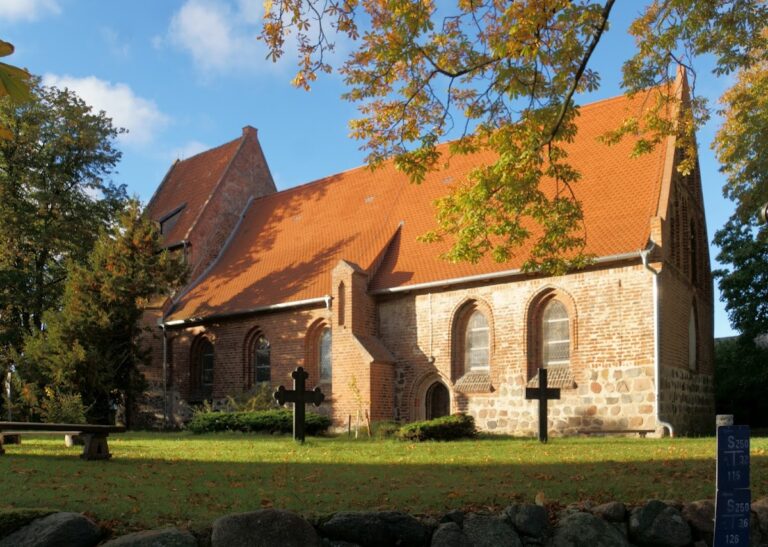
St. Petri-Kirche stands at the highest point of Wolgast’s historic town centre. Its surrounding square is open, and the building is encircled by the street Am Kirchplatz. The church is a four-bay, three-aisled basilica with a polygonal ambulatory choir, meaning that a passage runs around the rear of the choir. A northern sacristy with a baptistery, the southern Petri Chapel, and a western tower with side halls complete the main arrangement.
Choir and nave
The church is built predominantly of reddish brick with unplastered façades. The strongly recessed choir ends in five sides and has tall, multipart pointed-arch windows with stepped buttresses. The nave elevations are broadly symmetrical. Pointed-arch windows and buttresses mark each high aisle, while the compressed clerestory, the upper windowed part of the nave above the aisles, carries a tracery frieze.
West tower
The west portal has a five-fold stepped jamb. The western tower rises from a massive square base to an octagonal upper plan and is about 50 metres high. Its viewing platform is approximately 40 metres above ground and is reached by 184 steps. Tower chapels are incorporated into the lower structure and unified within the façade.
Pointed-arch windows, recessed decorative panels, sound openings, and an octagonal Baroque upper section shape the tower façade. A small octagonal stair tower rises at the northwestern corner, while the southern Petri Chapel is integrated with a round stair tower. The tower contains the bell frame and a kestrel nesting box. Its present octagonal tent roof was installed after the former Baroque spire collapsed in the 1920 fire. The earlier pointed-arch portal reused from an older building is set into the south wall of the southern tower side hall.
Interior and furnishings
Central nave and sanctuary
The interior has a hall-like character created by broad aisles and wide bays in the high central nave. Its vaults rest on octagonal piers with shallow-fluted corners and no capitals, and the piers continue into the transverse arches. The sanctuary contains a masonry altar and a probably sixteenth-century crucifix, given to the congregation by St. Mary’s Church in Stralsund in 1959. The associated figures are held in the Stralsund Museum. Two candlesticks dated 1749 flank the crucifix, donated by four sailors who survived a shipwreck.
The crucifix replaced a Baroque high altar made in 1739 and destroyed in the 1920 fire. Behind the altar is the 1929 stained-glass window The Sinking Peter. A zinc baptismal angel stands southwest of the altar. Cast in 1848, it copies a work by the Danish neoclassical sculptor Bertel Thorvaldsen made for Copenhagen Cathedral. A second Thorvaldsen copy, depicting Jesus, stands in the southeastern part of the church. W. Homeyer donated it, and the sculpture was produced in 1889 in the Berlin workshop of the Michaeli brothers. Its pedestal was made by the Kessel and Röhl stone-cutting workshop in Wolgast.
Pulpit and epitaph
A wooden pulpit from 1710 stands northwest of the crypt against a buttress. Its dark wooden basket has panels framed by twisted columns and is surmounted by a seven-sided sounding board decorated with acanthus leaves. The richly carved lectern dates from 1645.
An epitaph, a commemorative monument for a deceased person, to Philip I hangs on the octagonal pier east of the pulpit. Wolf Hillger cast it in brass in Freiberg in 1560. Its retable-like design includes a heraldic inscription panel, Pomeranian coats of arms, Renaissance plant ornament, grotesques, two upper sections depicting the Christ Child, and a base with putti. A Latin elegy in the main field laments Philip’s death. His five sons donated the epitaph, which survived the church’s fires.
Paintings, heraldry, and displayed objects
The interior contains stained-glass and vault paintings, a stone heraldic panel from Wolgast Castle, and a rare twelfth-century Slavic image stone incised with a representation of Jarovit. A panel bearing the arms of the Pomeranian dukes hangs in the northern tower room, and the same nine-field heraldic scheme appears on the crypt door. The fields represent the Duchies of Pomerania-Stettin, Pomerania, Kassubia, and Wends; the Principality of Rügen; the lordships of Usedom and Neuenkamp-Barth; the County of Gützkow; and the Duchy of Wolgast.
South of the west portal are a copper engraving of Gustav II Adolf of Sweden, presented by the Swedish government, and an oil painting showing the transfer of his body from Wolgast to Sweden. Nearby are Alex Schöngrün’s painting Castle Ruins, made about 1790, the arms of Wolgast, and Schöngrün’s 1920 painting The Burning Church. A display case in the northwestern nave contains the sword of Philip Julius, the last Duke of Pomerania-Wolgast, a weather vane from 1731, and a sandstone coffin of the Wakenitz family from 1757. The coffin was found during excavations in the side aisle in 1938.
Four large anchors suspended in the central nave carry biblical quotations concerning the Holy Spirit, Christ’s ascension, death and resurrection, redemption, peace, and the birth of the Saviour. The church also contains four votive ship models, religious offerings in the form of donated vessels, representing Wolgast ships. They include the full-rigged ship Leopold, the schooner Minna, and the barque Camilla of Wolgast. The models were probably donated during the second half of the nineteenth century. Three were mounted on wooden wall brackets in 1921, and research in 1942 and 1943 established key information about the full-rigged ship and schooner.
Ducal burial complex
Crypt
The ducal crypt lies approximately on the church’s central axis in front of the high altar. A crypt is a subterranean burial chamber. The structure developed in two building phases, around 1500 and in 1587, and measures about 14 metres in length including its entrance. The chamber is about 4.60 metres wide and 4.40 metres long. Its front part has a barrel vault about 1.75 metres high and 1.70 metres wide, while the rear room has a segmental-barrel vault.
A brick floor supports masonry benches running from east to west, on which the tin coffins were placed. The crypt contains nine coffins or sarcophagi associated with the Griffin dukes, together with a collective vessel holding the remains of three infants. A sarcophagus is a coffin, often made of stone or metal, intended for burial. The crypt also contains the remains of Amelia, Hedwig Maria, Sophia Hedwig, and two children of General Frederick VI of Baden-Durlach, Friedrich Casimir and Katharina Eleonore. Frederick VI was stationed near Wolgast during the Thirty Years’ War, the major European conflict fought from 1618 to 1648.
Two ventilation openings were originally placed at the same level, and moisture accumulated within the crypt, damaging its fabric and coffins. Since a glass door was installed in 1996, continuous dehumidification has reduced the humidity from 98 percent to about 65 percent.
Griffin Chapel
The Griffin Chapel stands against the north wall of the nave before the choir crossing. It has a diamond-shaped plan and is entered through a pointed-arch portal from the south. Its eastern wall contains the restored coffins of Philip I, Maria of Saxony, Ernst Ludwig, and Philip Julius. Their burial arrangement was reconstructed in 2007.
Chapels, organ, and bells
North Chapel
The North Chapel contains Carl Joseph Begas’s 1842 painting Christ on the Mount of Olives. The painting is set in a dark wooden structure flanked by two columns and decorated with a pelican on its base. It originally formed the predella of the high altar. The chapel also contains Axel Schöngrün’s painting of the brig Jupiter, two epitaphs, a wooden crucifix, another wooden work, and Schöngrün’s Castle Ruin of Landskron near Anklam.
South Chapel
After the 1920 fire, the South Chapel was separated from the south aisle and adapted for winter or short services. It is entered from the north through a pointed-arch portal. Its wall texts quote Psalm 100 and the Second Epistle to the Corinthians.
Max Kutschmann of Berlin and the Wolgast artist Louis Zillmann painted the chapel’s decoration using plant studies from Theodor Marsson’s 1869 Flora of New Pomerania and the Islands of Rügen and Usedom. The paintings were covered in 1950 and uncovered again in 2005. Brass chandeliers dated 1710 and 1754 also remain in the chapel.
Organ and bells
The present organ was built and installed in 1988 by the Sauer organ-building company of Frankfurt an der Oder. It is entirely mechanical, has about 1,400 pipes, and contains 22 stops distributed across two manuals and a pedalboard.
A bell dated 1516 was destroyed in the 1713 fire. Before 1920, the church had three bells. Two were surrendered during the First World War metal collection, while the third fell during the fire and survives in fragments. Replacement bells were cast in 1925, 1926, and 1932, weighing 2,000, 1,050, and 3,600 kilograms. Two were melted down during the Second World War. An iron set cast in 1962 at Morgenröthe-Rautenkranz had the notes C-sharp, E, and F-sharp. The remaining earlier bell was later exchanged and transferred to St. Nicholas Church in Stralsund.
Cracks in the bell yoke led to the removal of the bells in the early twenty-first century. In 2012, the congregation acquired four bronze bells from Paul-Gerhardt Church in Kassel, tuned to F, G, A, and B-flat. A fifth bell, tuned to D, was cast by the Bachert bell foundry in Karlsruhe in 2016. The five-bell peal entered use on Christmas Eve 2017.
Dance of Death, image stones, and library
Wolgast Dance of Death
The Wolgast Dance of Death consists of large painted panels made around 1700 by the painter and shipowner Caspar Siegmund Köppe. Adrian Dietrich Brentschneider is regarded as the author of the accompanying two-line verses. The panels originally hung in Wolgast’s cemetery chapel, moved to St. George’s Chapel after its 1868 renovation, and were later transferred to St. Petri-Kirche.
The series freely imitates Hans Holbein the Younger’s 1538 woodcut series Images of Death. Its first panel depicts the Fall of Man and its last the Last Judgement. The penultimate panel, showing the risen Christ, was lost after passing into unknown hands, while 24 panels survive. These works form one of the few monumental Dance of Death cycles preserved in northern Germany and have been progressively restored since 2008.
Slavic image stones
Two stone slabs bearing Slavic engravings are incorporated into the church foundations. The Jarovit Stone, measuring 193 by 117 centimetres, is set in the foundation of the Late Gothic tower. It shows a seated or standing figure on a hill holding a spear, while a probably later Maltese cross damaged the representation of the spearhead. A smaller stone, measuring 84 by 44 centimetres, lies in the choir ambulatory. It depicts a long-robed figure holding a spear, with a cross above its head.
Church library
The historic church library included books from the collection of the Greifswald professor Enwaldus Klene, transferred through Eldena Abbey to Wolgast in 1535, as well as books from Jasenitz Abbey after its dissolution during the Reformation. Of the 938 volumes transferred to the University Library of Greifswald in 1830 and 1831, 554 remain after wartime storage losses.
Heller’s later library reached 700 catalogued books and writings by 1837. The collection held 1,489 titles in the 2010s, preserving a further part of the church’s intellectual and institutional history.
Nearby sites